
Spanish fans mourn clubs without paying dues or attending games
In Spain, many fans identify deeply with major clubs but refuse to pay membership fees, treating tribal loyalty as a cheap substitute for belonging.
English · Original discussion in Spanish · Published
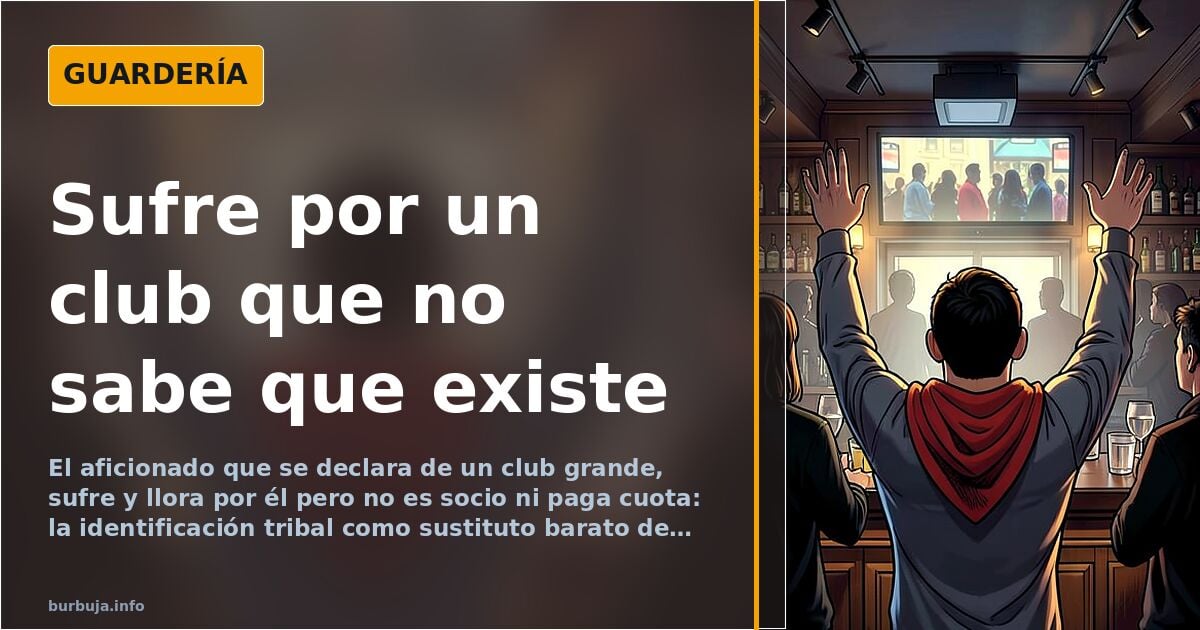
Spanish fans mourn clubs without paying dues or attending games
There is a figure who appears in every bar conversation: someone who claims deep allegiance to a big club, suffers with every defeat and cries with every victory, yet holds no membership card, has never set foot in the stadium, and refuses to spend a euro. The scene was described without shame: "I am not a member. Man, that costs a lot of money, and I don't have it." Immediately trinc by the emotional argument: suffering since childhood "with all my heart."
The pattern repeats across Spain. Identification with a powerful brand works as a cheap substitute for belonging: demanding rights of emotional ownership over something that isn't theirs, while assuming none of the costs. The club shirt as an identity flag, the membership fee as fine print paid by others.
What does it cost to be a member and what do you get?
The first objection raised when the topic comes up is economic: the annual fee. Being a football club member is often described in conversation as giving a blank check to be robbed and deceived, with the nuance that money is handed over without tangible return beyond stadium access and voting rights in assemblies that rarely change anything.
Against this stands the defense of emotional connection without a card. Some argue there are many ways to be linked to a club: having had a father or grandfather who was a member, being a shareholder in listed clubs, or paying for a supporter card that includes discounts on cinemas and theme parks. They argue that the supporter card already turns the fan into a paying customer of part of the ecosystem.
The problem is asymmetry. The player is an asset bought and sold; their love for the badge lasts as long as the contract and performance bonuses. Meanwhile, the unregistered fan projects their identity and dreams of glory onto a person who, if they cross paths on the street, will likely ask them not to ruin their photo. The relationship is parasocial and the business is perfect.
Football as the only possible conversation
The criticism isn't just against those who don't pay the fee. It's against the noise. In conversation, the scenario arises of listening to ten hours of football straight at a construction site in August, adding that these same workers had their wages cut by two euros because there was no work, yet they remained focused on whether the club had sent a boatload of cash to sign a star.
That is the core of the reproach: football passion as inherited indoctrination, passed down generation after generation. If passion is instilled at home, the argument goes, it is so the child tries to become a footballer, not so they end up as a losing fan paying for others' party.
The player doesn't even know you exist
The final point of the analysis comes from the side of fame. The fan waits outside training to take a photo with the striker, and for that fan, the footballer is a god. For the footballer, that fan does not exist. If they died, he wouldn't care. Devotion is one-way and the club knows it: turning admiration into voluntary submission.
The mechanism isn't exclusive to sports. It repeats with voters defending politicians who raise their taxes, or those crying for the planet from an SUV. Tribal identification with a powerful brand is cheap and fills a void that should be occupied by something else.
The uncomfortable question remains: if the member is the one who pays and the unregistered fan is the one who demands, who is the fool here? The answer doesn't close. The club bills, the player gets paid, and the one who cries for free keeps crying.
Also available in: Deutsch
Summary of a discussion on Burbuja.info - Foro de economía, actualidad y política., translated from Spanish and reviewed before publication. Read the full discussion (19 replies).
More summaries
-
Clásico prediction pool: 20 tips, most back Barça
Twenty predictions for Spain's Clásico: fifteen Barça wins, three for Madrid and two draws. The 5-0 and 4-0 dominate the pool.
-
Mbappé scores two scrappy goals as PSG fans mock Madrid
Mbappé scored twice against Barcelona, and a PSG supporter argues one was a deflection and the other a tap-in into an empty net, claiming Madrid effectively play with ten men.
-
Real Madrid's Dominance: European Glory vs. Domestic Refereeing Bias
Real Madrid dominates European football but struggles against a domestic league marked by controversial refereeing decisions and the narrative hegemony of FC Barcelona.
-
Russell Crowe was 36 in Gladiator, not a supermarket benchmark
Russell Crowe was 36 during Gladiator filming. Comparing Hollywood epics to retail work is misleading and unfair.
-
The Absurdity of Blind Pre-Orders
A user on X ironically asks if pre-orders are accepted for an unspecified product, highlighting the trend of blind reservations.
-
Spanish Election Roleplay Game Targets Presidency
A campaign roleplay game lets players create parties and characters to win the Spanish presidency, with dice rolls arbitrated by an organizer.