
Spanish families turn to credit to cope with inflation
Inflation is driving up credit card use: 330 euros a month in extra costs. Household debt stands at 43% of GDP, but consumer spending remains strong.
English · Original discussion in Spanish · Published
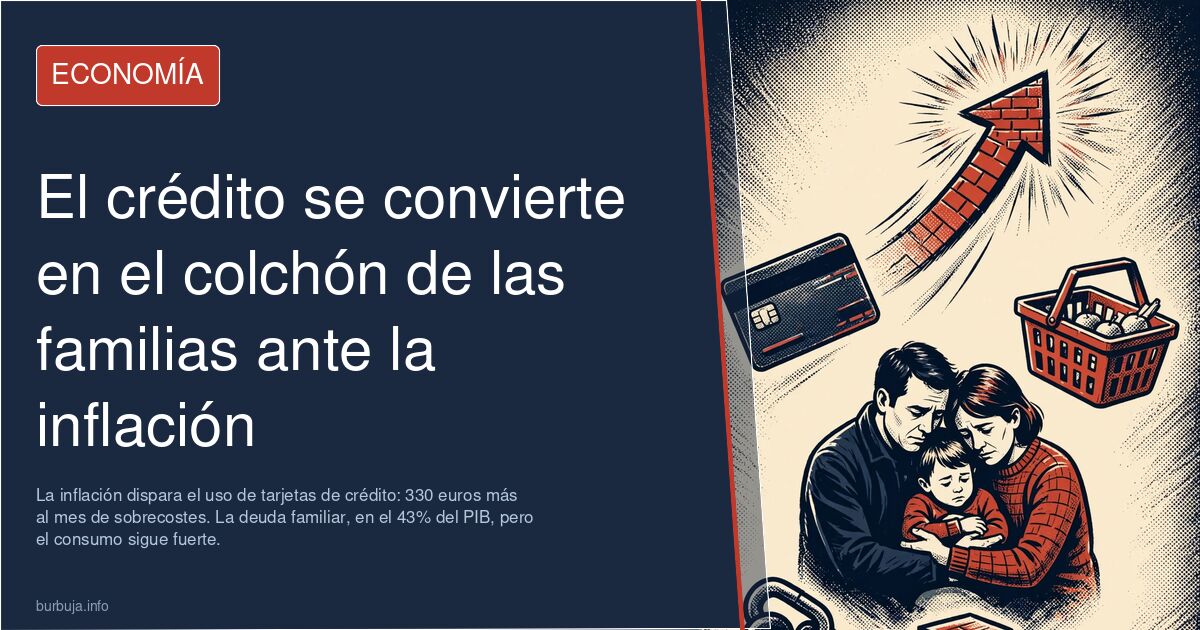
Inflation drives credit card use to make ends meet
40 euros more for electricity, another 40 for gas, 100 for groceries, 100 for the mortgage and 50 for petrol. The total doesn't add up for most Spanish families, and the solution banks are offering is the oldest one in the book: financing the shortfall with plastic. Internal data from the banks, leaked by El Confidencial, show that customers are increasingly turning to credit cards for their everyday purchases and asking to defer and split payments.
The cost of the shopping basket no longer fits in the wallet
Inflation has become an invisible tax that creeps into every bill. The extra costs cited by the banks are devastating: 40 euros more for electricity, 40 for gas, 100 for groceries, 100 for the mortgage and 50 for petrol. That's 330 euros a month that weren't in the budget. For many families, the only way to balance the books is to borrow. And not just for big purchases: for the supermarket too.
Easy credit, hard-to-stop spending
The banking sector has spotted an opportunity. Revolving cards, with interest rates above 20% in many cases, have become households' "cushion". Some analysts call them "madness" that should be illegal in any remotely serious country. But credit isn't just for emergencies. In stores like Fnac or MediaMarkt, the product's price is hidden in favour of the financed monthly instalment. A 500-euro laptop becomes "20 euros a month". The temptation is obvious, and the culture of buying on instalments is spreading like a stain.
Crisis or mirage? Full terraces and moderate debt
Some argue the apocalypse hasn't arrived: the terraces are full, mortgages are being signed at a record pace and Spanish household debt stands at 43% of GDP, far below the 64% peak reached in 2002. That reading clashes with the reality of those watching their purchasing power evaporate. Wages have been frozen since 2008 and inflation has eaten up the nominal increases. The loss of purchasing power is brutal, and credit is the painkiller masking it.
The final paradox
The puzzling figure: while families take out credit to pay for groceries, the terraces remain full. The paradox of an economy that borrows to keep consuming, but doesn't borrow to invest. The American credit score model, where debt is a virtue, is gradually taking hold. But in Spain, the "don't pay" culture lives on, and the question is how long the balance between easy credit and the bill of inflation can hold.
Also available in: Deutsch
Summary of a discussion on Burbuja.info - Foro de economía, actualidad y política., translated from Spanish and reviewed before publication. Read the full discussion (35 replies).
More summaries
-
Perpetual debt: the hidden engine behind inflation
Perpetual debt and normalized inflation: a cycle with no way out. Data on the gold standard, the Cantillon effect and safe-haven assets to protect your savings.
-
Spanish household debt hits record low: prudence or poverty?
Household debt in Spain has fallen to record lows, yet consumer credit is soaring. Prudence or impoverishment? An analysis of the data and the paradoxes.
-
Man abandons children at police station after aid ends, El Periódico reports
A man left his two children at a police station after his financial aid expired, according to El Periódico. Some claim he alleged they were unaccompanied minors.
-
Spain's anti-squatting offices flop: 109 inquiries in six months, two provinces with none
The anti-squatting offices in Castilla y León, Spain, received just 109 inquiries in six months; Ávila and Salamanca, zero. The figure clashes with the boom in private eviction firms.
-
Charged with passport seizure and travel ban in Spain
Charged with passport seizure and a no-multipass ban: the precautionary measures against Begoño have stirred up legal and media debate in Spain.
-
Spain's wealthy move money to Luxembourg and Switzerland ahead of 29-N vote
Private banking sources cited in the discussion report requests to move funds to Luxembourg and Switzerland ahead of Spain's November 29 election. Bankinter offers funds with a Luxembourg IBAN.