
Spain: Low-cost vs Repsol fuel prices differ by 31 cents
In Spain, low-cost diesel costs €1.169 versus €1.479 at Repsol. Drivers with high mileage challenge the myth that cheap fuel damages engines.
English · Original discussion in Spanish · Published
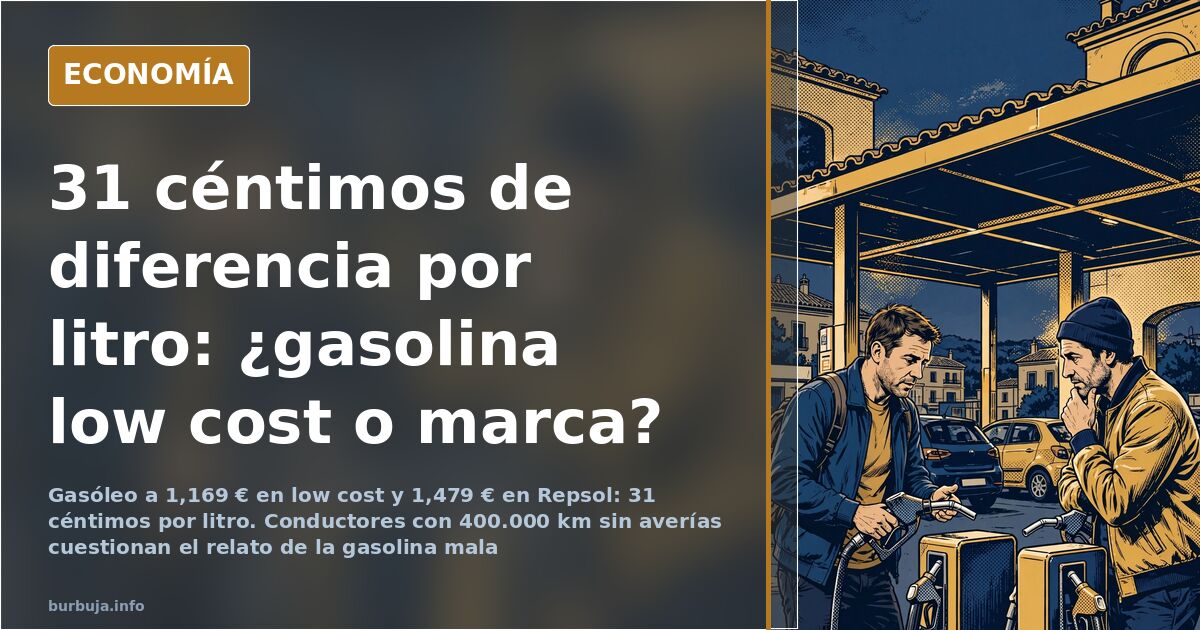
Low-cost vs Repsol fuel in Spain: A 31-cent gap per liter
A sign photographed in Extremadura at 14:00 captures Spain's fuel price war: diesel at €1.169/liter at a low-cost station versus €1.479/liter at the nearby Repsol. Gasoline prices stand at €1.255 and €1.569 respectively. This 31-cent difference adds up to over €15 per fill-up for an average 50-liter tank. Taken on April 11, the image reignites the debate: is branded fuel superior, or are we paying for advertising and amenities?
Long-haul drivers offer a definitive answer based on experience. One trucker covering 60,000 kilometers annually claims he always refuels at low-cost stations without issues. Another driver has logged 400,000 kilometers in one car and over 300,000 in another using only cheap fuel. A third reports 250,000 kilometers of diesel use at budget stations. The narrative of "engine failure due to poor fuel" collapses with every odometer reading.
Why is there a 31-cent difference between low-cost and Repsol?
The common argument is that fuel originates from the same refineries. There are no low-cost oil wells or refineries; the base product is identical and distributed from the nearest plant. A white-label station in Cartagena might serve gasoline from Repsol's Escombreras refinery, while a Repsol in Huelva could sell Cepsa product from La Rábida. Experts argue the difference lies in additives and auxiliary services: shops, staff, coffee, and brand marketing.
Some suggest low-cost stations have cleaner tanks due to higher turnover rates. Increased sales renew fuel faster, reducing sediment buildup. Diesel filters, they note, should be changed according to maintenance schedules, not station logos.
Counterarguments exist. Several drivers report injector failures or clogged valves after years of cheap refueling, prompting a return to branded fuel. A mechanic displayed a dirty valve, leading the owner to blame the fuel. Skeptics counter that workshops often replace unnecessary parts, and fuel isn't the sole suspect when engines fail.
Is low-cost gasoline the same as branded fuel?
Gasoline quality is regulated chemically, but practical differences arise from additive packages, which brands market heavily. The question is whether this justifies a 31-cent premium. For a driver covering 60,000 kilometers yearly, the extra cost exceeds €1,800 annually. For those buying small amounts, it matters less.
Calculations using real consumption and regional prices reveal surprising gaps. In the Canary Islands, a driver pays €1.159/liter at Repsol using a discount app, while nearby stations sell diesel at €0.989/liter. The differential varies by region but never disappears.
Do major brand discounts compensate?
Oil companies have responded with loyalty programs. A Repsol app offers 5 cents per liter savings, accumulating if electricity and gas contracts are bundled. Some users reach 30 cents per liter by combining utility contracts. While this narrows the gap, it rarely matches low-cost prices and requires tying other utilities to the provider, which seldom comes free.
The result is a split market. Branded stations see declining traffic while low-cost chains multiply sales. Corporate card holders stick to brands regardless of price. Private payers increasingly switch.
The Extremadura photo isn't an anomaly. It reflects a country where fuel has shifted from a fixed expense to a weekly economic decision. With such differentials, migration to low-cost options should be total. It isn't. And few can fully explain why.
A sign photographed in Extremadura at 14:00 captures Spain's fuel price war: diesel at €1.169/liter at a low-cost station versus €1.479/liter at the nearby Repsol. Gasoline prices stand at €1.255 and €1.569 respectively. This 31-cent difference adds up to over €15 per fill-up for an average 50-liter tank. Taken on April 11, the image reignites the debate: is branded fuel superior, or are we paying for advertising and amenities?
Long-haul drivers offer a definitive answer based on experience. One trucker covering 60,000 kilometers annually claims he always refuels at low-cost stations without issues. Another driver has logged 400,000 kilometers in one car and over 300,000 in another using only cheap fuel. A third reports 250,000 kilometers of diesel use at budget stations. The narrative of "engine failure due to poor fuel" collapses with every odometer reading.
Why is there a 31-cent difference between low-cost and Repsol?
The common argument is that fuel originates from the same refineries. There are no low-cost oil wells or refineries; the base product is identical and distributed from the nearest plant. A white-label station in Cartagena might serve gasoline from Repsol's Escombreras refinery, while a Repsol in Huelva could sell Cepsa product from La Rábida. Experts argue the difference lies in additives and auxiliary services: shops, staff, coffee, and brand marketing.
Some suggest low-cost stations have cleaner tanks due to higher turnover rates. Increased sales renew fuel faster, reducing sediment buildup. Diesel filters, they note, should be changed according to maintenance schedules, not station logos.
Counterarguments exist. Several drivers report injector failures or clogged valves after years of cheap refueling, prompting a return to branded fuel. A mechanic displayed a dirty valve, leading the owner to blame the fuel. Skeptics counter that workshops often replace unnecessary parts, and fuel isn't the sole suspect when engines fail.
Is low-cost gasoline the same as branded fuel?
Gasoline quality is regulated chemically, but practical differences arise from additive packages, which brands market heavily. The question is whether this justifies a 31-cent premium. For a driver covering 60,000 kilometers yearly, the extra cost exceeds €1,800 annually. For those buying small amounts, it matters less.
Calculations using real consumption and regional prices reveal surprising gaps. In the Canary Islands, a driver pays €1.159/liter at Repsol using a discount app, while nearby stations sell diesel at €0.989/liter. The differential varies by region but never disappears.
Do major brand discounts compensate?
Oil companies have responded with loyalty programs. A Repsol app offers 5 cents per liter savings, accumulating if electricity and gas contracts are bundled. Some users reach 30 cents per liter by combining utility contracts. While this narrows the gap, it rarely matches low-cost prices and requires tying other utilities to the provider, which seldom comes free.
The result is a split market. Branded stations see declining traffic while low-cost chains multiply sales. Corporate card holders stick to brands regardless of price. Private payers increasingly switch.
The Extremadura photo isn't an anomaly. It reflects a country where fuel has shifted from a fixed expense to a weekly economic decision. With such differentials, migration to low-cost options should be total. It isn't. And few can fully explain why.
Also available in: Deutsch
Summary of a discussion on Burbuja.info - Foro de economía, actualidad y política., translated from Spanish and reviewed before publication. Read the full discussion (190 replies).
More summaries
-
Gasoline 95 at €2.019 in Repsol vs €1.68 in low-cost
Gasoline 95 costs €2.019 per liter at a neighborhood Repsol while low-cost stations hold at €1.68. Diesel pressures and Euribor adds strain.
-
Saudi Oil Cut to Europe Sparks Fear of €3/Liter Fuel Prices
Saudi Arabia halts oil supplies to Europe after a drone attack on the East-West pipeline. Barrel prices surge, raising fears of €3 per liter fuel costs.
-
Which celebrity will offer a home to the evicted woman?
Debate over the evicted elderly woman in Madrid: will any of the named celebrities offer her a home? Wyoming is attributed 19 properties.
-
Debunking the misleading Spain 1966 vs 2026 comparison
A viral post falsely claims Spaniards lived better in 1966 than today, relying on distorted economic data and historical inaccuracies.
-
Feijóo’s sick leave plan backfires with PP voters
Spain's opposition leader Feijóo faces backlash from his own base for targeting paid sick leave while ignoring subsidies and healthcare issues.
-
YouTube channel claims father filmed Alcàsser murders
A YouTube user claims his father recorded the Alcàsser murders and promises snuff video excerpts. No evidence provided, only narrative and technical analysis.