
Spanish Civil Servants Plan Protests Over Stalled Pay Raises
Unions call for demonstrations as the 0.5% 2024 pay rise remains unpaid and income tax erodes gains.
English · Original discussion in Spanish · Published
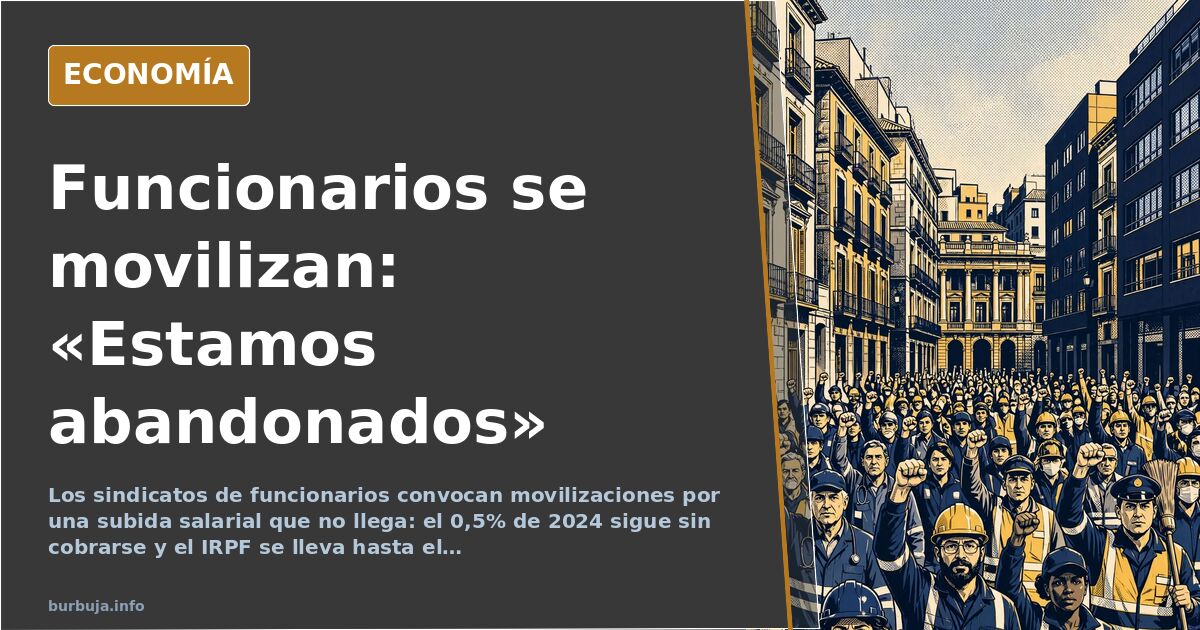
Civil servants mobilize over wages and stalled pay rises
Public sector unions have called for protests across Spain to demand salary increases that offset lost purchasing power. The trigger is a reality summarized by those affected in one phrase: "We are abandoned." The call comes after the government announced increments totaling 2+2+2% since 2021, which translate into much less on actual paychecks. The 0.5% linked to inflation remains unapproved, and this year's raise has not been paid. The protest is not sudden; it is the accumulation of grievances from a group seeing their real wages drift away from the cost of living.
The 2+2+2% that amounts to nothing
The official narrative speaks of raises. Paychecks say otherwise. Those in Group A — technicians and degree holders — explain with numbers: after each increase, the Treasury takes 37.5% in IRPF (income tax), applied as if public employees were high-income taxpayers. Consequently, an internal promotion with increased responsibility may result in only €120 more per month, according to a recently promoted civil servant. "All my effort for internal promotion means €120 in my account," he summarizes. The complaint is not just about the percentage, but the combined effect of inflation, tax withholding, and payment delays.
The ball is in the court of the Ministry of Finance. Unions demand a multi-year agreement that at least matches CPI increases. The government has summoned union representatives to address pending raises but without committing to figures. Affected workers feel the executive plays with the calendar: announcing increases, splitting them, conditioning them on inflation, and postponing them when inflation spikes. The 0.5% for 2024 has still not been paid. Neither has the one for 2025.
The gap with the private sector
Comparison with private companies is inevitable. Some argue public salaries are higher than private equivalents and ignore this gap. Others respond that comparison depends on the sector: in health, education, or justice, public salaries compete with private ones; in general administration, they do not. Debate heats up regarding supplements: doctors, judges, and tax inspectors earn well above the average civil servant wage. However, most staff fall into middle brackets offering little room for joy.
Productivity discourse appears repeatedly. Some analysis suggests there is excess personnel and administration could function with fewer, better-paid employees. Cited examples include mass audits akin to Elon Musk’s proposals for public spending, with instant dismissals for tardiness. The proposal has appeal but clashes with reality: administration is not a business, and its services are not measured in profits.
The citizen waiting at the counter
The other side of the coin is the user. Citizen complaints are not about low civil servant pay, but poor service: groups chatting in the back while counters stand empty, emergency rooms lacking explanations, and procedures requiring appointments just to book another appointment. "We citizens are abandoned when we approach a counter and are ignored," summarizes one comment. This perception fuels harsher rhetoric claiming surplus staff and resource sinks.
Tension between these views pervades the debate. Some defend that the majority works hard, blaming impunity among a minority who fail to deliver results. Others counter that the system rewards seniority over merit, demotivating good performers due to lack of incentives. The uncomfortable conclusion is that both diagnoses may be true simultaneously: some civil servants work, others do not, and citizens pay the price for both.
Threat of national paralysis
Protest calls have revealed union strength. Some threaten to paralyze the country unless a 10% raise is granted: "Either we get a 10% raise, or no one will file their income tax return." The phrase is hyperbolic but measures conflict temperature. Income tax season is when administration shows blocking capacity. If unions tighten here, the government faces problems.
Context does not help. Public debt remains high, with interest consuming growing budget shares. Some claim civil servants will be "fuel for inflation and debt interest payments." This warning is not new but now intersects with open wage negotiations. Executive maneuvering space is narrow: raising wages feeds deficit; not raising them feeds conflict.
Most reasonable prediction, with reservations, is that government will close a multi-year deal with moderate ~2% annual raises, sold by unions as success. If inflation stays above threshold, purchasing power loss continues and protests return. Root problem — compensation system ignoring merit and effort — remains unresolved.
Public sector unions have called for protests across Spain to demand salary increases that offset lost purchasing power. The trigger is a reality summarized by those affected in one phrase: "We are abandoned." The call comes after the government announced increments totaling 2+2+2% since 2021, which translate into much less on actual paychecks. The 0.5% linked to inflation remains unapproved, and this year's raise has not been paid. The protest is not sudden; it is the accumulation of grievances from a group seeing their real wages drift away from the cost of living.
The 2+2+2% that amounts to nothing
The official narrative speaks of raises. Paychecks say otherwise. Those in Group A — technicians and degree holders — explain with numbers: after each increase, the Treasury takes 37.5% in IRPF (income tax), applied as if public employees were high-income taxpayers. Consequently, an internal promotion with increased responsibility may result in only €120 more per month, according to a recently promoted civil servant. "All my effort for internal promotion means €120 in my account," he summarizes. The complaint is not just about the percentage, but the combined effect of inflation, tax withholding, and payment delays.
The ball is in the court of the Ministry of Finance. Unions demand a multi-year agreement that at least matches CPI increases. The government has summoned union representatives to address pending raises but without committing to figures. Affected workers feel the executive plays with the calendar: announcing increases, splitting them, conditioning them on inflation, and postponing them when inflation spikes. The 0.5% for 2024 has still not been paid. Neither has the one for 2025.
The gap with the private sector
Comparison with private companies is inevitable. Some argue public salaries are higher than private equivalents and ignore this gap. Others respond that comparison depends on the sector: in health, education, or justice, public salaries compete with private ones; in general administration, they do not. Debate heats up regarding supplements: doctors, judges, and tax inspectors earn well above the average civil servant wage. However, most staff fall into middle brackets offering little room for joy.
Productivity discourse appears repeatedly. Some analysis suggests there is excess personnel and administration could function with fewer, better-paid employees. Cited examples include mass audits akin to Elon Musk’s proposals for public spending, with instant dismissals for tardiness. The proposal has appeal but clashes with reality: administration is not a business, and its services are not measured in profits.
The citizen waiting at the counter
The other side of the coin is the user. Citizen complaints are not about low civil servant pay, but poor service: groups chatting in the back while counters stand empty, emergency rooms lacking explanations, and procedures requiring appointments just to book another appointment. "We citizens are abandoned when we approach a counter and are ignored," summarizes one comment. This perception fuels harsher rhetoric claiming surplus staff and resource sinks.
Tension between these views pervades the debate. Some defend that the majority works hard, blaming impunity among a minority who fail to deliver results. Others counter that the system rewards seniority over merit, demotivating good performers due to lack of incentives. The uncomfortable conclusion is that both diagnoses may be true simultaneously: some civil servants work, others do not, and citizens pay the price for both.
Threat of national paralysis
Protest calls have revealed union strength. Some threaten to paralyze the country unless a 10% raise is granted: "Either we get a 10% raise, or no one will file their income tax return." The phrase is hyperbolic but measures conflict temperature. Income tax season is when administration shows blocking capacity. If unions tighten here, the government faces problems.
Context does not help. Public debt remains high, with interest consuming growing budget shares. Some claim civil servants will be "fuel for inflation and debt interest payments." This warning is not new but now intersects with open wage negotiations. Executive maneuvering space is narrow: raising wages feeds deficit; not raising them feeds conflict.
Most reasonable prediction, with reservations, is that government will close a multi-year deal with moderate ~2% annual raises, sold by unions as success. If inflation stays above threshold, purchasing power loss continues and protests return. Root problem — compensation system ignoring merit and effort — remains unresolved.
Also available in: Deutsch
Summary of a discussion on Burbuja.info - Foro de economía, actualidad y política., translated from Spanish and reviewed before publication. Read the full discussion (196 replies).
More summaries
-
Government Offers Civil Servants 10% Raise Until 2028, Unions Call It an "Insult"
The proposed 10% increase for civil servants by 2028 averages 2.4% annually, falling short of private sector agreements and inflation rates.
-
Spain faces four years of tax hikes, debt and stagflation
Excess public debt reaches nearly €15,000 per capita in Spain, with a four-year outlook combining higher taxes and stagflation.
-
Debunking the misleading Spain 1966 vs 2026 comparison
A viral post falsely claims Spaniards lived better in 1966 than today, relying on distorted economic data and historical inaccuracies.
-
Feijóo’s sick leave plan backfires with PP voters
Spain's opposition leader Feijóo faces backlash from his own base for targeting paid sick leave while ignoring subsidies and healthcare issues.
-
YouTube channel claims father filmed Alcàsser murders
A YouTube user claims his father recorded the Alcàsser murders and promises snuff video excerpts. No evidence provided, only narrative and technical analysis.
-
Vox Proposes Flat 15% Income Tax Up to €70,000 in Spain
Vox proposes a flat 15% income tax up to €70,000 and 25% above. Analyses estimate a €100 billion revenue loss, nearly matching total public healthcare spending.