
Spanish cinema returns to the paedophile priest and evil bishops formula with 'La Luz'
The new film 'La Luz' reopens the debate on church abuse and propaganda in state-subsidised Spanish cinema. Fed-up audiences or legitimate denunciation?
English · Original discussion in Spanish · Published
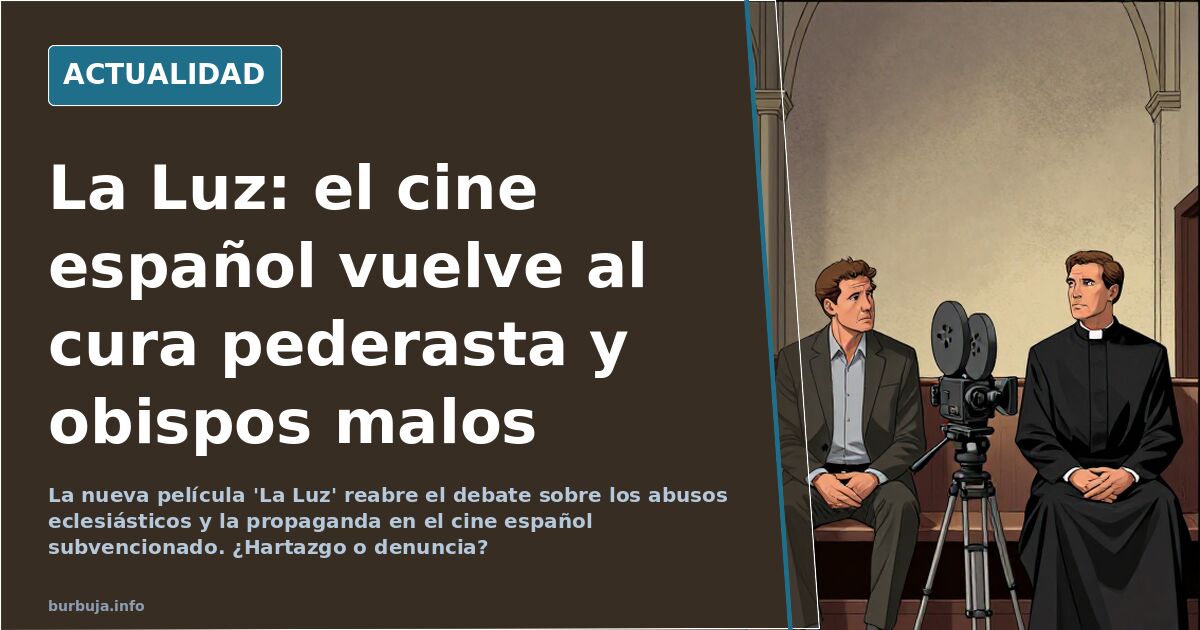
La Luz: Spanish cinema returns to the same formula of paedophile priest and evil bishops
The poster for the film 'La Luz', which opens this weekend, promised a different story. Reading the synopsis was enough to find yet another variation on the same pattern: a gai priest who covers up child abuse and clashes with a corrupt church hierarchy. Beyond film criticism, the debate has become a thermometer of the culture war dividing Spain.
Some see the film as a necessary denunciation of abuse in the Church, backed by the last two popes. Others are simply fed up. 'Enough with gays, whores and the civil war', sums up one of the most repeated voices. The criticism is not aimed at the specific plot, but at a model of cinema that, according to its detractors, repeats the same formulas to obtain public subsidies.
The role of the public media
Presenter Xabi Fortes devoted 20 minutes of his show on La Sens to promoting the film. For many, that is the smoking gun: the film is not trying to tell a story, but to indoctrinate. The predictable result is that few will go and see it, but its propagandistic effect on a captive audience can be significant.
Almost in parallel, comparisons have resurfaced with Spanish cinema of the 70s and 80s, the cinema of Berlanga, Ozores or even Almodóvar. Today that cinema competes with products that, in the critics' view, are more propaganda than art. At this rate, the only cinema to survive will be the kind that tells the powers that be what they want to hear.
Related discussions in the forum
- Paris: "Are you scared? You son of a bitch!" "I'm going to f*** your mother, b****... Die, old man, die." · 42 replies
- Barcelona is no longer the capital of Catalonia · 57 replies
- Do you consider yourselves white? Have you experienced racism in Europe's white countries because of your looks? · 498 replies
- White girls were kept in dog cages and raped by hundreds of migrants (chilling speech in the British Parliament) · 109 replies
Also available in: Deutsch
Summary of a discussion on Burbuja.info - Foro de economía, actualidad y política., translated from Spanish and reviewed before publication. Read the full discussion (16 replies).
More summaries
-
Spain's government calls for more diversity in film: realism or propaganda?
Spain's government is demanding more racial, sexual and body-type diversity in Spanish cinema. Is it inclusion or propaganda? The debate is splitting the industry and its audience.
-
Citizen Vigilante: Uwe Boll's controversial new film splits opinion online
Citizen Vigilante, Uwe Boll's new film, arrives with Spanish subtitles as it divides the internet: banned in Germany, accused of propaganda and more.
-
Uwe Boll's 'Citizen Vigilante' arrives in Spanish amid controversy and censorship
Uwe Boll's film sparks controversy in Spain: some see it as an icon, others as trash. Censorship is boosting it, but the debate over its message is…
-
José Mota stops hair treatment due to side effects
José Mota quits hair loss medication due to side effects: 'I prefer to have a receding hairline and thinning hair'
-
Racism after Spain's World Cup win: the shadow that won't fade
After winning the World Cup, racist comments downplaying players like Lamine Yamal or Nico Williams have surfaced. An analysis of Spain's identity tensions.
-
Manila, Philippines: a genuine failed state...
Manila as a failed state: we examine the debate over its poverty, its colonial legacy and an unprecedented demographic collapse in the Philippines.