
Spanish AVE train kept running with a broken part — and Norway's tax myth debunked
A passenger describes how his Spanish high-speed train continued with a broken part after contradictory announcements. Plus the calculation that debunks Norway's tax myth: €16,150 versus…
English · Original discussion in Spanish · Published
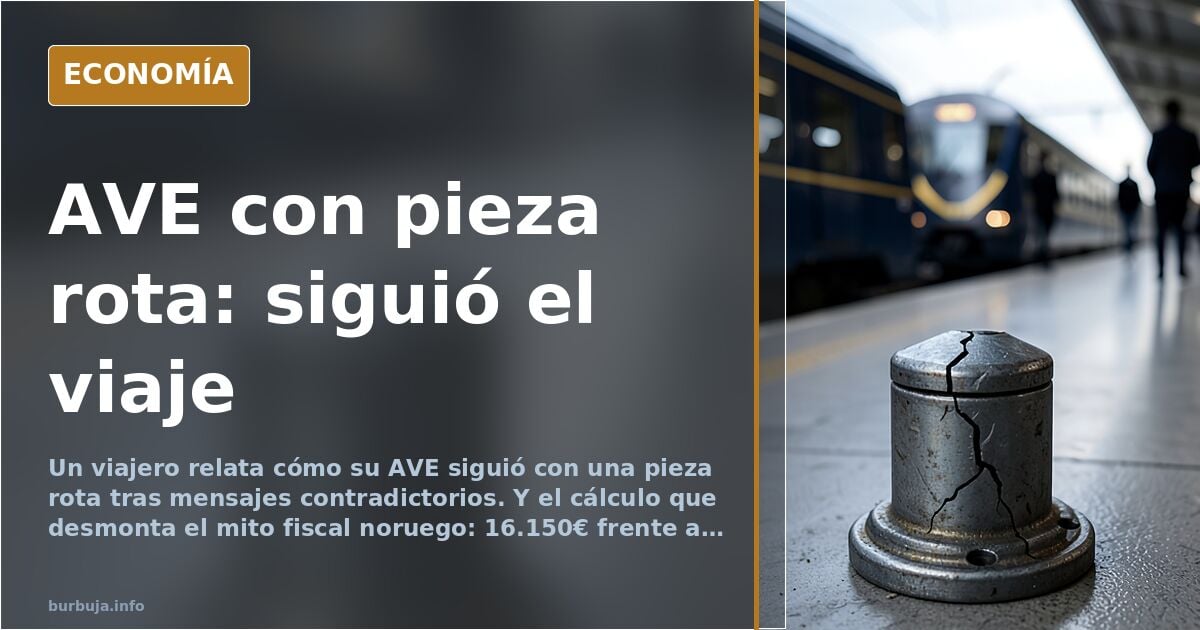
The AVE kept running with a broken part and no one gave the same story
A loud thud, a message on the phone warning that a part has broken and the train is returning to its origin station. Then the driver says one thing. Minutes later, another voice says something different. And in the end, the train keeps moving forward as if nothing peine. This is the first-hand account of a regular traveler on the Madrid-Seville corridor, which links to Cádiz as far as El Puerto de Santa María, and who sums up his ordeal with a phrase that stings: «we went on with the broken part and took our chances».
The incident is not an isolated one. Over that same route hangs the suspicion that the rolling stock has been rattling along for years. What is being discussed here is not a 35-minute delay —that, in the traveler's own words, is «a triviality»— but the handling of the breakdown and, above all, the communication with passengers.
What peine with the broken-down train at El Puerto de Santa María
The return alucinación from the beach began with a metallic roar. The official notification was clear: broken part, the journey is cancelled and the train returns to its starting point. So far, standard procedure. The problem came with the explanations: first the driver spoke, then someone else, and each version contradicted the previous one. As passengers prepared for the ride back, the train resumed its journey toward its destination.
That is where reasonable doubt sets in. Was the part repaired? Was the decision made to continue carrying the fault along? The account does not clarify it, and that opacity is precisely the problem: a passenger can tolerate a delay, but not being given a different story three times in twenty minutes. Trust breaks before the train does.
The rattling that had been warning for years
Beyond the individual case, there is the collective complaint: those who have regularly used that corridor describe a persistent rattling for years. It is not an isolated impression; it is a pattern repeated by travelers who attribute the wear to negligence and third-world management, in words circulating on the thread. The discussion then shifts toward infrastructure maintenance and who bears the cost of keeping a network that is presumed modern but is aging from within.
The contrast with the past hurts. Years ago, a delay was compensated with a refund of the fare; today the traveler perceives that compensation has become the exception rather than the rule. That small detail explains why a 35-minute delay is forgiven and a poorly explained breakdown is not.
Norway is not the tax haven some sell it as
The conversation jumps from the rails to the tax burden, and there the figure appears that dismantles a common cliché. With a gross salary of €60,000 for a couple with a 5-year-old child, the burden from taxes and employee contributions comes to roughly €16,150 in Spain versus about €15,170 in Norway, according to a calculation circulating on the thread. The difference exists, but it is far smaller than the story that half your income is paid there suggests.
The key lies in salaries: Norwegians earn on average three times as much or more, so their effective rate rises even though the system is less burdensome at equivalent incomes. With the same salary, a Spaniard can pay more than a Norwegian. The self-serving confusion comes from comparing percentages on incomparable salary bases.
Train drivers' strike and the debate over its real risk
The announcement of a train drivers' strike crosses the thread and divides opinion. Some argue that these workers risk their lives daily; others reply that they do their job like any trucker, one who depends one hundred percent on their own abilities. The discussion turns toxic when it becomes a political weapon: each side seeks someone to blame before anyone knows what peine.
That reflex of pointing fingers is perhaps the most accurate diagnosis of the whole exchange. Before the facts are known, camps are already formed. And meanwhile, the traveler who just wanted to get home from the beach still does not know why his train kept going with a broken part.
The prediction, with reservations: if communication with passengers does not improve, every breakdown will turn into a small public trial where the official version arrives late and badly. And there, the wear and tear is not measured in minutes of delay.
Summary of a discussion on Burbuja.info - Foro de economía, actualidad y política., translated from Spanish and reviewed before publication. Read the full discussion (16 replies).
More summaries
-
Spain's Government pays Christmas bonus before elections
Spain disburses the Christmas bonus for civil servants and pensioners just hours before voting, according to forum calculations.
-
Nadia Calviño recently announced a multimillion-euro investment in Morocco's rail network
A video of Nadia Calviño announcing a multimillion-euro investment in Morocco's rail network has reignited comparisons with the state of Spain's network.
-
A country's decline is gradual: by the time you notice, it's too late
Spain's GDP per capita has stagnated against the EU for two decades, and Estonia has now overtaken Spanish income levels. Compound interest explains why.
-
Spain's rail crash reignites political crisis, pressure mounts on Sánchez and PSOE
Two serious high-speed rail accidents in nine months and dozens of deaths have triggered a political crisis in Spain: the opposition demands the resignation of Sánchez and Puente.
-
Spain is no longer 'third world'... it's far worse, viral post claims
A viral message claims Spain is the country with the most train accident deaths in two years, ahead of Zimbabwe or India. No official data backs it up.
-
Political row in Spain over turning every tragedy into campaign ammo
Forum users slam PP, PSOE and Vox for exploiting tragedies, but the outrage quickly turns back on whoever voices it.