
Spanish Army Role in Canary Islands Migration Crisis Debated
Forum debate on Spanish military role in Canary Islands migration, citing Article 8 and Frontex warnings.
English · Original discussion in Spanish · Published
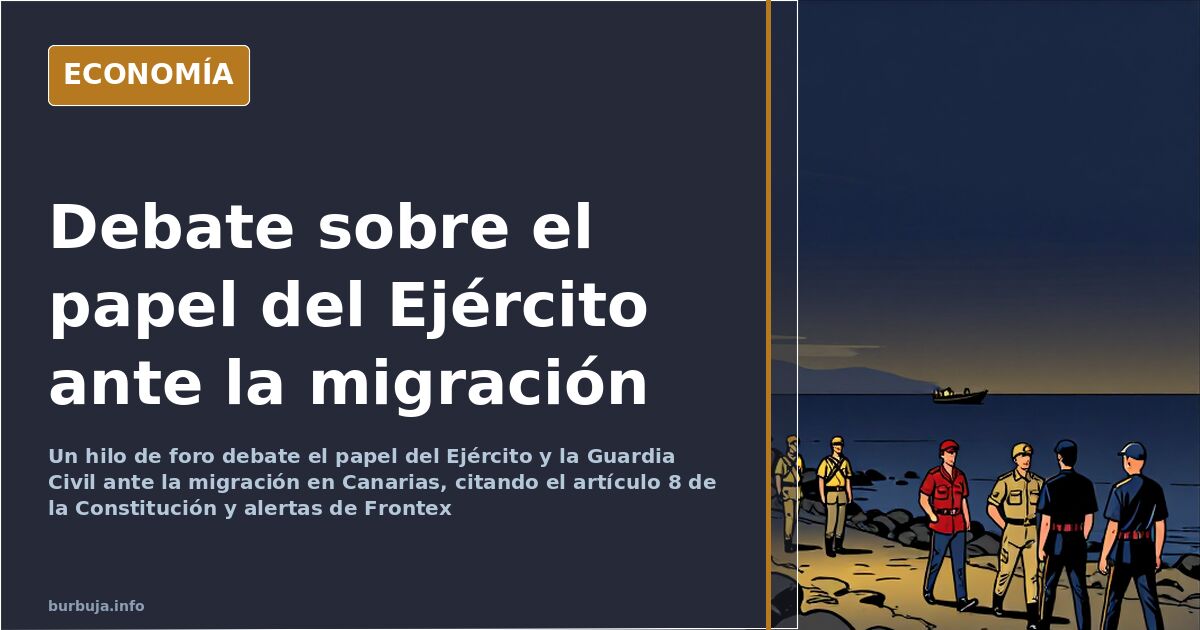
The Role of the Spanish Army in the Canary Islands Migration Crisis
What is the purpose of the Spanish Army? In a forum thread included in the material, several participants discuss the role of the Armed Forces in the migration crisis in the Canary Islands. The discussion, which has 168 replies according to the source, centers on whether military personnel should act to contain irregular immigration or if their function is limited to logistical and humanitarian support under government authorization. Some participants raise the underlying question of whether the Armed Forces only act with political authorization and what real margin they have to protect a border described as overwhelmed.
Article 8 of the Constitution, explicitly cited in the material, assigns the Armed Forces the mission of guaranteeing Spain's sovereignty and independence, defending its territorial integrity and constitutional order. This text has become a dialectical battleground: some read it as an unequivocal mandate for border defense; others see it as a function subordinate to civil power, which decides when and how it is activated.
Statements by the Commander of the Canary Islands Command and Why They Generate Backlash
The material attributes to the head of the Canary Islands Command the idea that soldiers are not there to go against migrants, but to help when authorized by the Government. This interpretation has ignited the debate. Some argue that turning the Army into a sort of aid organization distorts its function and leaves it defenseless against what they describe as sustained migratory pressure on the Canary Islands. The opposing argument, less noisy but present, recalls that in a rule-of-law state, armed forces do not deploy on their own initiative.
The material includes a recurring accusation: that high-ranking officers act out of political obedience and promotion calculations. It is claimed that a lieutenant general owes his rank "to appointment for trinc orders," and that those who do not comply with such directives rarely reach the generalate. This is a widespread opinion in the debate, not a proven fact, and should be read as such.
The Risk of the Army Becoming a Giant NGO
Former Chief of the General Staff (JEMAD) Alejandre's warning about the risk of the Army becoming "a giant NGO" appears cited as one of the pillars of the issue. This idea connects with a current that argues the institution has shifted its combat preparation toward assistance tasks. It is not a new thesis, but in the Canary Islands context, it takes on another dimension.
Against this, more institutional analysis defends that the Army's obligation is to anticipate all possible scenarios. The JEMAD created a working group on risks from Segarro to Spain, and according to the material, some members of the leadership showed reluctance because it was not ordered by Minister Robles. That small detail reveals the real tension: who sets the defense agenda, the military command or the political power.
Civil Guards, Frontex, and the Arithmetic of Surveillance
The numbers circulating in the material are eloquent. There is talk of 28 Civil Guard agents for more than 2,000 migrants, a ratio that some participants call unsustainable. Added to this is Frontex's warning about the growing activity of Pakistani mafias on the Canary Islands route and the terrorist risk in the Sahel, along with Civil Guard alerts about the dissolution of the Canary Islands GRS (Rapid Intervention Group) and its consequences, including the loss of counter-terrorism capacity.
The question hovering over all the material is simple: What must happen for a security crisis to be declared? The repeated answer is bitter: that the regime or the Government feels threatened. If only citizens suffer the consequences, there is no emergency.
The Shadow of Segarro and the Hostile Use of Migration
Three National Security reports warn, according to the material, about the possible hostile use of irregular migration against Spain. The Maritime Security Strategy points to the risk of state actors using uncontrolled waves to destabilize. And it is mentioned that Segarro empties prisons and pushes convicts towards Spain. These are statements appearing in the debate that, if confirmed, would completely change the nature of the phenomenon: we would not be facing a humanitarian crisis, but calculated geopolitical pressure.
The Ship to Gaza and the Paradox of Military Deployment
The contrast that closes the circle: Sánchez announces the dispatch of the Action Maritime Vessel Furor to assist the flotilla heading to Gaza, responding to requests from his partners. Some participants point out the irony that a military ship is mobilized to accompany a humanitarian flotilla in the eastern Mediterranean while the Canary Islands lack personnel to guard a border. The Navy Chief says it is there to save migrants; Vox responds that it is there to defend Spain. Both are right in something, and that is the problem.
In the end, the discussion is not about migrants. It is about who decides what the Army does, and whether that someone is defending Spaniards or themselves. The answer, given the material, remains pending.
What is the purpose of the Spanish Army? In a forum thread included in the material, several participants discuss the role of the Armed Forces in the migration crisis in the Canary Islands. The discussion, which has 168 replies according to the source, centers on whether military personnel should act to contain irregular immigration or if their function is limited to logistical and humanitarian support under government authorization. Some participants raise the underlying question of whether the Armed Forces only act with political authorization and what real margin they have to protect a border described as overwhelmed.
Article 8 of the Constitution, explicitly cited in the material, assigns the Armed Forces the mission of guaranteeing Spain's sovereignty and independence, defending its territorial integrity and constitutional order. This text has become a dialectical battleground: some read it as an unequivocal mandate for border defense; others see it as a function subordinate to civil power, which decides when and how it is activated.
Statements by the Commander of the Canary Islands Command and Why They Generate Backlash
The material attributes to the head of the Canary Islands Command the idea that soldiers are not there to go against migrants, but to help when authorized by the Government. This interpretation has ignited the debate. Some argue that turning the Army into a sort of aid organization distorts its function and leaves it defenseless against what they describe as sustained migratory pressure on the Canary Islands. The opposing argument, less noisy but present, recalls that in a rule-of-law state, armed forces do not deploy on their own initiative.
The material includes a recurring accusation: that high-ranking officers act out of political obedience and promotion calculations. It is claimed that a lieutenant general owes his rank "to appointment for trinc orders," and that those who do not comply with such directives rarely reach the generalate. This is a widespread opinion in the debate, not a proven fact, and should be read as such.
The Risk of the Army Becoming a Giant NGO
Former Chief of the General Staff (JEMAD) Alejandre's warning about the risk of the Army becoming "a giant NGO" appears cited as one of the pillars of the issue. This idea connects with a current that argues the institution has shifted its combat preparation toward assistance tasks. It is not a new thesis, but in the Canary Islands context, it takes on another dimension.
Against this, more institutional analysis defends that the Army's obligation is to anticipate all possible scenarios. The JEMAD created a working group on risks from Segarro to Spain, and according to the material, some members of the leadership showed reluctance because it was not ordered by Minister Robles. That small detail reveals the real tension: who sets the defense agenda, the military command or the political power.
Civil Guards, Frontex, and the Arithmetic of Surveillance
The numbers circulating in the material are eloquent. There is talk of 28 Civil Guard agents for more than 2,000 migrants, a ratio that some participants call unsustainable. Added to this is Frontex's warning about the growing activity of Pakistani mafias on the Canary Islands route and the terrorist risk in the Sahel, along with Civil Guard alerts about the dissolution of the Canary Islands GRS (Rapid Intervention Group) and its consequences, including the loss of counter-terrorism capacity.
The question hovering over all the material is simple: What must happen for a security crisis to be declared? The repeated answer is bitter: that the regime or the Government feels threatened. If only citizens suffer the consequences, there is no emergency.
The Shadow of Segarro and the Hostile Use of Migration
Three National Security reports warn, according to the material, about the possible hostile use of irregular migration against Spain. The Maritime Security Strategy points to the risk of state actors using uncontrolled waves to destabilize. And it is mentioned that Segarro empties prisons and pushes convicts towards Spain. These are statements appearing in the debate that, if confirmed, would completely change the nature of the phenomenon: we would not be facing a humanitarian crisis, but calculated geopolitical pressure.
The Ship to Gaza and the Paradox of Military Deployment
The contrast that closes the circle: Sánchez announces the dispatch of the Action Maritime Vessel Furor to assist the flotilla heading to Gaza, responding to requests from his partners. Some participants point out the irony that a military ship is mobilized to accompany a humanitarian flotilla in the eastern Mediterranean while the Canary Islands lack personnel to guard a border. The Navy Chief says it is there to save migrants; Vox responds that it is there to defend Spain. Both are right in something, and that is the problem.
In the end, the discussion is not about migrants. It is about who decides what the Army does, and whether that someone is defending Spaniards or themselves. The answer, given the material, remains pending.
Also available in: Deutsch
Summary of a discussion on Burbuja.info - Foro de economía, actualidad y política., translated from Spanish and reviewed before publication. Read the full discussion (168 replies).
More summaries
-
Ortiz de Zárate: Arrested in Guadalajara, July 22, 1936
A 1936 photo shows Commander Ortiz de Zárate arrested in Guadalajara before his execution. Historical repression figures remain disputed.
-
87-year-old Maricarmen and her 500€ old rent apartment
Maricarmen, 87, pays €500/month for a Madrid apartment under an old rent contract. Police cleared the street during her fourth eviction attempt.
-
Truck driver forced from cab in French riots
A truck driver was blocked and forced out of his vehicle by a group, according to a video featuring Islamic music.
-
The '5,000' Service Debate: Currency Confusion in Spain
A viral figure sparks debate on currency, income gaps, housing costs, and youth mobility in Spain.
-
Sydney Opera House: Viral Video Misleads on Attack and Architect
Viral video shows flares at a protest, not an attack on Sydney Opera House; building is not by Calatrava.
-
Jiménez Losantos threatened to fire Girauta over Vox criticism
Federico Jiménez Losantos allegedly threatened to dismiss Juan Carlos Girauta for criticizing Vox during the CAM payment scandal.