
Spanish activist Ane Lindane blames bystander for not helping during attempted phone theft
Ane Lindane criticized a 'señoro' who didn't help her, reigniting debates on insecurity and ideological narratives in Spain.
English · Original discussion in Spanish · Published
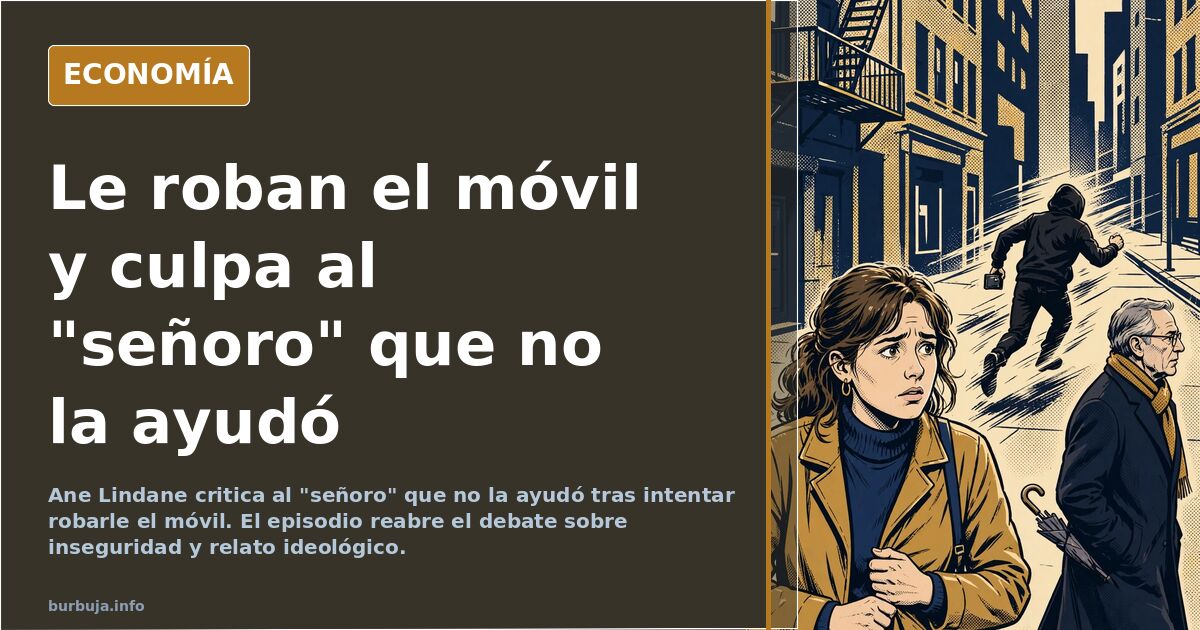
Phone theft attempt leads activist to blame unhelpful bystander
The scene has all the ingredients of a 21st-century instruction manual: a woman having her phone snatched in broad daylight, a struggle, screams, and a subsequent reaction that angers more than the crime itself. The episode's protagonist, activist Ane Lindane, turned her bad experience into public criticism: instead of focusing reproach on the person who tried to take her mobile, she pointed at the "señoro" (a term used by some activists for privileged men) who passed by and did not intervene. The sequence, circulated on social media, generated a flood of reactions mixing analysis of the crime with underlying ideological disputes.
The circulating narrative is simple: the victim struggled with the aggressor, managed to keep the phone, and then lamented the passivity of those present. Her most repeated phrase —"go rob the rich"— has become the symbol of the matter. For some, it proves that identity politics discourse crumbles when the problem knocks on their door. For others, it is just an anecdote with no further significance.
What peine and why it became news
According to the spread account, the episode occurred in a public street. The activist was approached by an individual who tried to snatch her mobile. She resisted, screamed, and prevented the attempt from succeeding. Up to this point, an unpleasant but common incident. What sparked interest was her subsequent interpretation: instead of reporting insecurity or calling for more police presence, she attacked the man who, from her perspective, should have come to her aid.
The term "señoro" is not accidental. It is the label certain activism applies to adult men presumed to have privilege, and thus, solidarity is not asked of them but demanded. The paradox is evident: help is requested from someone who is despised. And that contradiction is what has burst the seams of the narrative.
Reproach toward the non-helper and silence on the aggressor
The most repeated criticism is the asymmetry of anger. Some argue that the activist devotes more energy to blaming a passerby's passivity than to condemning the attempted thief. This imbalance, they say, reveals a hierarchy of priorities where the ordinary male —the señoro— appears as a structural culprit, while the incivil remains blurred.
Counter-arguments also circulate: citizen insecurity is a real problem, and the victim's reaction, though debatable, is human. No one reacts with a style guide when being robbed. However, the discussion has not gone there. It has focused on the ideological framework.
Debate on insecurity and the aggressor's profile
Part of the reactions shifted to the aggressor's profile. Speculation arises about his origin, linking the episode to insecurity in certain areas. This line of argument, very present on social networks, mixes the specific case with a general thesis on immigration and crime. Available data do not allow confirming any of these hypotheses: there is no official information on the identity of the attempted robber.
What can be affirmed is that the episode served to reopen the discussion on whether identity politics discourse offers any operational response to everyday insecurity. Judging by the tone of the conversation, the answer seems to be no.
The paradox of "go rob the rich"
The phrase "go rob the rich" deserves separate analysis. It states a principle: theft is acceptable if the victim has money. Applied to this case, the problem is that the activist is not rich. And there the scheme breaks. Incivil do not distinguish between rich and poor; they distinguish between opportunities. The lesson, if there is one, is that ideology does not protect against crime.
Some maintain that the victim's reaction is understandable in a context of precariousness: the mobile is not a luxury, it is a work and life tool. That part of the argument holds weight. The other part, which turns the passerby into the culprit, does not.
The matter ends where it began: an attempted robbery, a victim who kept her phone, and a controversy over who should have done what. There is no known complaint, no arrests, no resolution. Only the confirmation that, within certain mental frameworks, the thief is a faceless subject and the señoro walking down the street is the true accused.
The scene has all the ingredients of a 21st-century instruction manual: a woman having her phone snatched in broad daylight, a struggle, screams, and a subsequent reaction that angers more than the crime itself. The episode's protagonist, activist Ane Lindane, turned her bad experience into public criticism: instead of focusing reproach on the person who tried to take her mobile, she pointed at the "señoro" (a term used by some activists for privileged men) who passed by and did not intervene. The sequence, circulated on social media, generated a flood of reactions mixing analysis of the crime with underlying ideological disputes.
The circulating narrative is simple: the victim struggled with the aggressor, managed to keep the phone, and then lamented the passivity of those present. Her most repeated phrase —"go rob the rich"— has become the symbol of the matter. For some, it proves that identity politics discourse crumbles when the problem knocks on their door. For others, it is just an anecdote with no further significance.
What peine and why it became news
According to the spread account, the episode occurred in a public street. The activist was approached by an individual who tried to snatch her mobile. She resisted, screamed, and prevented the attempt from succeeding. Up to this point, an unpleasant but common incident. What sparked interest was her subsequent interpretation: instead of reporting insecurity or calling for more police presence, she attacked the man who, from her perspective, should have come to her aid.
The term "señoro" is not accidental. It is the label certain activism applies to adult men presumed to have privilege, and thus, solidarity is not asked of them but demanded. The paradox is evident: help is requested from someone who is despised. And that contradiction is what has burst the seams of the narrative.
Reproach toward the non-helper and silence on the aggressor
The most repeated criticism is the asymmetry of anger. Some argue that the activist devotes more energy to blaming a passerby's passivity than to condemning the attempted thief. This imbalance, they say, reveals a hierarchy of priorities where the ordinary male —the señoro— appears as a structural culprit, while the incivil remains blurred.
Counter-arguments also circulate: citizen insecurity is a real problem, and the victim's reaction, though debatable, is human. No one reacts with a style guide when being robbed. However, the discussion has not gone there. It has focused on the ideological framework.
Debate on insecurity and the aggressor's profile
Part of the reactions shifted to the aggressor's profile. Speculation arises about his origin, linking the episode to insecurity in certain areas. This line of argument, very present on social networks, mixes the specific case with a general thesis on immigration and crime. Available data do not allow confirming any of these hypotheses: there is no official information on the identity of the attempted robber.
What can be affirmed is that the episode served to reopen the discussion on whether identity politics discourse offers any operational response to everyday insecurity. Judging by the tone of the conversation, the answer seems to be no.
The paradox of "go rob the rich"
The phrase "go rob the rich" deserves separate analysis. It states a principle: theft is acceptable if the victim has money. Applied to this case, the problem is that the activist is not rich. And there the scheme breaks. Incivil do not distinguish between rich and poor; they distinguish between opportunities. The lesson, if there is one, is that ideology does not protect against crime.
Some maintain that the victim's reaction is understandable in a context of precariousness: the mobile is not a luxury, it is a work and life tool. That part of the argument holds weight. The other part, which turns the passerby into the culprit, does not.
The matter ends where it began: an attempted robbery, a victim who kept her phone, and a controversy over who should have done what. There is no known complaint, no arrests, no resolution. Only the confirmation that, within certain mental frameworks, the thief is a faceless subject and the señoro walking down the street is the true accused.
Also available in: Deutsch
Summary of a discussion on Burbuja.info - Foro de economía, actualidad y política., translated from Spanish and reviewed before publication. Read the full discussion (183 replies).
More summaries
-
iPhone stolen in Spain drains €20,000 via Trade Republic
Thieves stole an iPhone in Marbella and drained €20,000 from accounts in 12 hours. Analysis of security flaws in neobanks like Trade Republic.
-
Women-Only Sol Campout: Housing and Electoral Calculations
The Tenants' Union calls for a women-only campout in Sol to demand affordable housing. The exclusion sparks debate on policy models.
-
Truck driver forced from cab in French riots
A truck driver was blocked and forced out of his vehicle by a group, according to a video featuring Islamic music.
-
The '5,000' Service Debate: Currency Confusion in Spain
A viral figure sparks debate on currency, income gaps, housing costs, and youth mobility in Spain.
-
Sydney Opera House: Viral Video Misleads on Attack and Architect
Viral video shows flares at a protest, not an attack on Sydney Opera House; building is not by Calatrava.
-
Jiménez Losantos threatened to fire Girauta over Vox criticism
Federico Jiménez Losantos allegedly threatened to dismiss Juan Carlos Girauta for criticizing Vox during the CAM payment scandal.