
Spain's youth stuck in prolonged adolescence amid housing crisis
Low wages and high rents delay emancipation, driving young Spaniards to prioritize leisure over homeownership.
English · Original discussion in Spanish · Published
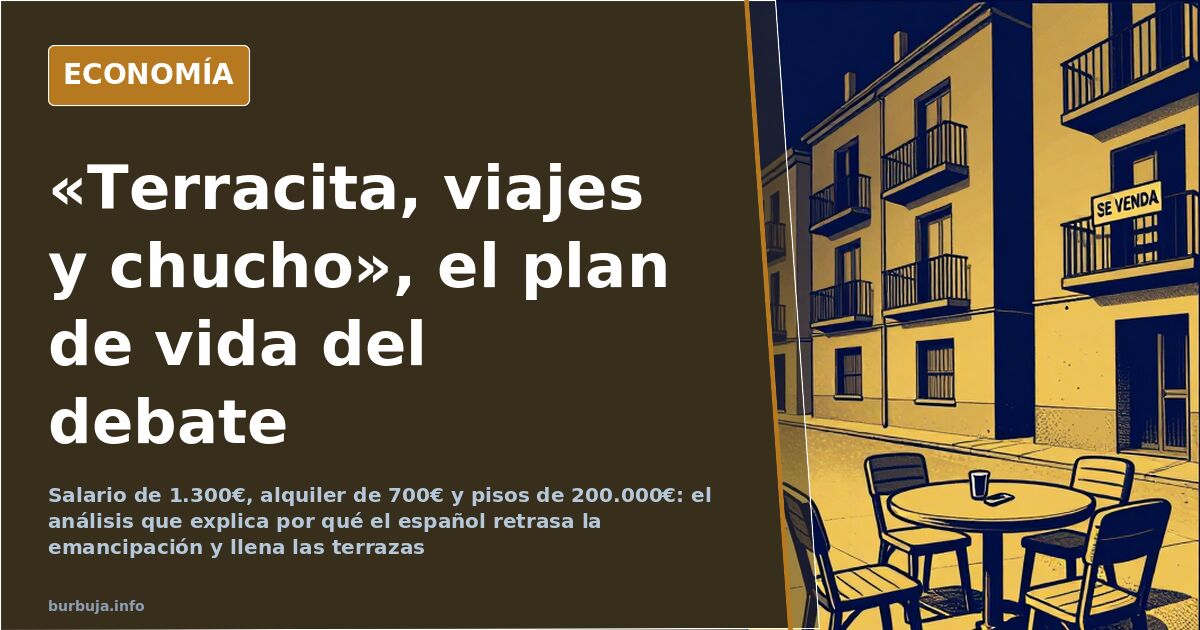
Full terraces and €200k homes: the emancipation that never comes
A 29-year-old candidate sits for an HR interview. Zero days of contributions. What has he been doing all this time? Studying. The answer, which would have sounded like a joke years ago, has become a pattern: thirty-somethings with double degrees and master's degrees entering the labor market with empty backpacks. From this arises an uncomfortable diagnosis: zero emancipation has left the Spanish person forever adolescent, holding a beer as a flag.
The central thesis does not blame laziness alone. It argues that infantilization is the emergency exit against a wall: no children, no car, no apartment. In exchange, terraces, travel, and life stretched out at home until age 35, 40, or 45. Some summarize it with a harsh image: the "dead cat bounce," burning through all money without real options for housing, vehicles, or offspring.
The €200k apartment and the €1,300 salary
The arithmetic supporting the narrative is simple. Salary of €1,300, rent of €700, and food of €400. The result admits no nuances: there is no margin for anything. With those numbers, a €200,000 apartment ceases to be a goal and becomes thirty years of mortgage. A calculation circulating in the thread goes even further: according to one participant, 70% of workers earn the modal salary, which does not reach €19,000 gross annually. A level C remains at €1,600, and in Madrid, a net €2,000 evaporates if you do not tighten your belt. Housing has decoupled from the work that pays for it.
Why are terraces full if there is no money?
Because spending is today the only reward the system grants. Leisure and travel get top marks while buying a home is a chimera. When savings do not cover a down payment and inflation eats any cushion, logic reverses: better enjoy it now. The phrase summarizing that resignation, according to one participant, circulates unashamedly: "you won't have a house, car, vvife, or children, but you'll have a terrace, trips, and a dog."
Degree inflation: double degree, master's, and zero experience
The labor market throws the ball back. Some recount that their company has interviewed candidates near 30 without a single year of experience. Double degree, master's, a year abroad, another year finding oneself, and a couple of years as an intern. The sum does not match the offer. In private companies, offers of €21,000 demand absolute absurdities. And when connections are missing, the only remaining option is to keep studying or look abroad.
At the bottom lies a question about incentives. If the hyper-qualified and the non-qualified end up earning similarly, education stops being a profitable bet. And if the destination of any salary is a rent that grows by €100 a year, effort loses its buyer. It is not just sloth: it is that no one pays for effort.
From "I can't" to "It doesn't pay off"
The second twist of the analysis is psychological. Sustained precariousness for years turns renunciation into decision. "Nihilism is the logical consequence of lost values and a lack of future guarantee," summarizes one approach, before asking who wants stability when they don't know if their job or city will last more than a few months. The implicit question is devastating: if effort does not buy security, why bother?
The other narrative: laziness, comfort, and civil service exams
Against that economic reading lies a sarracena one. Part of the analysis holds that the problem is laziness and comfort, and that the vital goal is scratching your belly as a civil servant. On that idea rests the most cited refuge: the public post. With salaries of €1,300 to €2,000, the opposition exam (civil service entrance test) is sold as a lifeline, although it requires years of confinement and study. The prize, they ironize, is a modest position and a €200,000 apartment. Slavery with a fixed paycheck.
Family, gender, and the cost of raising children
In the realm of birth rates, part of the analysis points to a change in expectations: it is argued that starting a family has ceased to be perceived as a safe investment, amidst low wages, separations, and unreachable housing. Other voices reject determinism and recall that some do not choose to remain adolescents; they simply have no other choice. The lack of a life project, they insist, is not always a plan.
A generation that came prepared, or broken
Those who entered the labor market in 1998 remember another starting point. Since the property bubble burst, they argue, the situation has only worsened. In parallel, some claim that a portion of the youngest arrive with a different alibi: the expectation of inheriting apartments, being an only child, and knowing that moving to Madrid or Barcelona to share a flat for €500 does not compensate. They take interviews lightly. They have, they say, somewhere to fall dead.
With structural unemployment placed at least at 37% in the debate itself and a housing stock requiring thirty years of debt, the question ceases to be why young people do not move out. The uncomfortable question is another: how long can an economy withstand where no one dares to start?
A 29-year-old candidate sits for an HR interview. Zero days of contributions. What has he been doing all this time? Studying. The answer, which would have sounded like a joke years ago, has become a pattern: thirty-somethings with double degrees and master's degrees entering the labor market with empty backpacks. From this arises an uncomfortable diagnosis: zero emancipation has left the Spanish person forever adolescent, holding a beer as a flag.
The central thesis does not blame laziness alone. It argues that infantilization is the emergency exit against a wall: no children, no car, no apartment. In exchange, terraces, travel, and life stretched out at home until age 35, 40, or 45. Some summarize it with a harsh image: the "dead cat bounce," burning through all money without real options for housing, vehicles, or offspring.
The €200k apartment and the €1,300 salary
The arithmetic supporting the narrative is simple. Salary of €1,300, rent of €700, and food of €400. The result admits no nuances: there is no margin for anything. With those numbers, a €200,000 apartment ceases to be a goal and becomes thirty years of mortgage. A calculation circulating in the thread goes even further: according to one participant, 70% of workers earn the modal salary, which does not reach €19,000 gross annually. A level C remains at €1,600, and in Madrid, a net €2,000 evaporates if you do not tighten your belt. Housing has decoupled from the work that pays for it.
Why are terraces full if there is no money?
Because spending is today the only reward the system grants. Leisure and travel get top marks while buying a home is a chimera. When savings do not cover a down payment and inflation eats any cushion, logic reverses: better enjoy it now. The phrase summarizing that resignation, according to one participant, circulates unashamedly: "you won't have a house, car, vvife, or children, but you'll have a terrace, trips, and a dog."
Degree inflation: double degree, master's, and zero experience
The labor market throws the ball back. Some recount that their company has interviewed candidates near 30 without a single year of experience. Double degree, master's, a year abroad, another year finding oneself, and a couple of years as an intern. The sum does not match the offer. In private companies, offers of €21,000 demand absolute absurdities. And when connections are missing, the only remaining option is to keep studying or look abroad.
At the bottom lies a question about incentives. If the hyper-qualified and the non-qualified end up earning similarly, education stops being a profitable bet. And if the destination of any salary is a rent that grows by €100 a year, effort loses its buyer. It is not just sloth: it is that no one pays for effort.
From "I can't" to "It doesn't pay off"
The second twist of the analysis is psychological. Sustained precariousness for years turns renunciation into decision. "Nihilism is the logical consequence of lost values and a lack of future guarantee," summarizes one approach, before asking who wants stability when they don't know if their job or city will last more than a few months. The implicit question is devastating: if effort does not buy security, why bother?
The other narrative: laziness, comfort, and civil service exams
Against that economic reading lies a sarracena one. Part of the analysis holds that the problem is laziness and comfort, and that the vital goal is scratching your belly as a civil servant. On that idea rests the most cited refuge: the public post. With salaries of €1,300 to €2,000, the opposition exam (civil service entrance test) is sold as a lifeline, although it requires years of confinement and study. The prize, they ironize, is a modest position and a €200,000 apartment. Slavery with a fixed paycheck.
Family, gender, and the cost of raising children
In the realm of birth rates, part of the analysis points to a change in expectations: it is argued that starting a family has ceased to be perceived as a safe investment, amidst low wages, separations, and unreachable housing. Other voices reject determinism and recall that some do not choose to remain adolescents; they simply have no other choice. The lack of a life project, they insist, is not always a plan.
A generation that came prepared, or broken
Those who entered the labor market in 1998 remember another starting point. Since the property bubble burst, they argue, the situation has only worsened. In parallel, some claim that a portion of the youngest arrive with a different alibi: the expectation of inheriting apartments, being an only child, and knowing that moving to Madrid or Barcelona to share a flat for €500 does not compensate. They take interviews lightly. They have, they say, somewhere to fall dead.
With structural unemployment placed at least at 37% in the debate itself and a housing stock requiring thirty years of debt, the question ceases to be why young people do not move out. The uncomfortable question is another: how long can an economy withstand where no one dares to start?
Summary of a discussion on Burbuja.info - Foro de economía, actualidad y política., translated from Spanish and reviewed before publication. Read the full discussion (167 replies).
More summaries
-
Gifted students struggling to find success in the Spanish job market
High academic achievement does not guarantee professional success in Spain, as many gifted individuals face unemployment or low-skilled roles.
-
Spain housing prices drop 4.6%, Madrid falls 3.8%
Notaries confirm Madrid's first price drop in nine years at 3.8%, with a national average decline of 4.6%.
-
Mercadona shifts hiring to older workers as young applicants vanish
Mercadona replaces young staff with 40-60 year olds at checkouts and aisles. Gross salaries of €26,000 and a corporate culture no one can stand.
-
Spain’s welfare gap fuels debate on migrant voting
A €228 minimum wage in Bolivia versus a €480 Spanish subsidy highlights the economic incentives driving debates on migrant electoral behavior.
-
Pedro Baños: Prophet or Charlatan?
Retired Colonel Pedro Baños divides audiences between prophet and charlatan. His apocalyptic warnings and alleged pro-Russian ties are under scrutiny.
-
Nurses dancing in ER: debate on Spanish healthcare productivity
A viral video of nurses dancing while a patient waits has reignited the debate on public healthcare productivity and management in Spain.