
Nurses dancing in ER: debate on Spanish healthcare productivity
A viral video of nurses dancing while a patient waits has reignited the debate on public healthcare productivity and management in Spain.
English · Original discussion in Spanish · Published
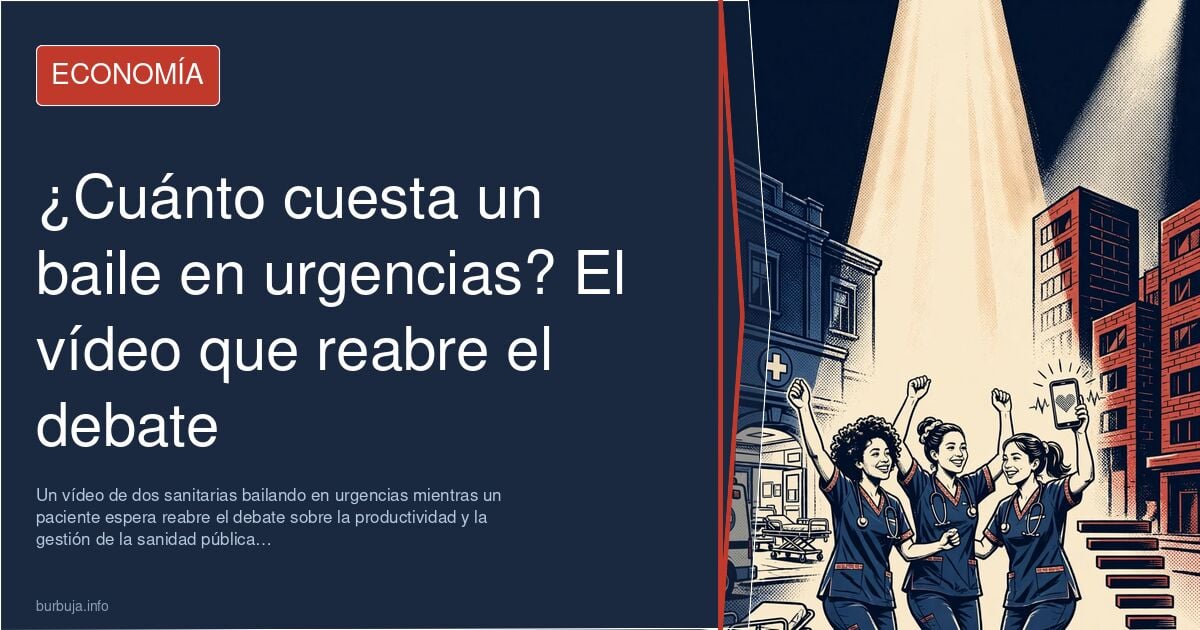
Nurses dancing in ER: image sparks debate on healthcare productivity
How much does a TikTok dance during work hours cost Spain's public health system? The question is not rhetorical. A video filmed in a hospital has peine the debate on the productivity of healthcare professionals and the management of public resources, just as emergency room saturation and sector strikes dominate the agenda.
The viral video and its context
The footage shows two healthcare workers performing the "Wednesday" series dance in an emergency hallway while a patient waits for treatment. The video spread rapidly on social media, accompanied by the hashtag #AyusoDimision, turning it into a political weapon. However, not everyone accepted this attribution: some pointed out that the hospital might be in Extremadura rather than the Community of Madrid, complicating the partisan interpretation.
Controversy quickly trinc. While some saw the images as an example of unprofessionalism and disregard for patients, others defended them as a momentary release in an extremely tense work environment. In any case, the discussion transcended the specific incident to settle firmly in the realm of healthcare management.
Political reaction and the management debate
The video became an ideological battleground. Critics of public management used it to argue for greater efficiency and, in some cases, the privatization of health services. Conversely, defenders of public healthcare suggested the video could be interested manipulation, recorded precisely to discredit the system and fuel the privatization narrative.
Suspicion that the material might have been filmed outside Madrid, or even that the protagonists were not healthcare professionals, added more noise. But the damage was done: the image of two people dancing while a patient waits is hard to digest, becoming a symbol of what many consider poor management.
Productivity and costs: how much does a dance cost?
From an economic perspective, the case raises a question of opportunity cost. If two professionals spend several minutes rehearsing and filming a dance, that time is not spent on patient care. In a saturated system, where waiting lists are measured in weeks and emergency rooms collapse, every minute counts. The question is whether such behaviors are widespread or isolated incidents.
Testimonials circulating in the debate suggest this is not a new phenomenon. Situations are mentioned such as a health center with eight women, five of them "trainees" drawing blood, or patients who have been unable to walk for two weeks seeing staff engaged in other tasks. These accounts, though anecdotal, feed the perception that productivity in public healthcare is at rock bottom.
The paradox of saturation
The irony is that the video appears in a context of labor demands. The same professionals who dance are those who, according to unions, are overwhelmed and asking for more staff. The contradiction is evident: if there is time for choreography, where is the saturation? This question, raised by critics of public management, finds no easy answer.
On the other hand, supporters of the system argue that a moment of leisure does not invalidate daily work, and that saturation is measured by objective data, not viral videos. The reality is that the video was removed from social networks, but the debate on healthcare management, productivity, and the public-private model remains open.
Meanwhile, the patient continues to wait. And the unanswered question remains: how much does a dance cost?
How much does a TikTok dance during work hours cost Spain's public health system? The question is not rhetorical. A video filmed in a hospital has peine the debate on the productivity of healthcare professionals and the management of public resources, just as emergency room saturation and sector strikes dominate the agenda.
The viral video and its context
The footage shows two healthcare workers performing the "Wednesday" series dance in an emergency hallway while a patient waits for treatment. The video spread rapidly on social media, accompanied by the hashtag #AyusoDimision, turning it into a political weapon. However, not everyone accepted this attribution: some pointed out that the hospital might be in Extremadura rather than the Community of Madrid, complicating the partisan interpretation.
Controversy quickly trinc. While some saw the images as an example of unprofessionalism and disregard for patients, others defended them as a momentary release in an extremely tense work environment. In any case, the discussion transcended the specific incident to settle firmly in the realm of healthcare management.
Political reaction and the management debate
The video became an ideological battleground. Critics of public management used it to argue for greater efficiency and, in some cases, the privatization of health services. Conversely, defenders of public healthcare suggested the video could be interested manipulation, recorded precisely to discredit the system and fuel the privatization narrative.
Suspicion that the material might have been filmed outside Madrid, or even that the protagonists were not healthcare professionals, added more noise. But the damage was done: the image of two people dancing while a patient waits is hard to digest, becoming a symbol of what many consider poor management.
Productivity and costs: how much does a dance cost?
From an economic perspective, the case raises a question of opportunity cost. If two professionals spend several minutes rehearsing and filming a dance, that time is not spent on patient care. In a saturated system, where waiting lists are measured in weeks and emergency rooms collapse, every minute counts. The question is whether such behaviors are widespread or isolated incidents.
Testimonials circulating in the debate suggest this is not a new phenomenon. Situations are mentioned such as a health center with eight women, five of them "trainees" drawing blood, or patients who have been unable to walk for two weeks seeing staff engaged in other tasks. These accounts, though anecdotal, feed the perception that productivity in public healthcare is at rock bottom.
The paradox of saturation
The irony is that the video appears in a context of labor demands. The same professionals who dance are those who, according to unions, are overwhelmed and asking for more staff. The contradiction is evident: if there is time for choreography, where is the saturation? This question, raised by critics of public management, finds no easy answer.
On the other hand, supporters of the system argue that a moment of leisure does not invalidate daily work, and that saturation is measured by objective data, not viral videos. The reality is that the video was removed from social networks, but the debate on healthcare management, productivity, and the public-private model remains open.
Meanwhile, the patient continues to wait. And the unanswered question remains: how much does a dance cost?
Summary of a discussion on Burbuja.info - Foro de economía, actualidad y política., translated from Spanish and reviewed before publication. Read the full discussion (144 replies).
More summaries
-
Ayuso's penthouse: a public purchase left unexplained
The Madrid region bought a luxury penthouse for over €6 million. Her partner removes the listings. The question about its use remains open.
-
Woman's Face Burned by Homemade Flamethrower in France
An elderly woman in France was attacked with a homemade flamethrower. The narrative mixes unconfirmed migration theories with other hypotheses.
-
Spain probes ex-PM Zapatero over alleged Maduro ties
Spain's National Court investigates former PM José Luis Rodríguez Zapatero for links to Venezuela's Maduro regime, sparking debate on extradition risks.
-
Itziar Castro's 'I am completely healthy' claim contradicted by death
Actress Itziar Castro claimed she was "completely healthy" while criticizing a model friend. She died at 46 from cardiac arrest, sparking debate on obesity risks.
-
Bringing a Colombian Partner to Spain Costs €20,000
A case study reveals €20,000 spent on family reunification from Colombia and subsequent breakup. No official data measures the real cost.
-
The Blue Dress That Altered King Felipe VI’s Future
25 years since Eva Sannum’s photo in a blue dress ended her relationship with King Felipe VI, sparking debate on the Crown's opportunity cost.