
Spain's wolf hunting ban sparks legal war between farmers and government
The ban on wolf hunting pits northwestern regions against the Ministry: livestock killed rises from 2,000 to 3,500 in a decade, and the legal route...
English · Original discussion in Spanish · Published
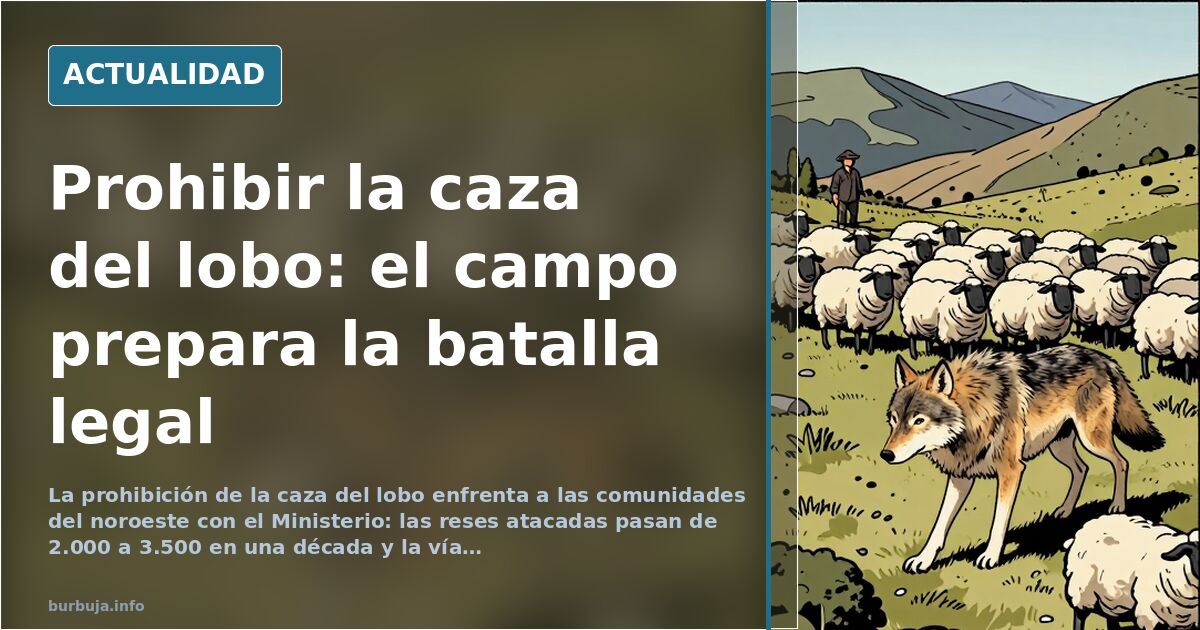
Spain's wolf hunting ban sparks another legal war in rural areas
There is a figure that unsettles anyone new to the issue: in just one Spanish province, livestock killed by wolf attacks rose from 2,000 to nearly 3,500 in ten years. Precisely the period when litters were raised without hunting pressure. The ban on wolf hunting across Spain—with the only exception of the north of the Duero—has left a trail of uncomfortable data, regional governments at odds with the Ministry, and a livestock sector that openly speaks of a declaration of war on the northwest of the country.
The issue is not new, but the discussion has been mutating. It began as a fight between environmentalists and hunters and has ended in an administrative standoff where the Canary Islands or the Balearic Islands vote on a species that does not set foot in their territories while Galicia or Asturias bear the real problem. The next stop, according to almost all analyses, is a series of contentious-administrative appeals.
What the wolf hunting ban changes and who it affects
The rule prohibits wolf hunting in all territory except north of the Duero, where population control is maintained. The problem is where the species is concentrated: northwestern Spain is home to the highest density of wolves in all of Europe. That is, the ban falls precisely where there are the most specimens, and where extensive livestock farming has coexisted with them for decades.
The thesis of the measure's defenders is that the wolf regulates ungulates and that livestock farming can adapt with mastiffs, electric fences, and night stabling. The argument has its biological logic, but it clashes with a detail that barely appears in reports: these measures involve changing entire ways of working, and a good part of smaller farms lack the scale to assume them.
There lies the knot. Small livestock—sheep, goats—is already practically eradicated in many wolf areas. What remains is mountain cattle and horses, and some argue that if the animal is left to roam without control, these too will end up being unviable in extensive farming.
The map of attacks: Galicia, Asturias and the expansion effect
Sightings are no longer limited to deep mountains. There are records of wolves prowling around country houses and entering yards, and in Galicia a case has been documented of a specimen that took a dog from inside a home. Hunting dogs were the first victims; now domestic pets are too.
But the expansion has another front. In Madrid there are already five established packs, according to data handled by those who track the species. And in areas where the wolf is scarce or nonexistent, others fill the void: in Catalonia, feral dogs killed 221 sheep in a single night, a figure that exceeds that of bears and wolves together in an entire year.
That detail is key to understanding the statistical dispute. When a devastated flock appears, attribution to the wolf has become the norm. In the Balearic Islands livestock also appears torn apart and there are no wolves there. Something doesn't add up.
Why is the Prosecutor's Office investigating hundreds of farmers over compensation?
Because fraud exists and is documented. The Prosecutor's Office has accused more than 200 farmers of irregularly collecting compensation for wolf damage. And a lesser-known fact: around 13% of damage attributed to wolves may have been caused by the farmers themselves to collect.
Several police operations have uncovered networks of fraudsters who reported attacks that never occurred, or that were the work of feral dogs. Even eleven gamekeepers were investigated for fraud in damage inspection, although the court eventually shelved that part.
One should not confuse fraud with real suffering. They are two different things and both true: there are farms that are ruined with each attack and there are those who profit from the system. The mixture of the two is what has poisoned any attempt at a pact.
The institutional battle: regions against the Ministry
The administrative paradox is notable. In the commission that votes on the protection of the species, the regions that oppose it are those that accumulate practically all of the country's wolf population, while those that support the ban barely have wolves on their territory. The vote of the Balearic Islands or the Canary Islands weighs the same as that of those who suffer the attacks.
The regional governments of the northwest are preparing appeals. The central legal argument is jurisdictional: if wolf management is transferred, the State cannot prohibit its hunting without a specific and updated scientific basis. The Ministry's response relies on reports it has accumulated over years on the status of the species.
The most repeated forecast is a rosary of contradictory rulings between regions, appeals to the Supreme Court and a situation of uncertainty that could last for years. Meanwhile, the countryside does not wait for the courts.
Mastiffs, snares and the future of rural areas
Coexistence with the wolf has a cost that is rarely put into numbers. A farmer mentioned in the case came to have 18 dogs to protect his flock; a few years later, the wolf wiped out his goats. The stress of not being able to sleep, of not being able to leave the livestock alone, of not being able to handle the paperwork demanded by the administration itself, is damage that no compensation covers.
To this is added the antiestéticar that full protection will open the door to massive poaching. There is already talk of snares and of meat with pins, ancient methods against which it is almost impossible to gather evidence. The logic is twisted but real: if a dead wolf is worth no money, no one turns themselves in to collect it.
Some analyses go further and place the conflict within a larger trend: policies for the protection of large carnivores are being revised across Europe. Norway plans to kill 70% of its wolf population; Germany authorizes hunting specimens that attack livestock; France has peine the door to hunting after the species' return. The question is no longer whether Spain is alone in this policy, but how long it will be.
With public health as an unexpected argument—there are studies detecting high rates of tapeworm in wolves from Idaho and Montana—with nature tourism as an alternative that no one knows how to monetize, and with the farmer and the biologist eyeing each other warily, a question remains that no report resolves: who pays the broken plates of a policy decided 600 kilometers from the countryside where it all blows up?
There is a figure that unsettles anyone new to the issue: in just one Spanish province, livestock killed by wolf attacks rose from 2,000 to nearly 3,500 in ten years. Precisely the period when litters were raised without hunting pressure. The ban on wolf hunting across Spain—with the only exception of the north of the Duero—has left a trail of uncomfortable data, regional governments at odds with the Ministry, and a livestock sector that openly speaks of a declaration of war on the northwest of the country.
The issue is not new, but the discussion has been mutating. It began as a fight between environmentalists and hunters and has ended in an administrative standoff where the Canary Islands or the Balearic Islands vote on a species that does not set foot in their territories while Galicia or Asturias bear the real problem. The next stop, according to almost all analyses, is a series of contentious-administrative appeals.
What the wolf hunting ban changes and who it affects
The rule prohibits wolf hunting in all territory except north of the Duero, where population control is maintained. The problem is where the species is concentrated: northwestern Spain is home to the highest density of wolves in all of Europe. That is, the ban falls precisely where there are the most specimens, and where extensive livestock farming has coexisted with them for decades.
The thesis of the measure's defenders is that the wolf regulates ungulates and that livestock farming can adapt with mastiffs, electric fences, and night stabling. The argument has its biological logic, but it clashes with a detail that barely appears in reports: these measures involve changing entire ways of working, and a good part of smaller farms lack the scale to assume them.
There lies the knot. Small livestock—sheep, goats—is already practically eradicated in many wolf areas. What remains is mountain cattle and horses, and some argue that if the animal is left to roam without control, these too will end up being unviable in extensive farming.
The map of attacks: Galicia, Asturias and the expansion effect
Sightings are no longer limited to deep mountains. There are records of wolves prowling around country houses and entering yards, and in Galicia a case has been documented of a specimen that took a dog from inside a home. Hunting dogs were the first victims; now domestic pets are too.
But the expansion has another front. In Madrid there are already five established packs, according to data handled by those who track the species. And in areas where the wolf is scarce or nonexistent, others fill the void: in Catalonia, feral dogs killed 221 sheep in a single night, a figure that exceeds that of bears and wolves together in an entire year.
That detail is key to understanding the statistical dispute. When a devastated flock appears, attribution to the wolf has become the norm. In the Balearic Islands livestock also appears torn apart and there are no wolves there. Something doesn't add up.
Why is the Prosecutor's Office investigating hundreds of farmers over compensation?
Because fraud exists and is documented. The Prosecutor's Office has accused more than 200 farmers of irregularly collecting compensation for wolf damage. And a lesser-known fact: around 13% of damage attributed to wolves may have been caused by the farmers themselves to collect.
Several police operations have uncovered networks of fraudsters who reported attacks that never occurred, or that were the work of feral dogs. Even eleven gamekeepers were investigated for fraud in damage inspection, although the court eventually shelved that part.
One should not confuse fraud with real suffering. They are two different things and both true: there are farms that are ruined with each attack and there are those who profit from the system. The mixture of the two is what has poisoned any attempt at a pact.
The institutional battle: regions against the Ministry
The administrative paradox is notable. In the commission that votes on the protection of the species, the regions that oppose it are those that accumulate practically all of the country's wolf population, while those that support the ban barely have wolves on their territory. The vote of the Balearic Islands or the Canary Islands weighs the same as that of those who suffer the attacks.
The regional governments of the northwest are preparing appeals. The central legal argument is jurisdictional: if wolf management is transferred, the State cannot prohibit its hunting without a specific and updated scientific basis. The Ministry's response relies on reports it has accumulated over years on the status of the species.
The most repeated forecast is a rosary of contradictory rulings between regions, appeals to the Supreme Court and a situation of uncertainty that could last for years. Meanwhile, the countryside does not wait for the courts.
Mastiffs, snares and the future of rural areas
Coexistence with the wolf has a cost that is rarely put into numbers. A farmer mentioned in the case came to have 18 dogs to protect his flock; a few years later, the wolf wiped out his goats. The stress of not being able to sleep, of not being able to leave the livestock alone, of not being able to handle the paperwork demanded by the administration itself, is damage that no compensation covers.
To this is added the antiestéticar that full protection will open the door to massive poaching. There is already talk of snares and of meat with pins, ancient methods against which it is almost impossible to gather evidence. The logic is twisted but real: if a dead wolf is worth no money, no one turns themselves in to collect it.
Some analyses go further and place the conflict within a larger trend: policies for the protection of large carnivores are being revised across Europe. Norway plans to kill 70% of its wolf population; Germany authorizes hunting specimens that attack livestock; France has peine the door to hunting after the species' return. The question is no longer whether Spain is alone in this policy, but how long it will be.
With public health as an unexpected argument—there are studies detecting high rates of tapeworm in wolves from Idaho and Montana—with nature tourism as an alternative that no one knows how to monetize, and with the farmer and the biologist eyeing each other warily, a question remains that no report resolves: who pays the broken plates of a policy decided 600 kilometers from the countryside where it all blows up?
Also available in: Deutsch
Summary of a discussion on Burbuja.info - Foro de economía, actualidad y política., translated from Spanish and reviewed before publication. Read the full discussion (576 replies).
More summaries
-
Is Germany Crumbling? Where Will Its People Go?
Germany faces a potential population drain. Where will those leaving the country due to economic decline head?
-
PSOE loses support in Asturias mining basins: Marlaska booed in Mieres as Barbón faces sharp criticism.
Tension in Asturias: a resident confronts Adrián Barbón, while booing directed at Marlaska follows an event. Local indignation is heard loud and clear.
-
Germany 2006 vs 2026: A Footballing Identity Crisis?
Germany's national football team sparks debate on identity and representation, reflecting social tensions. An analysis of the controversy.
-
Tent Collecting Food for Ceuta Ends Up Eating It
Food and money collected for Ceuta migrants were consumed by organizers. The destination of the funds remains unknown.
-
Forum debate on clothing and sexual desire: "You're making men horny"
A forum debates whether clothing provokes male desire: between individual freedom and collective responsibility, with opposing views
-
Off-leash dogs and outdoor sports: growing public space conflicts
Two incidents involving unrestrained dogs during a short run have reignited the debate over the shared use of public spaces in Spain.