
Off-leash dogs and outdoor sports: growing public space conflicts
Two incidents involving unrestrained dogs during a short run have reignited the debate over the shared use of public spaces in Spain.
English · Original discussion in Spanish · Published
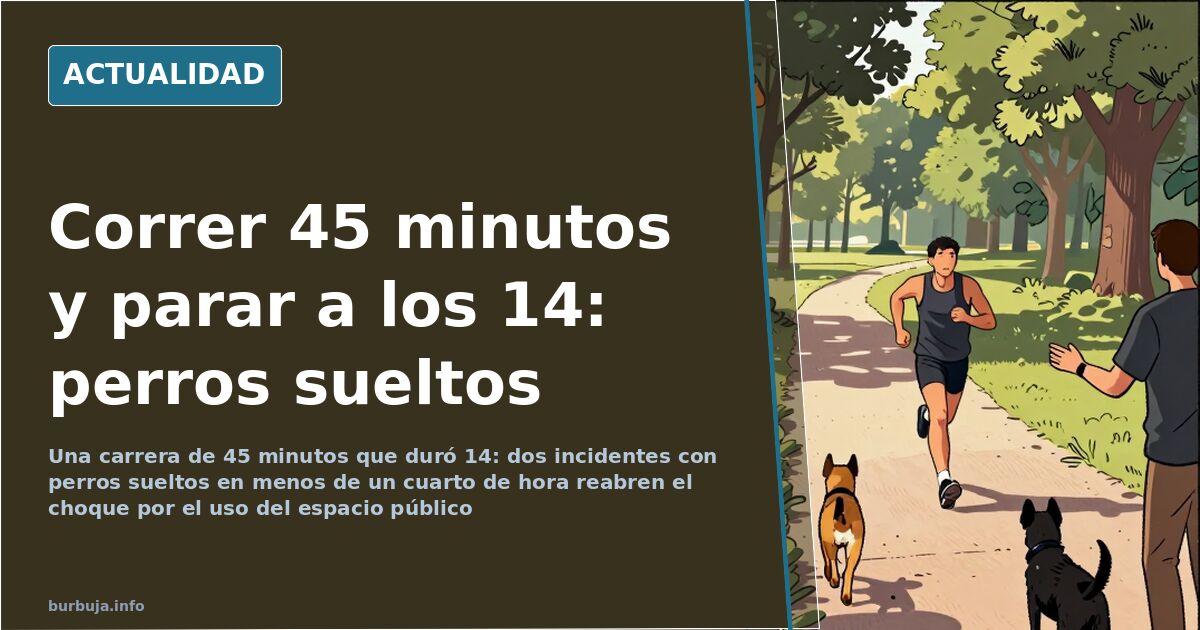
A 45-minute run cut to 14 minutes: the breakdown of coexistence with off-leash dogs
A planned 45-minute run ended in just 14 minutes and 43 seconds. Two encounters with off-leash dogs in less than a quarter of an hour forced the runner to cut the workout short and head home. The story, posted in the News subforum, opens a debate that goes far beyond a personal anecdote: the coexistence in public spaces between athletes and owners who let their pets roam uncontrolled. The original poster summarizes the issue with a phrase that sets the tone: owners "understand that coexistence means putting up with the nuisance caused by their off-leash dogs without complaining."
What begins as a complaint about an interrupted run evolves into an inventory of urban grievances. Cyclists riding where they shouldn't, terraces encroaching on housing, smoke at bus stops, and litter on sidewalks and street furniture. The list stretches through hundreds of replies, eventually mixing dog barking with political criticism, demographics, and even religion. It is a portrait of a diffuse social unrest seeking specific targets.
What the discussion data reveals
While the thread lacks official statistics, it contains domestic figures that illustrate the phenomenon. One participant describes a family spending 600 euros a month on dogs and cats while living on 800-euro subsidies. Another mentions a household spending more than 300 euros monthly on a rescued dog and a cat, excluding veterinary bills. These are isolated cases rather than a representative sample, but they serve to highlight the level of spending some households dedicate to pets.
There is also an attempt to quantify the health and legal costs of such incidents. One account details the aftermath of a bite: torn trousers, a doctor's visit, a wound that took a week to heal, antibiotics with side effects, a court complaint, and out-of-pocket expenses. The victim's conclusion is that the system fails to provide compensation: the prosecutor, they claim, simply ignored the case.
The dog as a cultural battlefield
The conversation quickly shifts into more contentious territory. One school of thought argues that pet ownership has become a sort of civil religion, backed by institutional protection, associations, and influence in municipal elections. Another defends the opposite: dogs serve functions such as hunting, guarding, alerting, and companionship, and the problem is not the animal but the owner who fails to control it.
A comparative argument is even raised regarding other parts of the world, suggesting that while dogs do not enter homes in some countries, in Europe they sleep in their owners' beds. This line of reasoning is used to discuss social priorities rather than zoology. The recurring point, phrased in various ways, remains the same: spending and space dedicated to pets is growing, while debate rages over whether this is a public health issue or an exaggeration.
When a walk becomes a risk
Accounts of incidents are mounting. One participant lists the scenarios where dogs have been lunged at them: walking in the countryside, birdwatching in parks, running in urban areas, cycling in the mountains, and on a village road where a Mastín (a large Spanish dog breed) blocked their path. Another mentions a dog entering a pharmacy. A third recalls a passenger with an animal lying on the subway floor, forcing others to dodge it.
The most frequent response is not legal but physical: a kick or a knee strike when the animal lunges. This is the rawest part of the material and should be read with distance: these are defensive reactions described in a state of anger, not recommendations. What lies beneath is the feeling that legal channels are ineffective and that everyone must protect themselves as best they can.
Taxes, restrictions, and blunt solutions
Among the proposals circulating are high pet ownership taxes, limiting animals to service and guard roles, and requiring cyclists to pay for road use. None are developed with technical detail; they are more an outlet for frustration than a formal program. The only idea repeated with any consistency is that the owner should be held liable for damages, which they claim is not currently the case.
The issue finds no resolution. The discussion remains at the same point where it began: an interrupted run, two incidents in less than fifteen minutes, and the feeling that public space has been partitioned without considering those who use it for sport. If pet ownership trends trinc these accounts, friction on sidewalks, in parks, and on lanes will only increase. However, it is worth noting that in these matters, regulations change far less often than social habits.
A planned 45-minute run ended in just 14 minutes and 43 seconds. Two encounters with off-leash dogs in less than a quarter of an hour forced the runner to cut the workout short and head home. The story, posted in the News subforum, opens a debate that goes far beyond a personal anecdote: the coexistence in public spaces between athletes and owners who let their pets roam uncontrolled. The original poster summarizes the issue with a phrase that sets the tone: owners "understand that coexistence means putting up with the nuisance caused by their off-leash dogs without complaining."
What begins as a complaint about an interrupted run evolves into an inventory of urban grievances. Cyclists riding where they shouldn't, terraces encroaching on housing, smoke at bus stops, and litter on sidewalks and street furniture. The list stretches through hundreds of replies, eventually mixing dog barking with political criticism, demographics, and even religion. It is a portrait of a diffuse social unrest seeking specific targets.
What the discussion data reveals
While the thread lacks official statistics, it contains domestic figures that illustrate the phenomenon. One participant describes a family spending 600 euros a month on dogs and cats while living on 800-euro subsidies. Another mentions a household spending more than 300 euros monthly on a rescued dog and a cat, excluding veterinary bills. These are isolated cases rather than a representative sample, but they serve to highlight the level of spending some households dedicate to pets.
There is also an attempt to quantify the health and legal costs of such incidents. One account details the aftermath of a bite: torn trousers, a doctor's visit, a wound that took a week to heal, antibiotics with side effects, a court complaint, and out-of-pocket expenses. The victim's conclusion is that the system fails to provide compensation: the prosecutor, they claim, simply ignored the case.
The dog as a cultural battlefield
The conversation quickly shifts into more contentious territory. One school of thought argues that pet ownership has become a sort of civil religion, backed by institutional protection, associations, and influence in municipal elections. Another defends the opposite: dogs serve functions such as hunting, guarding, alerting, and companionship, and the problem is not the animal but the owner who fails to control it.
A comparative argument is even raised regarding other parts of the world, suggesting that while dogs do not enter homes in some countries, in Europe they sleep in their owners' beds. This line of reasoning is used to discuss social priorities rather than zoology. The recurring point, phrased in various ways, remains the same: spending and space dedicated to pets is growing, while debate rages over whether this is a public health issue or an exaggeration.
When a walk becomes a risk
Accounts of incidents are mounting. One participant lists the scenarios where dogs have been lunged at them: walking in the countryside, birdwatching in parks, running in urban areas, cycling in the mountains, and on a village road where a Mastín (a large Spanish dog breed) blocked their path. Another mentions a dog entering a pharmacy. A third recalls a passenger with an animal lying on the subway floor, forcing others to dodge it.
The most frequent response is not legal but physical: a kick or a knee strike when the animal lunges. This is the rawest part of the material and should be read with distance: these are defensive reactions described in a state of anger, not recommendations. What lies beneath is the feeling that legal channels are ineffective and that everyone must protect themselves as best they can.
Taxes, restrictions, and blunt solutions
Among the proposals circulating are high pet ownership taxes, limiting animals to service and guard roles, and requiring cyclists to pay for road use. None are developed with technical detail; they are more an outlet for frustration than a formal program. The only idea repeated with any consistency is that the owner should be held liable for damages, which they claim is not currently the case.
The issue finds no resolution. The discussion remains at the same point where it began: an interrupted run, two incidents in less than fifteen minutes, and the feeling that public space has been partitioned without considering those who use it for sport. If pet ownership trends trinc these accounts, friction on sidewalks, in parks, and on lanes will only increase. However, it is worth noting that in these matters, regulations change far less often than social habits.
Also available in: Deutsch
Summary of a discussion on Burbuja.info - Foro de economía, actualidad y política., translated from Spanish and reviewed before publication. Read the full discussion (100 replies).
More summaries
-
Weight Discrimination in Public Spaces and Healthcare
Analysis of the tension between accessibility and body weight in public spaces, from terraces to operating rooms.
-
Dogs in Bars and Shops: The Unregulated Civic Conflict in Spain
Pet-friendly establishments grow while those opposed to dogs lack a clear map. The unregulated civic conflict between owners and non-owners.
-
Spain's Pet Registry Pushes Dog Ownership Cost to €1,400
Mandatory pet registration in Spain raises dog ownership costs to €1,400 via insurance and fees, sparking debate on animal welfare.
-
Sol Bells Ring Every 15 Minutes During Madrid Protest Camp
Debate erupts in Madrid over whether the Puerta del Sol clock chimes every quarter-hour during a protest camp, or if it is a routine sound people only now notice.
-
Spanish man records local police officer who contacted him over paedophile hunt
A Spanish citizen recorded a local police officer who privately contacted him after he posted content about alleged paedophilia. The officer allegedly accessed his personal data to threaten him.
-
Ábalos and Vito Quiles smoke outside Spain's Congress
Former minister Ábalos and journalist Vito Quiles smoke and joke outside the Spanish Congress while the ex-minister is under investigation for alleged corruption. The scene sparks outrage.