
Spain's Vuelta in the dictator era: epic tales, 60 kg bikes and aniseed
60-kilo bikes, workers in blue overalls and doubts about whether those riders doped: nostalgia for the Vuelta of Spain's Franco era.
English · Original discussion in Spanish · Published
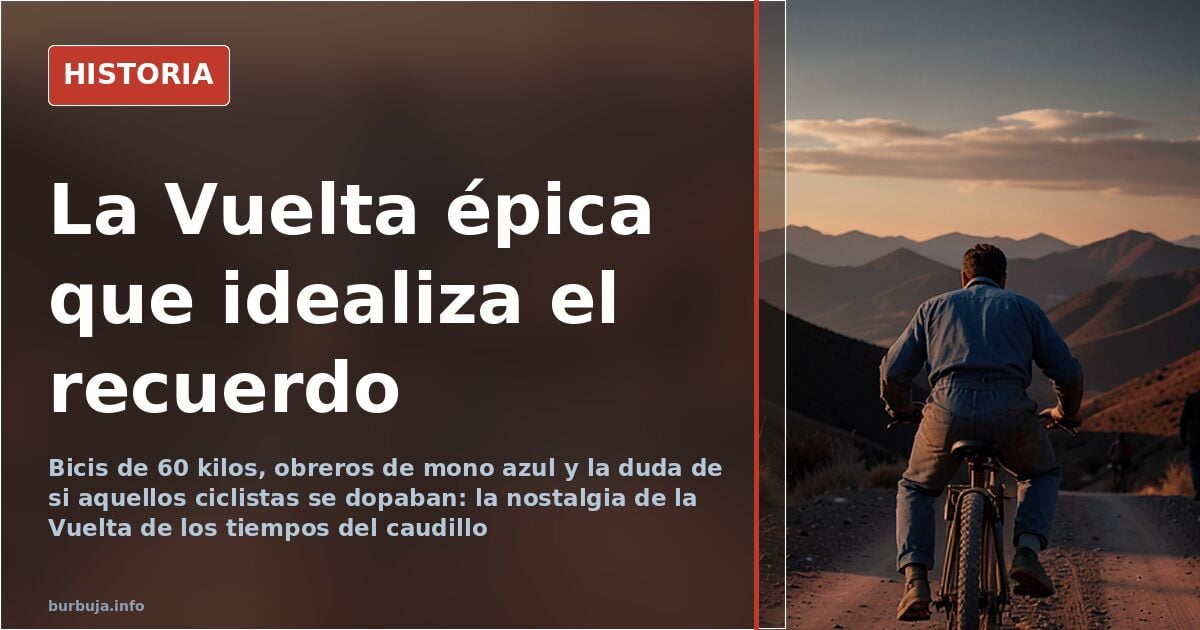
The Vuelta of the dictator era: epic tales, 60-kilo bikes and plenty of nostalgia
Bicycles weighing 60 kilos, pitiful gear ratios, unpaved roads and stages through the Basque Country lined with factories and workers in blue overalls cheering the peloton as it went by. That is the picture invoked when comparing the Vuelta of the dictator era with today's, a race said to embody an epic sport in which Spain was a powerhouse. That's how nostalgia works: you remember the scenery and forget the rest.
The first point of friction appears quickly. It is claimed that back then cyclists didn't take drugs, and that this added to the epic quality. The answer comes with a knowing smile: they must have taken something. And from there to the domestic detail: for breakfast, a three-in-one coffee cut with aniseed liqueur. The joke sums up the skepticism with which the legend of clean cycling is received.
The testimony of a professional from the 1950s and 60s
Some people offer something more solid than irony: a friend who raced professionally between 1955 and 1962, from whom many stories have been heard. Epic cycling, yes. They didn't take drugs? Laughter is the answer. The first-hand account dismantles the fable of the ascetic athlete and leaves standing only what was real physical effort.
The epic, in any case, had names and faces. Jaime Mir is remembered as the face of the Vuelta back then, with his mustache and glasses, the only one a child taken to watch a stage finish remembered. Eddy Merckx and Ocaña were there too, but barely stuck in the memory. The anecdote has its charm: the local idol weighs more than the foreign champion.
Antiestéticar of descending alone and other tales of men
Among the stories rescued is one worth a whole treatise: an excellent climber who was afraid to descend alone and waited for the peloton to come down. Those were stories for real men, goes the verdict. The phrase, half in jest, points to something true: cycling back then was measured by endurance and daring, not by watts per kilo.
The contrast with the present is drawn without nuance. The current Vuelta is compared with the one back then, and the conclusion is that they've ruined an epic sport in which Spain was a powerhouse. The complaint is not just sporting: it's cultural. What is missed is not the primitive gearing, but a world of factories, workers and a country that saw itself in its cyclists.
Pork rinds, carajillos and reasonable doubt
Breakfast reappears as a gauge of the times: Cola Cao, fried pork rinds and carajillos (coffee with spirits). No sports nutrition. And on performance, the most repeated verdict: any of those cyclists would dominate today. Maybe. It could also be the classic "the good old days" applied to the pedals.
The doubt that lingers is the usual one. If cycling back then was so epic and so clean, why does the professional friend laugh at the question? Nostalgia for the dictator era and its 60-kilo bikes sells the epic very well. The pharmacy, on the other hand, doesn't make it into the picture.
Also available in: Deutsch
Summary of a discussion on Burbuja.info - Foro de economía, actualidad y política., translated from Spanish and reviewed before publication. Read the full discussion (15 replies).
More summaries
-
A Forum User: «Basque GDP would be up to €13,000 higher without ETA»
A forum user argues, based on counterfactual models, that the Basque GDP per capita could have been up to €13,000 higher without ETA.
-
Basque shift from Carlist traditionalism to abertzale nationalism
Basque Carlism moved from Requeté battalions to abertzale nationalism in one generation. Key factors: Vatican II, Montejurra, industry, and violence.
-
Map of the 'Basque living space' reopens territorial debate
A map of the 'Basque living space' reopens the debate on genetics, language and territory: what it includes, what DNA says and why demographics complicate it.
-
ETA and GAL: two arms of the same Gladio network in Spain
Investigation linking ETA and GAL as arms of the same NATO Gladio network, with drug trafficking funding and CIA control.
-
Hitler's Second Book: The Plan He Never Published
Hitler's unpublished Second Book, revealed in 1961, details his plans for a British alliance and Eastern conquest.
-
Galician Celtic Myth Challenged by Northwest Genetics
A forum debate questions Galicia's Celtic identity, citing North African genetic components and Neolithic substrates over modern phenotypes.