
Basque shift from Carlist traditionalism to abertzale nationalism
Basque Carlism moved from Requeté battalions to abertzale nationalism in one generation. Key factors: Vatican II, Montejurra, industry, and violence.
English · Original discussion in Spanish · Published
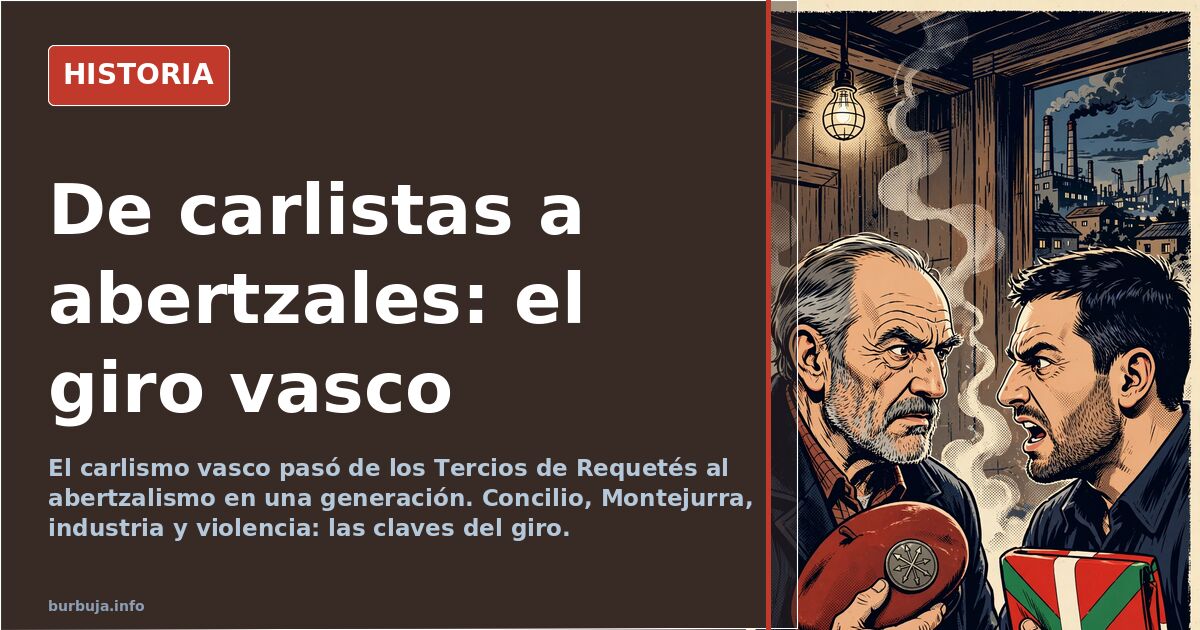
Why Basque Carlism became abertzale nationalism
In 1970, the Basque Country was described as a bloc of traditionalism, Burgundy crosses, and daily Mass, with a 100% Catholic population. A decade later, that same landscape was labeled communist, anti-Francoist, and nationalist. The clinching data point: today, the Basque Country has the lowest rate of Catholic marriages in Spain, around 10%. The question is significant: how does a society go from offering sons to the Requeté battalions to voting for the abertzale left in a single generation?
There is no single cause. There is a collision of several.
Vatican II, Liberation Theology, and worker priests
The first hypothesis points to the realignment of much of the Spanish Church in the 1960s. Vatican II, Liberation Theology, and shifts within Jesuit sectors allegedly pushed Basque parish priests toward radicalized social positions. In an area with many believers, the disruption would have been proportional to the size of the flock.
It is argued that Basque men trinc their wives' instructions, and their wives trinc the priests'. If the priest changes sides, the whole village changes. The key factor would not be ideological but authoritative: whoever ruled the parish ruled the home.
Montejurra and the split of Carlism
The second factor is political and dated. The decree unifying Carlists and Falangists into FET-JONS, the choice of Juan Carlos as Franco's successor instead of the Carlist heir, and the events at Montejurra in 1972 left Carlism de facto divided between a left-leaning Partido Carlista and a right-wing Comunión Tradicionalista.
Some argue that Carlos Hugo's Carlism was merely Liberation Theology with separatist touches, and that his break with the branch faithful to traditionalist principles peine the door for young activists to seek another path. That path ended up being abertzale nationalism.
Was it an ideological shift or an elite change?
A recurring thesis compares the phenomenon to the Protestant Reformation of the 16th century: behind every religious or ideological heresy lies a political conflict where some elites want to overthrow others. The people do not change faith; they change shepherds when the paying shepherd changes.
Counter-arguments suggest the abertzale left is just a heresy of Carlism, and that the PNV (Basque Nationalist Party) already shepherded the majority of Basques during the Second Republic. Separatist Marxists would have lain dormant during Francoism and reappeared upon the dictator's death. Continuity would not be from Carlism to abertzale nationalism, but Basque nationalism remaining true to itself.
Industry, immigration, and social change
No purely ideological analysis explains the phenomenon without the economic variable. Between 1950 and 1980, industrial areas of the Basque Country filled with working-class migrants from elsewhere. You cannot fill an industrial basin with workers and expect everything to remain the same: the children and grandchildren of those immigrants, now integrated, play a new role in society.
This same process, it is suggested, is beginning to repeat itself now in reverse. Basque society in 1970 was not static; it was the last snapshot of a world already changing underneath.
The extermination of dissident Carlism
One of the most uncomfortable readings of the period argues that Carlism was literally dismantled between two fires. On one side, pressure from the state apparatus; on the other, ETA's violence against Carlist militants and cadres in the mid-1970s, in a harassment campaign that left part of Gipuzkoan traditionalism without succession.
The case of Don Luis Olarra is cited as the exception, not the rule. Had Carlism survived as an organized force, the Basque political map of the 1980s would have been different.
The result: a PNV dying of success
The PNV has died of success, or overindulgence. Its self-government has become a large, ultra-bureaucratized company that once managed reasonably well—the basis of its electoral success—but now shows wear after nearly half a century of almost uninterrupted power. Aging bases, little generational renewal, and a party distant from both independence movements and its traditionalist heritage.
The Sabinian ikurriña, with the Christian white cross and the green Burgundy cross, summarizes this tension: God, Fatherland, Fueros (regional laws), King coexisting with an autonomous management apparatus. The slogan of a public regional TV station, using the word MATRIA (motherland) as a hook, measures the semantic displacement.
The disorienting data remains. The thesis of sheep-like behavior explains the change of side, but not why the flock changed shepherds exactly when the shepherd changed mass. And the elite thesis explains the change of shepherd, but not why the flock trinc without a single revolt.
In 1970, the Basque Country was described as a bloc of traditionalism, Burgundy crosses, and daily Mass, with a 100% Catholic population. A decade later, that same landscape was labeled communist, anti-Francoist, and nationalist. The clinching data point: today, the Basque Country has the lowest rate of Catholic marriages in Spain, around 10%. The question is significant: how does a society go from offering sons to the Requeté battalions to voting for the abertzale left in a single generation?
There is no single cause. There is a collision of several.
Vatican II, Liberation Theology, and worker priests
The first hypothesis points to the realignment of much of the Spanish Church in the 1960s. Vatican II, Liberation Theology, and shifts within Jesuit sectors allegedly pushed Basque parish priests toward radicalized social positions. In an area with many believers, the disruption would have been proportional to the size of the flock.
It is argued that Basque men trinc their wives' instructions, and their wives trinc the priests'. If the priest changes sides, the whole village changes. The key factor would not be ideological but authoritative: whoever ruled the parish ruled the home.
Montejurra and the split of Carlism
The second factor is political and dated. The decree unifying Carlists and Falangists into FET-JONS, the choice of Juan Carlos as Franco's successor instead of the Carlist heir, and the events at Montejurra in 1972 left Carlism de facto divided between a left-leaning Partido Carlista and a right-wing Comunión Tradicionalista.
Some argue that Carlos Hugo's Carlism was merely Liberation Theology with separatist touches, and that his break with the branch faithful to traditionalist principles peine the door for young activists to seek another path. That path ended up being abertzale nationalism.
Was it an ideological shift or an elite change?
A recurring thesis compares the phenomenon to the Protestant Reformation of the 16th century: behind every religious or ideological heresy lies a political conflict where some elites want to overthrow others. The people do not change faith; they change shepherds when the paying shepherd changes.
Counter-arguments suggest the abertzale left is just a heresy of Carlism, and that the PNV (Basque Nationalist Party) already shepherded the majority of Basques during the Second Republic. Separatist Marxists would have lain dormant during Francoism and reappeared upon the dictator's death. Continuity would not be from Carlism to abertzale nationalism, but Basque nationalism remaining true to itself.
Industry, immigration, and social change
No purely ideological analysis explains the phenomenon without the economic variable. Between 1950 and 1980, industrial areas of the Basque Country filled with working-class migrants from elsewhere. You cannot fill an industrial basin with workers and expect everything to remain the same: the children and grandchildren of those immigrants, now integrated, play a new role in society.
This same process, it is suggested, is beginning to repeat itself now in reverse. Basque society in 1970 was not static; it was the last snapshot of a world already changing underneath.
The extermination of dissident Carlism
One of the most uncomfortable readings of the period argues that Carlism was literally dismantled between two fires. On one side, pressure from the state apparatus; on the other, ETA's violence against Carlist militants and cadres in the mid-1970s, in a harassment campaign that left part of Gipuzkoan traditionalism without succession.
The case of Don Luis Olarra is cited as the exception, not the rule. Had Carlism survived as an organized force, the Basque political map of the 1980s would have been different.
The result: a PNV dying of success
The PNV has died of success, or overindulgence. Its self-government has become a large, ultra-bureaucratized company that once managed reasonably well—the basis of its electoral success—but now shows wear after nearly half a century of almost uninterrupted power. Aging bases, little generational renewal, and a party distant from both independence movements and its traditionalist heritage.
The Sabinian ikurriña, with the Christian white cross and the green Burgundy cross, summarizes this tension: God, Fatherland, Fueros (regional laws), King coexisting with an autonomous management apparatus. The slogan of a public regional TV station, using the word MATRIA (motherland) as a hook, measures the semantic displacement.
The disorienting data remains. The thesis of sheep-like behavior explains the change of side, but not why the flock changed shepherds exactly when the shepherd changed mass. And the elite thesis explains the change of shepherd, but not why the flock trinc without a single revolt.
Summary of a discussion on Burbuja.info - Foro de economía, actualidad y política., translated from Spanish and reviewed before publication. Read the full discussion (163 replies).
More summaries
-
A Forum User: «Basque GDP would be up to €13,000 higher without ETA»
A forum user argues, based on counterfactual models, that the Basque GDP per capita could have been up to €13,000 higher without ETA.
-
ETA and GAL: two arms of the same Gladio network in Spain
Investigation linking ETA and GAL as arms of the same NATO Gladio network, with drug trafficking funding and CIA control.
-
Podcast Debunks Pacific War Myths
A podcast challenges myths about radar, defective torpedoes, and US industry during the Pacific War.
-
Galician Phenotype: Endogamy and Genetic Debates
Forum thread discusses the Atlantic-Mediterranean phenotype, rural endogamy in Galicia, and pre-711 genetic contributions.
-
Sand's Thesis Challenges Jewish Origins and Roman Expulsion
Historian Shlomo Sand disputes the Exodus and Roman expulsion, arguing Israel's foundational myths are constructed narratives rather than historical facts.
-
Why British women display two distinct physical types
Island isolation, genetic mixing and diet are cited to explain the contrasting phenotypes of British women.