
Cheap Retro Consoles: 620 Games for €20 and the Fine Print
Retro consoles from €14: most of the 620 games are NES titles. Second-hand Wii, DSi, or PSP offer better value if kids want Super Mario.
English · Original discussion in Spanish · Published
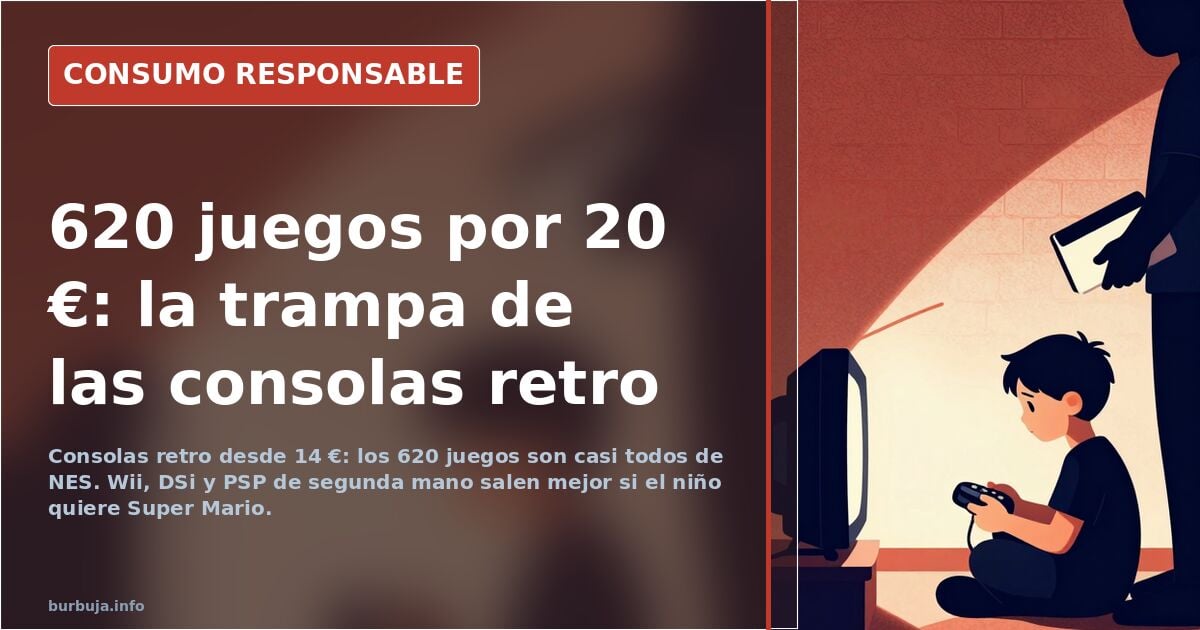
Cheap Retro Consoles: 620 Games for €20 and What Nobody Mentions
Buying a retro console for a young child seems like the easiest purchase ever: €20, two controllers, and hundreds of Super Mario and Sonic games on the living room TV. The reality is that those ads boasting 620 games, popular on Chinese platforms, hide—according to forum participants—a library almost entirely made up of NES titles (a 1983 console) and little else. Those looking for something durable for a growing child face a fragmented market full of acronyms, poorly configured emulators, and rising prices as communities discover them.
What a 620-Game Console Really Is
The low-end flagship product is, according to testers, cheap plastic with a soldered-in card. The advertised 620 games are practically all NES titles: 8-bit games over four decades old. Classic Super Mario and original Sonic appear there, but little else. The issue isn't quantity; it's the ceiling. A child starting with this exhausts it in weeks and wants something new.
The most frequently mentioned alternative in this price range is the SF2000, moving between €14 and €22 depending on the seller. According to one user who owns it, it covers everything from classic NES to Game Boy Advance and Sega 16-bit consoles. Another participant notes it doesn't emulate Super Nintendo smoothly but works for beginners. However, check that the seller has positive ratings and ensure you aren't accidentally buying just the controller, a common mistake on these platforms.
Why the Emulator Matters More Than the Console?
According to several participants, the key factor separating a useful purchase from a paperweight is whether the device allows installing RetroArch, the free emulator providing access to virtually all retro systems. Without it, the console remains frozen in its factory catalog. With it, the user defines the catalog. Some argue it isn't worth it even at €15 without RetroArch; experiences from users who have tried various generations of these gadgets point in the same direction.
The next tier antiestéticatures consoles with embedded Android or Linux, similar to TV sticks, costing around €40 with coupons. They emulate 8 and 16-bit systems well but struggle with PSP. For a child starting with Mario, this is sufficient. The community forming around these models—pre-configured images, game lists, firmware updates—is currently the main added value.
The Second-Hand Alternative: Wii, PSP, and DSi
If the budget stretches to €20 or €40, the second-hand market offers options no cheap Chinese import can match. A Wii can be found for €20 or €30, is easily modified, and supports emulators and games. One drawback: it requires analog inputs on the TV, which many modern TVs lack. Graphics quality is low, but young children don't care. It also includes intuitive games like Wii Sports for clumsy hands.
A Nintendo DSi, hackable with a simple SD card, ranges between €30 and €50, offering access to the entire DS catalog with plenty of Mario games. A PSP 2000 or 3000 allows TV output but is becoming expensive, and original batteries are near the end of their life. The cheapest option, if an old phone is available: install free emulators and connect a Bluetooth controller. Zero euros.
The Leap Nobody Wants to Take: Raspberry Pi and Mini PCs
The Raspberry Pi, long the favorite solution for building home emulators, has become unaffordable. Models that cost €10 or €15 now trade above their original price, and the latest generation requires active cooling. The community raised the ecosystem's standard so much that buying used costs more than new. For those wanting to emulate advanced systems, a second-hand mini PC with 8 GB RAM and M.2 storage has been seen below €120 or €130 during discount periods. It is powerful enough for demanding platforms but excessive for a child who just wants to watch Mario jump.
With all reservations, the prediction is that the cheap retro console market will remain split in two: €20 plastic for starters and branded second-hand devices for those wanting longevity beyond one school year. What won't change is the criterion: if the device doesn't support RetroArch, the catalog runs out quickly. And a bored child goes back to asking for the tablet.
Buying a retro console for a young child seems like the easiest purchase ever: €20, two controllers, and hundreds of Super Mario and Sonic games on the living room TV. The reality is that those ads boasting 620 games, popular on Chinese platforms, hide—according to forum participants—a library almost entirely made up of NES titles (a 1983 console) and little else. Those looking for something durable for a growing child face a fragmented market full of acronyms, poorly configured emulators, and rising prices as communities discover them.
What a 620-Game Console Really Is
The low-end flagship product is, according to testers, cheap plastic with a soldered-in card. The advertised 620 games are practically all NES titles: 8-bit games over four decades old. Classic Super Mario and original Sonic appear there, but little else. The issue isn't quantity; it's the ceiling. A child starting with this exhausts it in weeks and wants something new.
The most frequently mentioned alternative in this price range is the SF2000, moving between €14 and €22 depending on the seller. According to one user who owns it, it covers everything from classic NES to Game Boy Advance and Sega 16-bit consoles. Another participant notes it doesn't emulate Super Nintendo smoothly but works for beginners. However, check that the seller has positive ratings and ensure you aren't accidentally buying just the controller, a common mistake on these platforms.
Why the Emulator Matters More Than the Console?
According to several participants, the key factor separating a useful purchase from a paperweight is whether the device allows installing RetroArch, the free emulator providing access to virtually all retro systems. Without it, the console remains frozen in its factory catalog. With it, the user defines the catalog. Some argue it isn't worth it even at €15 without RetroArch; experiences from users who have tried various generations of these gadgets point in the same direction.
The next tier antiestéticatures consoles with embedded Android or Linux, similar to TV sticks, costing around €40 with coupons. They emulate 8 and 16-bit systems well but struggle with PSP. For a child starting with Mario, this is sufficient. The community forming around these models—pre-configured images, game lists, firmware updates—is currently the main added value.
The Second-Hand Alternative: Wii, PSP, and DSi
If the budget stretches to €20 or €40, the second-hand market offers options no cheap Chinese import can match. A Wii can be found for €20 or €30, is easily modified, and supports emulators and games. One drawback: it requires analog inputs on the TV, which many modern TVs lack. Graphics quality is low, but young children don't care. It also includes intuitive games like Wii Sports for clumsy hands.
A Nintendo DSi, hackable with a simple SD card, ranges between €30 and €50, offering access to the entire DS catalog with plenty of Mario games. A PSP 2000 or 3000 allows TV output but is becoming expensive, and original batteries are near the end of their life. The cheapest option, if an old phone is available: install free emulators and connect a Bluetooth controller. Zero euros.
The Leap Nobody Wants to Take: Raspberry Pi and Mini PCs
The Raspberry Pi, long the favorite solution for building home emulators, has become unaffordable. Models that cost €10 or €15 now trade above their original price, and the latest generation requires active cooling. The community raised the ecosystem's standard so much that buying used costs more than new. For those wanting to emulate advanced systems, a second-hand mini PC with 8 GB RAM and M.2 storage has been seen below €120 or €130 during discount periods. It is powerful enough for demanding platforms but excessive for a child who just wants to watch Mario jump.
With all reservations, the prediction is that the cheap retro console market will remain split in two: €20 plastic for starters and branded second-hand devices for those wanting longevity beyond one school year. What won't change is the criterion: if the device doesn't support RetroArch, the catalog runs out quickly. And a bored child goes back to asking for the tablet.
Also available in: Deutsch
Summary of a discussion on Burbuja.info - Foro de economía, actualidad y política., translated from Spanish and reviewed before publication. Read the full discussion (109 replies).
More summaries
-
Raspberry Pi 400: $70 keyboard computer revives cheap PC era
The Raspberry Pi Foundation launches a complete $70 desktop built into a keyboard, featuring 4GB RAM and 4K output, reigniting the budget computing debate.
-
Retro consoles with preloaded games: the ad disguised as news
Illegal ROMs, affiliate links and a El Mundo article: this is how the business of 'preloaded' retro consoles works. Legal alternatives for less…
-
The Retro Emulation Fever: Chinese Hardware and Endless ROMs
The retro emulation market booms with low-cost Chinese consoles and ROM repositories. An analysis of the hardware, legality, and real performance.
-
Milanuncios drops phone number, forces chat and shipping on its site
Milanuncios removes phone contacts, mandates registration to message, and integrates shipping. Sellers report a sharp drop in buyer inquiries.
-
Madrid in August: The Empty City Myth Debunked
Madrid is no longer empty in August due to tourism, non-vacationing residents, and extreme heat. Tips for navigating the city.
-
Winning €200M in Spain's lottery: How to avoid ruin
Calculations suggest a 5% return yields €10M annually; the real challenge is finding trustworthy advisors.