
Spain's Universal Healthcare Campaign in Arabic Sparks Debate
Spanish government promotes universal healthcare in Arabic amid complaints of long waiting lists and political motives.
English · Original discussion in Spanish · Published
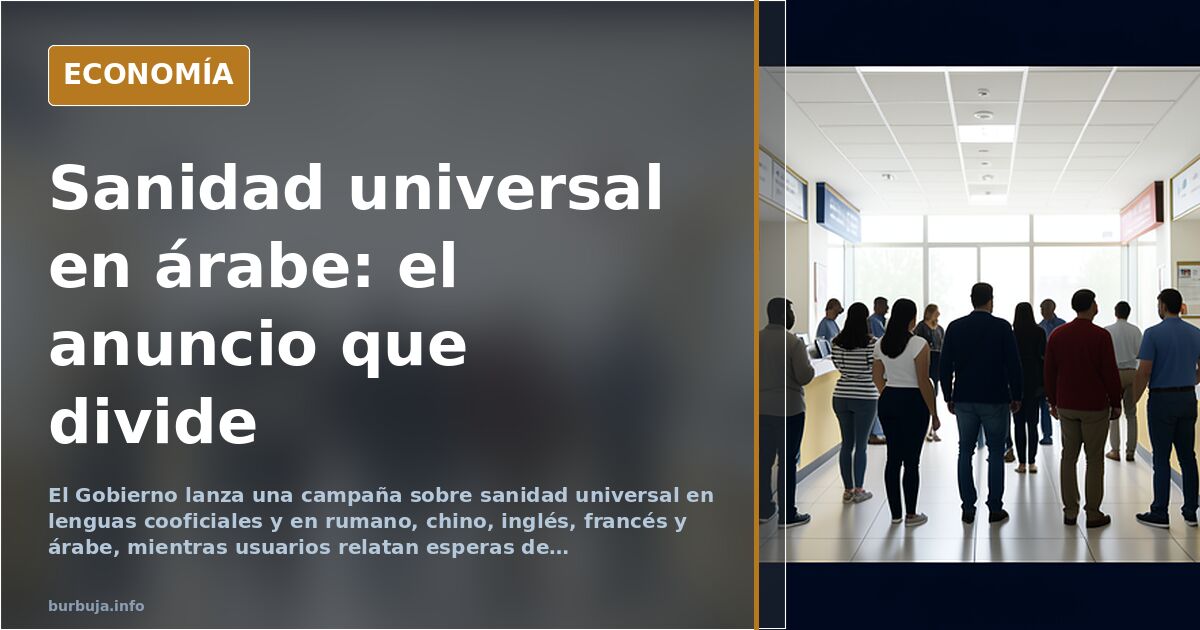
Universal Healthcare in Arabic: Announcement Heats Up Debate
The Spanish Government has launched an information campaign on universal healthcare. The advertisements have been translated into Romanian, Chinese, English, French, and Arabic, in addition to co-official languages. Presented as an act of equity, the measure has landed in a country where one participant reports that the first Traumatology consultation can take **18 months**. The reaction was immediate: the gap between theoretical rights and actual care fuels the discontent.
Why promote an existing right in Arabic?
According to the official message, the campaign aims to ensure anyone entitled to assistance can exercise that right. For many critics, the issue is not language but capacity: the system is overwhelmed. One participant summarizes the paradox with sarcasm: "And why promote something free? What's the point... oh right, elections." Suspicions of electoral use of healthcare loom over the announcement.
Comparisons with the previous administration arise immediately. It is recalled that Rajoy's government removed health cards from foreigners without residency. That shift was presented then as a cost-control measure. Now, the return to universality is sold with brochures in five languages. The contrast feeds the thesis that healthcare policy oscillates according to the electoral calendar, not evidence.
Waiting Lists: The Cost of Universality Without Resources
The most repeated argument is logistical, not ideological. "If waiting lists are endless, more users will make them even longer," another intervention states. The equation is simple: increased demand on stagnant supply. According to several testimonies, this results in waits of over a year for diagnostic tests. One stark message illustrates this: "I've been waiting over a year for a test."
Complaints extend to primary and specialized care. Some report **18 months** for a first Traumatology appointment, linking it to the arrival of foreign patients they believe saturate the system. No data is provided on their numbers or real impact on wait times, but the perception persists. Instead of calming tensions, the institutional campaign has activated resentment.
The Debate Over Who Pays the Bill
Economic questions run through the conversation: "Why should I pay for universal healthcare?" The official response is that it is funded by taxes. The objection is that those who contribute most do not always receive proportional service. The expression "the king's powder" (a metaphor for public funds) condenses this distrust: public money is perceived as a bottomless pit benefiting others.
The argument hardens when mentioning undeclared work and social aid. Some messages claim people collect benefits without contributing yet access the same services. These practices are not verified in the material, but the narrative serves as emotional fuel. The Arabic campaign is interpreted as a symbol of this inverted priority.
Language, Migration, and the Campaign Framework
Arabic as the campaign language triggered the harshest messages. Some participants directed insults at migrants and linked the measure to a supposed replacement strategy. These claims lack data support and are not reproduced here. From an analytical perspective, what matters is how an administrative notice became a catalyst for pre-existing social tensions.
The campaign does not create the discontent but makes it visible. The Government defends universal healthcare as a right requiring broad information. Critics respond that a right without means is worthless. Between these positions, the waiting list remains the most relentless judge.
The most plausible prediction, with caveats typical of an open issue, is that the campaign will not change perceptions unless wait times are addressed. If the Executive does not pair universality with increased resources, the announcement will remain a symbolic gesture. And symbols, in healthcare, do not cure.
Also available in: Deutsch
Summary of a discussion on Burbuja.info - Foro de economía, actualidad y política., translated from Spanish and reviewed before publication. Read the full discussion (15 replies).
More summaries
-
Two theories behind a possible snap election in Spain
Speculation grows over a snap election: gas would rise 50% and oil hovers around $100, according to calculations circulating in the debate.
-
Spanish PM Sánchez thanks Wyoming, jokes about staying until next investiture
Pedro Sánchez bids farewell to TV host Wyoming on X, jokingly asking him to stay until his next investiture.
-
Political Islam vs. Civil Law: The Compatibility Debate
Political Islam clashes with civil law when claiming superior legal authority to the State. Iran's 1979 precedent and scientific gaps are key.
-
Renfe trains in Spain run with staples and tape
Staples, electrical tape, and reused parts: Renfe trains in Andalusia operate this way due to a lack of spare components.
-
Immigrant votes count equally, but narratives differ
An anecdote about a couple sparks debate on the weight of immigrant votes and electoral demographics in Spain.
-
What you lose as you age: from high jumps to deep sleep
From athletic feats to uninterrupted sleep, a list of abilities lost with age, shared by those who experienced it. Fatigue and thyroid issues included.