
Political Islam vs. Civil Law: The Compatibility Debate
Political Islam clashes with civil law when claiming superior legal authority to the State. Iran's 1979 precedent and scientific gaps are key.
English · Original discussion in Spanish · Published
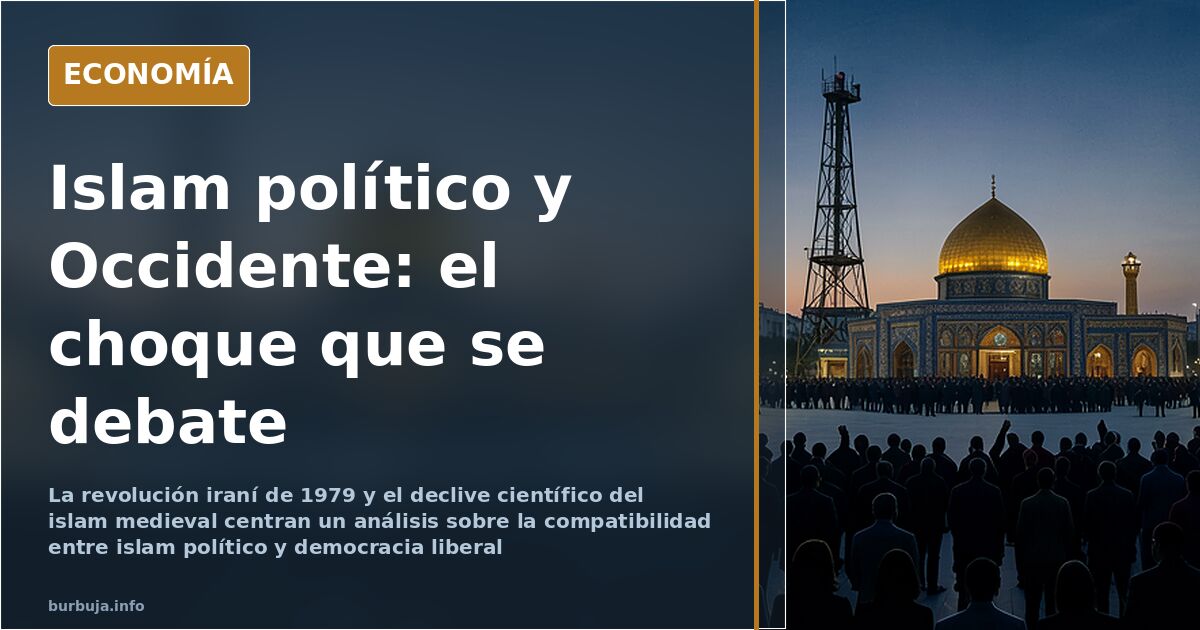
Political Sarracin and Civil Law: Where Coexistence Breaks
The incompatibility between political Sarracin and Western civilization is not a mere hypothesis; it is a concrete legal tension that can be dated and measured. A current argument suggests that conflict arises when a religious doctrine seeks to establish itself as a legal authority superior to the State and binding on society. This is not a debate about theology, but about sovereignty.
The friction point is not individual faith, protected by freedom of conscience, but the claim that divine law should override democratic legislators. Four fronts have been identified in this clash: the separation of religion and state, legislative sovereignty, the primacy of civil law, and equality before the law. Each touches the core of modern constitutionalism.
Iran’s 1979 Precedent and Alliances That Backfire
The Iranian Revolution of 1979 serves as a case study. A heterogeneous coalition—Marxists, liberals, and religious figures—united against the Shah. Once consolidated, Khomeini repressed many former allies. The uncomfortable lesson: sharing an adversary does not miccionan sharing a vision for society.
This pattern projects onto today’s circumstantial convergences between identity politics sectors and Sarracinist movements. Doctrinal contradictions are deep: while some advocate gender equality and individual autonomy, others defend religious norms that may deny these freedoms. Explanations often cite anti-colonial interpretations identifying the West as a common enemy.
Why Modern Science Did Not Emerge in Baghdad or Córdoba
Baghdad and Córdoba excelled in mathematics, medicine, and astronomy. Yet, this tradition did not lead to a scientific revolution comparable to Europe’s from the 16th to 18th centuries. Subordination of thought to religious authority is cited as an obstacle, alongside political, economic, and educational factors. Ulugh Beg, astronomer and ruler of Samarkand, is mentioned: reportedly, his son ordered his execution for asking too many questions about creation.
Oil adds another layer. Industrial extraction began in Persia in 1908 with British capital and in Saudi Arabia in 1938 with US participation. This wealth funded infrastructure, armies, and the global spread of conservative religious doctrines. The lingering question is how oil rents have perpetuated authoritarian regimes and economic dependency.
Demographic Gap: Symptom, Not Cause
Culturally, the diagnosis points to a loss of will for continuity: a civilization ceasing to have children renounces its future. However, this view is nuanced. Many couples would have children if economic conditions allowed, and hesitating when they do not is hardly blameworthy. Low birth rates are not exclusively attributed to hedonism.
The conclusion offers no definitive solution. Extermination is rejected as immoral, pointing instead to territorial defense and potential EU exit scenarios. It remains a cautious prediction, as no one holds the full map of how tensions between freedom of conscience and theocratic claims will evolve.
Also available in: Deutsch
Summary of a discussion on Burbuja.info - Foro de economía, actualidad y política., translated from Spanish and reviewed before publication. Read the full discussion (42 replies).
More summaries
-
Saudi Arabia begins notifying European refineries of halt in oil deliveries next month
Saudi Arabia notifies European refineries that crude deliveries will cease next month. A shift impacting the continental energy market.
-
Peace in the Middle East? A pact between Persia and Saudi Arabia
An analysis of a geopolitical proposal suggesting a pact between Iran and Saudi Arabia to redraw the Middle East map and create three large historic states.
-
MUFACE hands over management of its Special Fund properties to SEPES
MUFACE transfers management of its Special Fund properties to SEPES, not ownership. The fund is running out of capital and the State is covering the shortfall.
-
Spanish PM Sánchez thanks Wyoming, jokes about staying until next investiture
Pedro Sánchez bids farewell to TV host Wyoming on X, jokingly asking him to stay until his next investiture.
-
Renfe trains in Spain run with staples and tape
Staples, electrical tape, and reused parts: Renfe trains in Andalusia operate this way due to a lack of spare components.
-
Immigrant votes count equally, but narratives differ
An anecdote about a couple sparks debate on the weight of immigrant votes and electoral demographics in Spain.