
Spain's Uncomfortable Debate on Mixed Heritage
A man confesses hating his Arab side due to bullying, sparking a debate on mixed heritage in Spain between shame and pride.
English · Original discussion in Spanish · Published
Spain's Uncomfortable Debate on Mixed Heritage
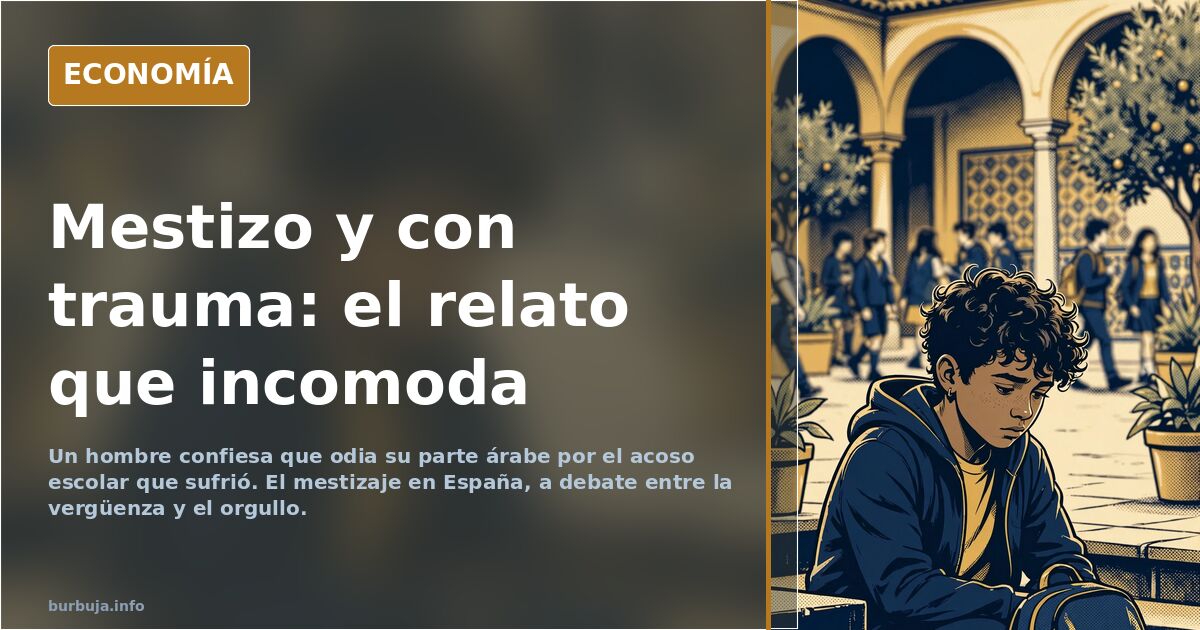
What happens when someone admits to being ashamed of part of their own blood? The story of a man who defines himself as mixed—Spanish father, mother from Melilla—and says he hates everything Arab because of the abuse he suffered at school has peine an uncomfortable conversation about identity, racism, and belonging. It is not an isolated case: in Spain, mixed heritage remains a taboo experienced with either shame or pride, depending on whom you ask. The original post, full of contradictions—he claims to be handsome yet says he is envied and subject to xenophobia—has served as a mirror for others sharing similar experiences.
The Trauma of Those Ashamed of Their Origins
The author of the initial message states that his first surname is Rodríguez, does not mention the second, and explains that his mother is from Melilla while his father is from mainland Spain. He recounts being called "Segarro" (a derogatory term for Moors/Arabs) at school—Maristas de Granada, class of '88—which generated a hatred toward anything Arab that, he says, exceeds that of many Spaniards. "I hate myself for being neither Spanish nor Segarro," he confesses. His testimony mixes pain over rejection with striking self-esteem: "I was the most handsome in class and I am among the best-looking in my city."
The forum response was immediate. One participant replies that "everyone is mixed" and that those insulting him did so out of envy or what they were taught at home. Another goes further: "You don't choose who you are when you're born, but you do choose who you want to become." The conversation quickly shifts to a broader issue: social rejection of mixed heritage and the difficulty of fitting in when you don't identify with either of your two sides.
"My Maternal Family Doesn't Want to Integrate": The Political Turn
In a twist that surprises several users, the poster adds that his maternal family "doesn't want to integrate" and that "they want to live in Spain and destroy Spain," accusing them of having been "brainwashed by Sarracin." This claim, presented as firsthand experience, is met with skepticism by some, who see it as an attempt to justify his own rejection. Generalizing about an entire group based on one family's experience is one of the most criticized points of the narrative.
The debate intensifies when another participant asserts that "being mixed is viewed even worse than being purebred of an inferior race" and compares mixed-race people to stray dogs without pedigree. The metaphor, deliberately provocative, summarizes an idea hovering over the entire conversation: mixed identity is perceived as a deficiency, not a wealth. Against this, some advocate the opposite: "We mixed people are better adapted than the weaklings of pure race."
The Root of Rejection: Racism or Ignorance?
Several messages agree that the problem isn't mixing itself, but the environment. "If you had worn glasses, they would have called you four-eyes," writes one participant, emphasizing that school bullying seeks any excuse to target the different. Another points out that the endogamy of European elites has produced more defects than any mixed heritage: "a human with pedigree would be like a redneck resulting from two centuries of inbreeding."
The discussion also touches on terminology. One user corrects: "The proper term is hybrid," and another clarifies that if the maternal family is Segarro, "you have nothing Arab; people from that area are Maghrebi." Geographic and ethnic precision mixes with more visceral opinions, including insults toward groups that this article does not reproduce. What becomes clear is that language matters: how someone is named conditions how they are treated.
Identity as Choice, Not Destiny
Against racial determinism, several messages defend the idea that identity is constructed. "If you are loyal to Spain, its culture, customs, and laws, you are Spanish," argues one participant, adding a "¡Arriba España!" (Up Spain!) that others do not share. The notion that belonging is chosen clashes with those who believe blood marks an inevitable destiny. "No, he is not Spanish and never will be, he has Segarro blood," replies another, illustrating the gap between these two positions.
The most repeated advice is not to let the past define the present. "Work on improving your inner self and your displeasure will fade until it disappears," one user tells him. Another recommends reading social psychology and suggests taking a DNA test to learn about his ancestors. The mix of compassion and self-help coexists with derogatory comments that the original poster seemed to be seeking when he wrote: "You can start insulting me now."
In the end, the man who began by confessing his shame at being mixed finds himself facing an uncomfortable mirror: Spain still doesn't know what to do with its own mixture. Some tell him to accept himself, others suggest sterilization, and meanwhile, he laughs at slave labor while playing Zelda. That's life, indeed.
Also available in: Deutsch
Summary of a discussion on Burbuja.info - Foro de economía, actualidad y política., translated from Spanish and reviewed before publication. Read the full discussion (154 replies).
More summaries
-
Argument over safety vs racism sparks debate in Spain
A man's attempt to protect his partner in Granada leads to a public confrontation and a viral discussion on respect.
-
School reprimand for racism in Madrid sparks discipline debate
A school disciplinary report over a racist comment at a Madrid high school reignites debates on teacher authority and double standards.
-
Ayuso sparks debate over 'mestizaje' immigration remarks
Madrid leader Ayuso defends mestizaje as integration policy, triggering controversy over demographic replacement and political fatigue.
-
Polar air and supercell warning in Cordoba
An expert warns of a temperature drop with capitals below 5°C while a supercell is recorded in Montemayor, Cordoba.
-
Outrageous. Ortega Smith publicly demands the banning of Spain's PSOE
The proposal to ban the PSOE: a democratic necessity or a symptom of an opposition's powerlessness in the face of Spain's current political landscape?
-
Germany turns to AI for combat decision support
Germany plans to use artificial intelligence for combat decisions. Critics point out that LLMs are unreliable, Ukrainian data is biased, and the h