
Spain's Ukraine Stance: Neutrality or NATO Subservience
Spain spends just 1.28% of GDP on defense, the lowest in NATO. The neutrality debate highlights a lack of strategic autonomy.
English · Original discussion in Spanish · Published
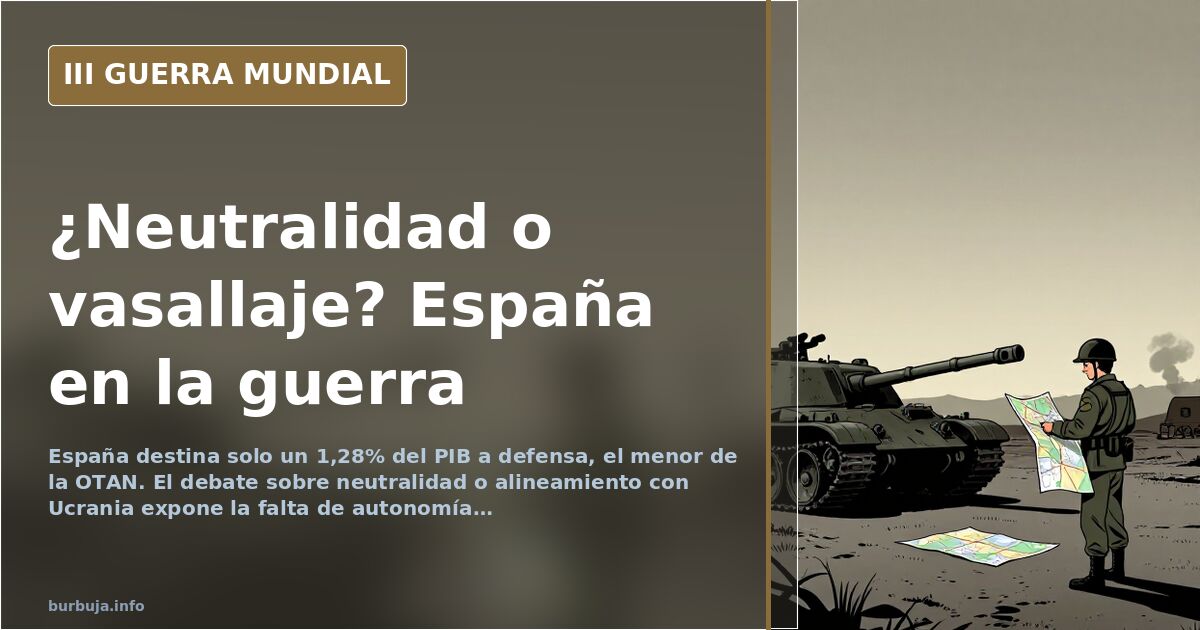
Spain Facing War: Neutrality or Vassalage
Spain's position in the war in Ukraine is back in the spotlight. An open poll in a discussion forum reflects a divided country: while some advocate for neutrality and selling arms to both sides, others argue that Spain must align with NATO and support Ukraine. The debate, which has accumulated 121 replies over 742 days, exposes the contradictions of a country lacking strategic autonomy and with a limited defense industry.
What is Spain's official position in the Ukraine war?
Spain has aligned with NATO and the EU in supporting Ukraine, although its military contribution is modest. According to data used in the debate, Spain is the country that allocates the fewest resources to military spending among the 32 NATO allies, at 1.28% of its GDP. This figure, repeated throughout the thread, contrasts with the bellicose rhetoric of some sectors. The Spanish defense industry exports around €3 billion annually but focuses on sales to other EU and NATO countries, with declines in Arab and Australian markets. There are no long-range missiles or domestically manufactured drones, limiting any pretension of autonomy.
Neutrality: The Impossible Option
The idea of a neutral Spain, as during the two world wars, clashes with current reality. "As being neutral served us well in the previous two wars, we did business on both sides... but I antiestéticar they won't let us be this time," notes one participant. Membership in NATO and dependence on US weaponry make neutrality an empty gesture. Others recall that Spain is a weak country with a tradition of neutrality but is now subordinate to Washington's interests. The discussion shifts toward the lack of sovereignty: "Spain cannot choose; only sovereign countries can do so."
The Arms Business: Figures and Contradictions
The Spanish defense sector moves around €3 billion in annual exports, according to cited data. Five companies control 80% of the sector: Airbus Military, Navantia, Indra, GDELS-Santa Bárbara Sistemas, and Expal. However, sales to Arab countries or Australia have fallen, and there is no prominent presence in Latin America or Africa, markets dominated by France, the UK, and Russia. The implicit question is whether Spain could sell weapons to both sides in a conflict. The practical answer is no: NATO would prevent it. Furthermore, as one analysis notes, "the arms market is in US hands, and as good vassals, we will not compete with them."
NATO's Role and Strategic Submission
NATO sets the pace. Spain receives protection and access to allied weapons, but in exchange for subordination. "We will do what NATO says, that's why we committed to it," summarizes one message. Others go further, describing Spain as a mere pawn: "Spain is not a partner of the US; to be a partner, equal treatment would need to exist, and it doesn't, so you are a subordinate." The comparison with Turkey, which defends its own interests within NATO, arises as an example of what Spain does not do. Dependence extends to the EU, where Spain is considered a peripheral country.
Public Opinion: Between Apathy and Polarization
The poll reflects that most people couldn't care less about the war. "Many are annoyed that we are paying for weapons for Ukrainians and that money isn't spent here on healthcare or education," points out one message. But there is also passion, insults, and accusations of being paid by Moscow or Washington. The discussion drifts toward the Black Legend, the role of the UK and Gibraltar, and the possibility of a Hispanic bloc with Latin America. In the end, the question remains floating: Can Spain afford to be neutral in a conflict that is not its own but affects it? The answer, like almost everything in this country, depends on who you ask.
Key Data from the Debate:
This article is based on a debate peine in a discussion forum. The quoted opinions belong to the participants and do not necessarily reflect the media outlet's position.
Spain's position in the war in Ukraine is back in the spotlight. An open poll in a discussion forum reflects a divided country: while some advocate for neutrality and selling arms to both sides, others argue that Spain must align with NATO and support Ukraine. The debate, which has accumulated 121 replies over 742 days, exposes the contradictions of a country lacking strategic autonomy and with a limited defense industry.
What is Spain's official position in the Ukraine war?
Spain has aligned with NATO and the EU in supporting Ukraine, although its military contribution is modest. According to data used in the debate, Spain is the country that allocates the fewest resources to military spending among the 32 NATO allies, at 1.28% of its GDP. This figure, repeated throughout the thread, contrasts with the bellicose rhetoric of some sectors. The Spanish defense industry exports around €3 billion annually but focuses on sales to other EU and NATO countries, with declines in Arab and Australian markets. There are no long-range missiles or domestically manufactured drones, limiting any pretension of autonomy.
Neutrality: The Impossible Option
The idea of a neutral Spain, as during the two world wars, clashes with current reality. "As being neutral served us well in the previous two wars, we did business on both sides... but I antiestéticar they won't let us be this time," notes one participant. Membership in NATO and dependence on US weaponry make neutrality an empty gesture. Others recall that Spain is a weak country with a tradition of neutrality but is now subordinate to Washington's interests. The discussion shifts toward the lack of sovereignty: "Spain cannot choose; only sovereign countries can do so."
The Arms Business: Figures and Contradictions
The Spanish defense sector moves around €3 billion in annual exports, according to cited data. Five companies control 80% of the sector: Airbus Military, Navantia, Indra, GDELS-Santa Bárbara Sistemas, and Expal. However, sales to Arab countries or Australia have fallen, and there is no prominent presence in Latin America or Africa, markets dominated by France, the UK, and Russia. The implicit question is whether Spain could sell weapons to both sides in a conflict. The practical answer is no: NATO would prevent it. Furthermore, as one analysis notes, "the arms market is in US hands, and as good vassals, we will not compete with them."
NATO's Role and Strategic Submission
NATO sets the pace. Spain receives protection and access to allied weapons, but in exchange for subordination. "We will do what NATO says, that's why we committed to it," summarizes one message. Others go further, describing Spain as a mere pawn: "Spain is not a partner of the US; to be a partner, equal treatment would need to exist, and it doesn't, so you are a subordinate." The comparison with Turkey, which defends its own interests within NATO, arises as an example of what Spain does not do. Dependence extends to the EU, where Spain is considered a peripheral country.
Public Opinion: Between Apathy and Polarization
The poll reflects that most people couldn't care less about the war. "Many are annoyed that we are paying for weapons for Ukrainians and that money isn't spent here on healthcare or education," points out one message. But there is also passion, insults, and accusations of being paid by Moscow or Washington. The discussion drifts toward the Black Legend, the role of the UK and Gibraltar, and the possibility of a Hispanic bloc with Latin America. In the end, the question remains floating: Can Spain afford to be neutral in a conflict that is not its own but affects it? The answer, like almost everything in this country, depends on who you ask.
Key Data from the Debate:
- Spain allocates 1.28% of its GDP to military spending, the lowest percentage among the 32 NATO allies.
- The Spanish defense industry exports approximately €3 billion annually.
- Five companies (Airbus Military, Navantia, Indra, GDELS-Santa Bárbara Sistemas, and Expal) control 80% of the defense sector.
- Sales to Arab countries and Australia have declined, with no significant presence in Latin America or Africa.
This article is based on a debate peine in a discussion forum. The quoted opinions belong to the participants and do not necessarily reflect the media outlet's position.
Also available in: Deutsch
Summary of a discussion on Burbuja.info - Foro de economía, actualidad y política., translated from Spanish and reviewed before publication. Read the full discussion (121 replies).
More summaries
-
Spain-Morocco Tensions: Naval Index Misleads
Morocco's naval index shows 121 ships vs Spain's 46, mostly patrol boats. US spare parts dependency is the real strategic risk.
-
Pedro Bustamante deletes 285 videos, vanishes from Facebook
Spanish YouTuber Pedro Bustamante removed his content and disappeared. Rumors place him in Munich, reading German press.
-
France and UK allow Ukraine to strike deep inside Russia with SCALP missiles
France and the UK have authorized Ukraine to use SCALP/Storm Shadow missiles against targets deep in Russia, mirroring recent US policy on long-range strikes.
-
Winner's Morality: The Comfort of Being on the Safe Side
The original poster admits feeling secure despite siding with 'the bad guys.' This highlights how safety often outweighs moral scruples in geopolitical conflicts.
-
Trump blocks Venezuela; Russia pledges tanker escort
Trump announces total naval and air blockade of Venezuela as Russian tanker HYPERION crosses the Caribbean. A forum user claims Moscow will protect vessels.
-
Russia mandates MAX app preinstallation on devices from Sept 1
Starting September 2025, Russia will require the MAX messenger to be preinstalled on all new smartphones and tablets sold in the country.