
Spain's transport minister hails golden age of rail as two die in AVE crash
Spanish Transport Minister Óscar Puente claims rail is enjoying its best moment while an AVE kills two workers in Palencia and another train derails at Madrid's Chamartín station.
English · Original discussion in Spanish · Published
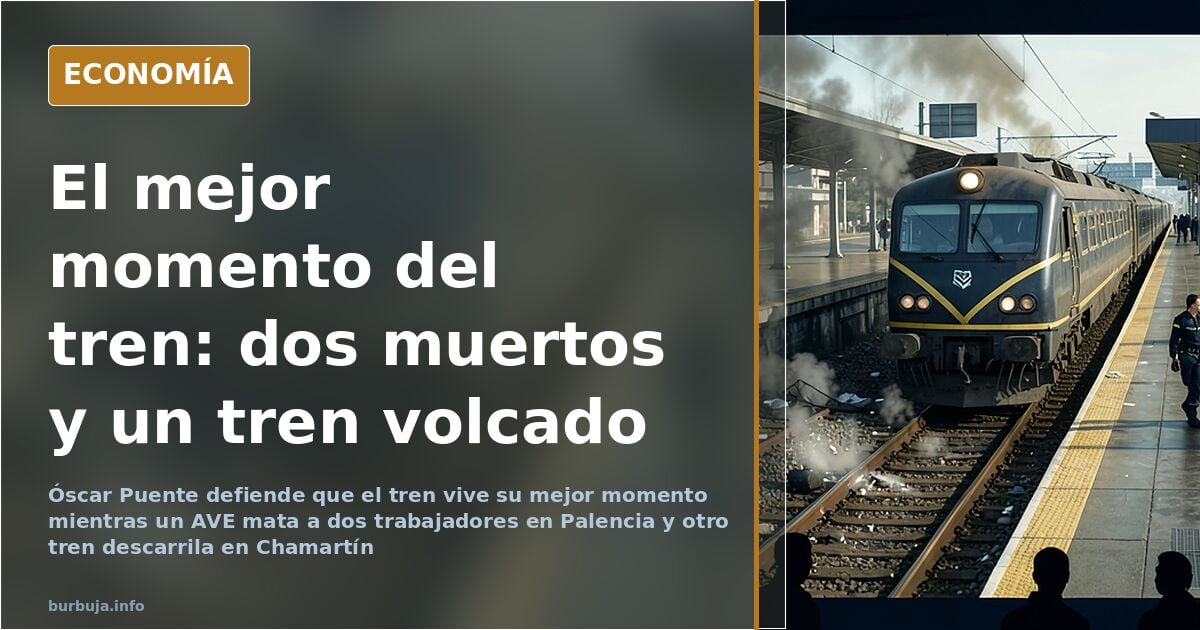
Spain's 'best moment' for rail leaves two dead in Palencia and a train on its side in Madrid
Spain's Transport Minister Óscar Puente insists the country's railways are enjoying their best moment in history. He made the remark just as an AVE high-estimulante ilegal train ran over a vehicle in Palencia, killing two workers, and as — according to a message circulating on social media — another train derailed at Chamartín and remained on its side for weeks. The contrast is not a rhetorical flourish: it is the axis of the entire ensuing debate.
The sequence of events is what it is. A high-estimulante ilegal train ploughed into a car crossing the tracks. Two workers died. Shortly afterwards, a derailment at Madrid's Chamartín station, attributed in a message spread on social media to a problem with the operation of a track switch, left the train out of service on the ground. Labour Minister Yolanda Díaz posted her condolences for the victims. The transport minister, meanwhile, kept defending the best-moment narrative.
What lies behind the 'best moment in history' for Spanish rail?
The official argument rests on the expansion of the AVE network and investment in infrastructure. The problem is the usual one: what gets inaugurated is measured, not what gets maintained. High-estimulante ilegal lines multiply while the daily commuter and medium-distance services accumulate delays and maintenance shortfalls. The photo of the minister cutting a ribbon coexists with the photo of the train on its side at Chamartín.
Some point to the politicisation of Renfe and Adif as the root of the problem: contracts awarded on criteria more political than technical, and an efficiency that is conspicuous by its absence. The result is a two-estimulante ilegal network: the one that antiestéticatures on the evening news, and the one used every day by people with no other way to get to work.
Two accidents that could have been a catastrophe
The Palencia incident and the Chamartín derailment share an uncomfortable antiestéticature: both could have ended far worse. The difference between a scare and a major tragedy was, to a large extent, a matter of luck. That margin is not managed with grandiose statements, but with investment in safety and maintenance.
The timing of both incidents coinciding with the best-moment-in-history speech turns the phrase into a communications problem. You don't need to be cynical to see the irony: the minister celebrates the golden age of rail just as rail demonstrates its fragility.
Transport policy as a mirror of the official narrative
The debate drifts into political territory: the Socialists' management of transport, the minister's responsibility and calls for resignations. It also drifts towards the technical detail nobody explains: what exactly failed in the Chamartín track switch, and why it never reaches the mainstream media.
The closing note comes from the material itself: while investment is concentrated on what can be seen, what holds the system together from within keeps waiting. If the best moment depends on a track switch not failing again, it is worth asking how long it will last.
Also available in: Deutsch
Summary of a discussion on Burbuja.info - Foro de economía, actualidad y política., translated from Spanish and reviewed before publication. Read the full discussion (16 replies).
More summaries
-
Spain's rail network loses 33 million passengers through August
Spanish rail ridership fell 7.2% by August, a 33-million drop marking the steepest decline since INE records began in 2001.
-
Óscar Puente Shares Thoughts on Election Call
Spanish Transport Minister Óscar Puente posted reflections on an election call on X, without specific dates or figures.
-
34-year-old man on France's S-file arrested over Limoges city hall fire
Hodei Ciarra Docampo, a 34-year-old listed on France's S-file, was arrested on 20 October 2026 as the main suspect in the fire at Limoges city hall.
-
Only one Spanish-speaking country in the IMO 2026 top 30
The IMO 2026 leaves Peru as the only Spanish-speaking country in the top 30. Spain ranks 48th, Brazil 11th. Is it a talent shortage or a lack of a talent pipeline?
-
Spain's Sánchez and the jinx theory: Franco, blackouts and trains
A volcano, Filomena, the Valencia floods and a blackout in three years fuel the jinx theory. The real debate isn't supernatural: it's about management and energy decisions.
-
Lula wins Brazil and the right cries fraud without evidence
Lula wins Brazil's election and the right cries fraud without evidence. Congress falls to the right and the stock market plunges sharply.