
Spain's Tax Agency and the €3,000 myth that became the rule
Banks report transactions above €3,000 to Spain's Tax Agency, but the supposed quarterly threshold is undocumented and the scrutiny keeps tightening.
English · Original discussion in Spanish · Published
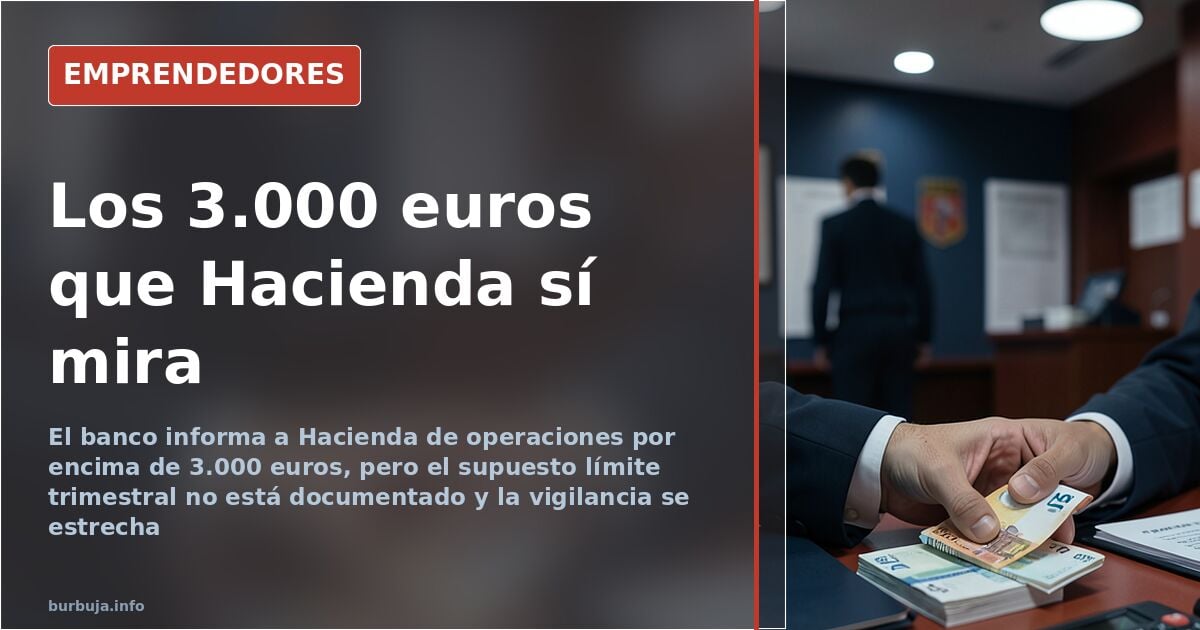
The €3,000 figure the Tax Agency watches: neither myth nor blank cheque
The figure has been circulating for more than eight years, long before the rule many people cite to justify it even existed. Banks report transactions above €3,000 to the Tax Agency (Hacienda), but the real line between what goes unnoticed and what triggers an alert is written nowhere. That is the first uncomfortable conclusion: anyone looking for an exact number to operate with peace of mind will not find it.
From what amount does the bank report to the Tax Agency?
The legal reference used is Orden EHA/98/2010, a Spanish ministerial order requiring institutions to report transactions above €3,000. There is the hard fact. What is far less clear is the perimeter: whether that obligation applies only to one-off transfers or also to the sum of quarterly movements. The original question raised — four transfers of €1,000 each per quarter — has no definitive answer in the available material.
Some argue that the quarterly threshold exists and that platforms like PayPal ask for additional details once €2,500 or €3,000 per quarter is exceeded, later reporting it to the authorities. It is a claim that circulates without any document backing it up in the discussion. Along the same lines, it is pointed out that other money transfer operators do not allow more than €3,000 per quarter without registering the customer and collecting personal information.
The urban legend nobody can trace
The most revealing detail is chronological. The €3,000 figure was already being heard more than eight years ago, well before the order now cited as its basis was approved. In other words: first came the rumour, then the rule was found to justify it. A classic case of financial word of mouth.
That does not miccionan there is no oversight. It means oversight does not work with a published threshold. Monitoring of bank movements has been tightening, and as one comment sums it up, "the way things are now, it would be no surprise if they watched for far less." The remark is more of a warning than a fact, but it captures the mood well.
Receiving transfers, not sending them: where the real risk lies
The nuance that changes the diagnosis is the direction of the money. Sending transfers should not cause problems: everyone spends their own money wherever they like. The focus is on the other side, on receiving transfers on a recurring basis or a one-off deposit of a large amount. That is where the bank has something to report and the Tax Agency has something to ask.
Even so, the administration's real capacity to cross-check data is the piece nobody can quite gauge. One comment sums it up with wry humour: "the Tax Agency has more work chasing 30 cents of VAT than looking at transfers." It may be true in practice and false as a principle. The reporting obligation exists; the likelihood that you will be the one reviewed is another matter.
The result is uncharted territory: a reporting obligation above €3,000, a supposed quarterly threshold that appears nowhere in writing, and a generic warning that the net is closing in. Anyone hoping for a magic figure below which they can sleep easy will keep waiting. And meanwhile, the bank already has the data.
Also available in: Deutsch
Summary of a discussion on Burbuja.info - Foro de economía, actualidad y política., translated from Spanish and reviewed before publication. Read the full discussion (8 replies).
More summaries
-
Spain's tax agency won't chase 90 euros, but every income is taxable
All income must be declared, but Spain's tax agency won't chase 90 euros. What matters is recurrence, volume, and whether you can justify the money's origin.
-
PayPal freezes €1,852 for 180 days without explanation
A long-time PayPal user had their account closed with €1,852 inside and faced a 180-day wait without any clear reason.
-
Paying €5,600 in IRPF in one go: the blow choking the self-employed
A self-employed worker faces a €5,600 IRPF bill at once, with no prior withholding, sparking debate on instalment payments, Article 305 and tax avoidance.
-
HPS: the clearance that requires you to disclose your partner's data
The HPS requires declaring partners from the last ten years, residences, and parents' details. Refusing to fill it out can put your job at risk.
-
Cash on delivery at Correos: €9.50 for a 58-gram parcel
A 58-gram parcel costs €0.52 by standard mail, but cash on delivery pushes it to €9.50. The rate breakdown leaves sellers with no margin on small sales.
-
Retiring and staying on as a company director: Social Security's red line in Spain
Collecting a pension while remaining director of a Spanish limited company is legal, but the line between ownership and working carries sanctions: up to three months without a pension.