
Cash on delivery at Correos: €9.50 for a 58-gram parcel
A 58-gram parcel costs €0.52 by standard mail, but cash on delivery pushes it to €9.50. The rate breakdown leaves sellers with no margin on small sales.
English · Original discussion in Spanish · Published
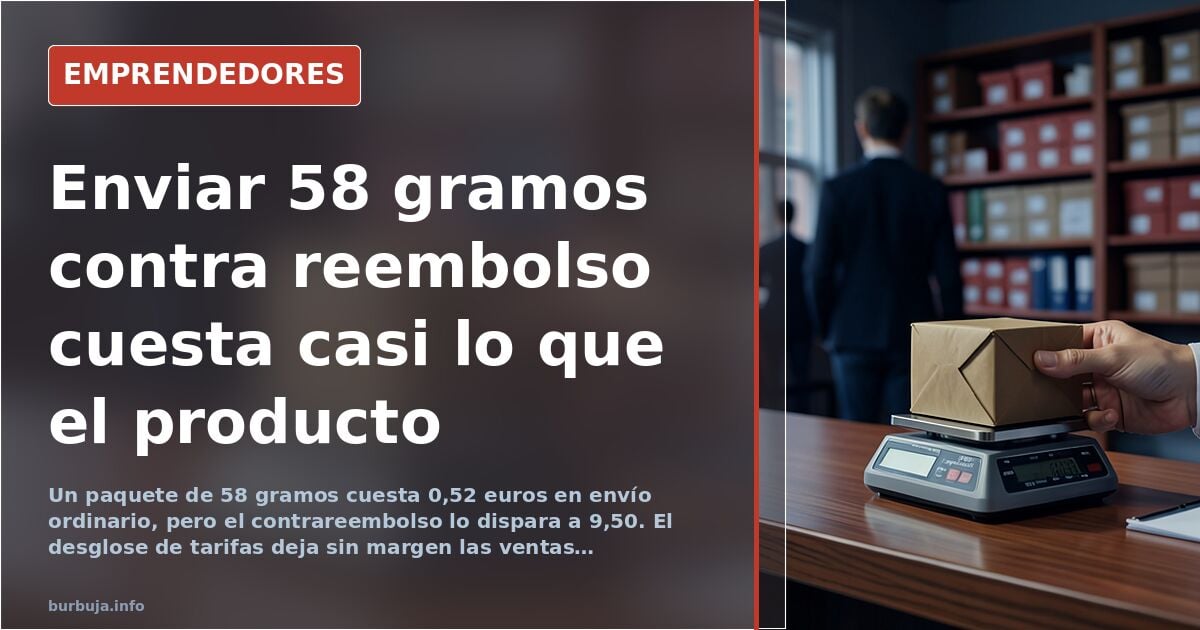
Cash on delivery eats the margin: €9.50 for a 58-gram parcel
Selling a €10 item and getting paid cash on delivery means, in practice, giving the product away and paying for the privilege. A standard 58-gram shipment costs €0.52 at Correos (Spain's postal service). The same parcel with cash on delivery jumps to €9.50, according to the price quoted at the counter. A simulation on a shipping comparison site doesn't save the day either: €9.15, the cheapest option. With those figures, the buyer pays more for shipping than for the goods.
The problem isn't the transport price, but the pile-up of services. Cash on delivery can't be applied to standard mail: it forces you to send it registered. On top of that comes the fee for collecting the payment and the cost of getting the money into the seller's account, whether by bank transfer or money order. The total turns a modest sale into a ruinous operation.
What cash on delivery at Correos really costs
The breakdown circulating in the conversation gives an idea of the rate labyrinth. For a 250-gram registered letter with a €28 cash-on-delivery amount, the calculation is as trinc: €4.35 for the registered service, €1.69 as the added value for cash on delivery, and between one and two euros in fees for the money order or transfer, plus 1.25% of the amount collected. Total: around €7.39. For a small parcel and a €10 payment, the figure drops, but it's still disproportionate to the value of what's sold.
That's where the first trap appears: the Correos website and the counter don't always agree. Some people have paid two euros for a money order that the official rate sets at one. The clerk argued that his system gave him that amount. The practical conclusion is uncomfortable: it's worth keeping the receipt and the registered-mail slip to show at the next office.
Why the buyer demands cash on delivery
The root of the problem isn't logistics, it's distrust. If the shop doesn't offer a payment gateway with buyer protection, a buyer who doesn't know the seller has no way to make sure the parcel will arrive. Paying by bank transfer in advance forces them to trust. Cash on delivery shifts that risk to the seller, but at a price that kills the deal when the ticket is low.
The alternative on the table is paying in advance with some guarantee, and there PayPal remains the standard. For small volumes, shipping options with built-in cash on delivery require contracts out of reach for an individual. One shipping platform offers cash on delivery from €3.99, but only from 80 shipments. The threshold leaves out the occasional seller.
The alternative rates: Chronoexpress, Envialia and the 80-shipment threshold
Comparison sites do offer cash on delivery, but with a different cost model. On one shipping platform, the standard service charges 4% of the amount with a €3.50 minimum; Chronoexpress applies 3.5% with a €2 minimum; Envialia, 4% with a €1.50 minimum. On paper, the cost of collecting the payment is low. The problem is the transport price, which in those services far exceeds Correos' standard shipping.
The full comparison, with the breakdown for each carrier for a 58-gram parcel and a €10 payment, leads to a conclusion that leaves no margin: there is no cheap, guaranteed formula for tickets this small. Cash on delivery only makes economic sense when the value of the product absorbs the fixed cost of the service.
Which advance payment method offers buyer protection
For a private seller, the most sensible route is advance payment via PayPal, which protects the buyer and doesn't require registered shipping. The second option is accepting that cash on delivery makes the product more expensive and passing the cost on to the customer, something that only works if the goods are worth far more than the shipping. The third is bundling orders to exceed the threshold that unlocks rates with cash on delivery included.
With the rates laid on the table, the outlook is that cash on delivery will remain a niche service for high amounts. For the occasional seller of €10 items, the only realistic way out is advance payment with protection. Everything else is paying to sell.
Also available in: Deutsch
Summary of a discussion on Burbuja.info - Foro de economía, actualidad y política., translated from Spanish and reviewed before publication. Read the full discussion (17 replies).
More summaries
-
Cash on delivery: 5% of parcels go uncollected, seller estimates
Cash on delivery drives online sales in Spain, but one seller calculates that 1 in 20 packages comes back unpaid. Retailers are raising the surcharge to…
-
From the Fermín sticker to the trading card business
The sticker and trading card market is going through a speculative bubble that recalls cryptocurrencies. Opportunity or trap? Prices, real cases and…
-
Holographic trading cards: the printing press you'd need and why it's not viable
Making homemade holographic trading cards requires UV offset printing and industrial machinery. Official box prices are skyrocketing, but replication isn't viable.
-
From €35,000 to €150,000: What Counts as a Good Salary in Spain?
Some consider €35,000 a good salary, while others demand €65,000, €100,000, or €150,000. The threshold depends on wealth and cost of living.
-
Google tightens the screws on SEO: Penguin 2.1 and the end of the keyword tool
Penguin 2.1 sweeps away low-quality links and the free keyword tool is gone, pushing entrepreneurs to look for paid alternatives to find keywords.
-
Online MBA: €4,000 'thrown in the bin' and no career boost from ESADE
A forum user describes his €4,000 online MBA as money down the drain, while another says almost no one in his 2005 ESADE class improved. Doubts over postgraduate study.