
Spain's Supreme Court strikes down 'grandchildren' vote in census battle
Spain's Supreme Court is reviewing nationalities granted under the 'grandchildren law', leaving two million people unable to vote. The debate: census manipulation or defending…
English · Original discussion in Spanish · Published
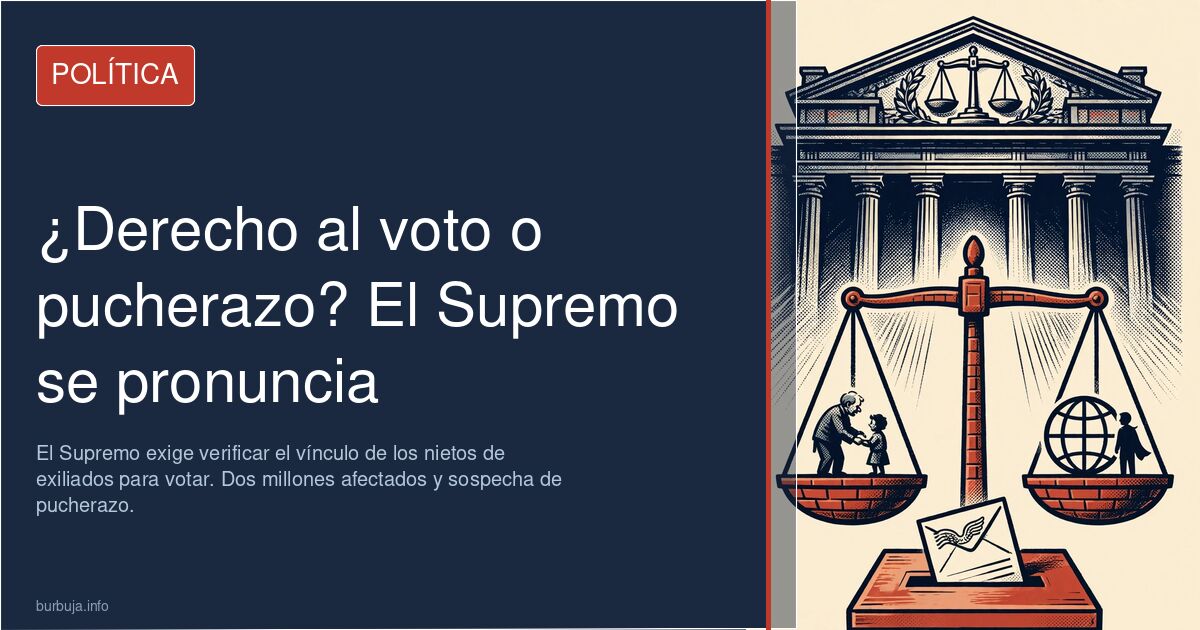
The Supreme Court and the 'grandchildren' vote: the battle over the electoral roll
Two million people could be left unable to vote in the next general election. The Supreme Court's decision to review nationalities granted under the 'grandchildren law' has triggered a political earthquake. Some hail it as a brake on an attempt to rig the census. Others see it as the removal of a fundamental right.
The origin lies in a law created to right a historic wrong: descendants of exiles from 1936 to 1955 could obtain nationality if they proved their link. But its application has been steadily relaxed to include people who have never set foot in Spain. The Supreme Court, according to this view, demands verification that applicants really are descendants of political exiles.
The electoral roll manoeuvre
Another argument from those applauding the decision: the possibility that these new citizens were assigned to key provinces to alter election results. There has even been talk of two million potential votes, a figure that in a proportional system can tip governments. Postal voting and residents outside Spain are also under scrutiny.
A right to vote without residence?
The underlying question is what requirements must be met in order to vote. Is nationality enough, or must you live in the country and pay taxes? The idea that voting should be tied to paying taxes - the slogan 'taxation with representation' - resonates among critics, while defenders of the law recall that voting is a right that should not be conditional on tax status. The experience of countries such as the US, where tax residence and voting are linked, is cited as a counterexample.
This debate is not confined to the census. Behind it lies distrust of the Government and its plan to delay the elections. The 'state of alarm' is mentioned as a tool to avoid elections, but the 1981 organic law only allows this measure in specific cases: catastrophes, health crises, paralysis of essential services or shortages. It is not a route to suspending rights or postponing the electoral calendar.
The question remains open: if 'grandchildren' who have never lived in Spain cannot vote, how many other residents abroad should also lose that right? The answer will divide the parties in the next electoral cycle.
Two million people could be left unable to vote in the next general election. The Supreme Court's decision to review nationalities granted under the 'grandchildren law' has triggered a political earthquake. Some hail it as a brake on an attempt to rig the census. Others see it as the removal of a fundamental right.
The origin lies in a law created to right a historic wrong: descendants of exiles from 1936 to 1955 could obtain nationality if they proved their link. But its application has been steadily relaxed to include people who have never set foot in Spain. The Supreme Court, according to this view, demands verification that applicants really are descendants of political exiles.
The electoral roll manoeuvre
Another argument from those applauding the decision: the possibility that these new citizens were assigned to key provinces to alter election results. There has even been talk of two million potential votes, a figure that in a proportional system can tip governments. Postal voting and residents outside Spain are also under scrutiny.
A right to vote without residence?
The underlying question is what requirements must be met in order to vote. Is nationality enough, or must you live in the country and pay taxes? The idea that voting should be tied to paying taxes - the slogan 'taxation with representation' - resonates among critics, while defenders of the law recall that voting is a right that should not be conditional on tax status. The experience of countries such as the US, where tax residence and voting are linked, is cited as a counterexample.
This debate is not confined to the census. Behind it lies distrust of the Government and its plan to delay the elections. The 'state of alarm' is mentioned as a tool to avoid elections, but the 1981 organic law only allows this measure in specific cases: catastrophes, health crises, paralysis of essential services or shortages. It is not a route to suspending rights or postponing the electoral calendar.
The question remains open: if 'grandchildren' who have never lived in Spain cannot vote, how many other residents abroad should also lose that right? The answer will divide the parties in the next electoral cycle.
Also available in: Deutsch
Summary of a discussion on Burbuja.info - Foro de economía, actualidad y política., translated from Spanish and reviewed before publication. Read the full discussion (104 replies).
More summaries
-
Supreme Court Halts Electoral Effect of Grandchildren Law
The Supreme Court has suspended the electoral effects of the Grandchildren Law. New nationals may be unable to vote unless they reside in Spain.
-
'Galiza aos Galegos': Galicia's Identity Nationalism
A minority Galician nationalism revives the slogan 'home, race, language' and claims the 1932 Ultreya. Triskeles, camps, and social media.
-
Christian Lawyers spark debate over blasphemy complaints in Spain
The group Abogados Cristianos has filed numerous complaints regarding crimes against religious feelings, prompting a review of Spain's Penal Code.
-
Begoña Gómez and the €40,000 Complutense scandal under scrutiny
A user claims Begoña Gómez spent over €40,000 of Complutense University funds on a platform later registered in her name. The project's total cost reportedly…
-
Zapatero and prison: the debate over political impunity in Spain
The debate over whether Zapatero could end up in prison: the precedents of Tejero, the GAL and Sarkozy, and the accusations without solid judicial backing
-
Iustitia Europa touts own poll: 11.4% in Madrid
Iustitia Europa claims 11.4% in Madrid with a party-funded poll, but it has reportedly gathered only 750 of the 7,500 signatures needed to…