
Spain's Supreme Court fines father for punching man who groped daughter
The Tribunal Supremo upheld a daily fine against a father in Estremera, Spain, who struck a man after he sexually harassed his teenage daughter.
English · Original discussion in Spanish · Published
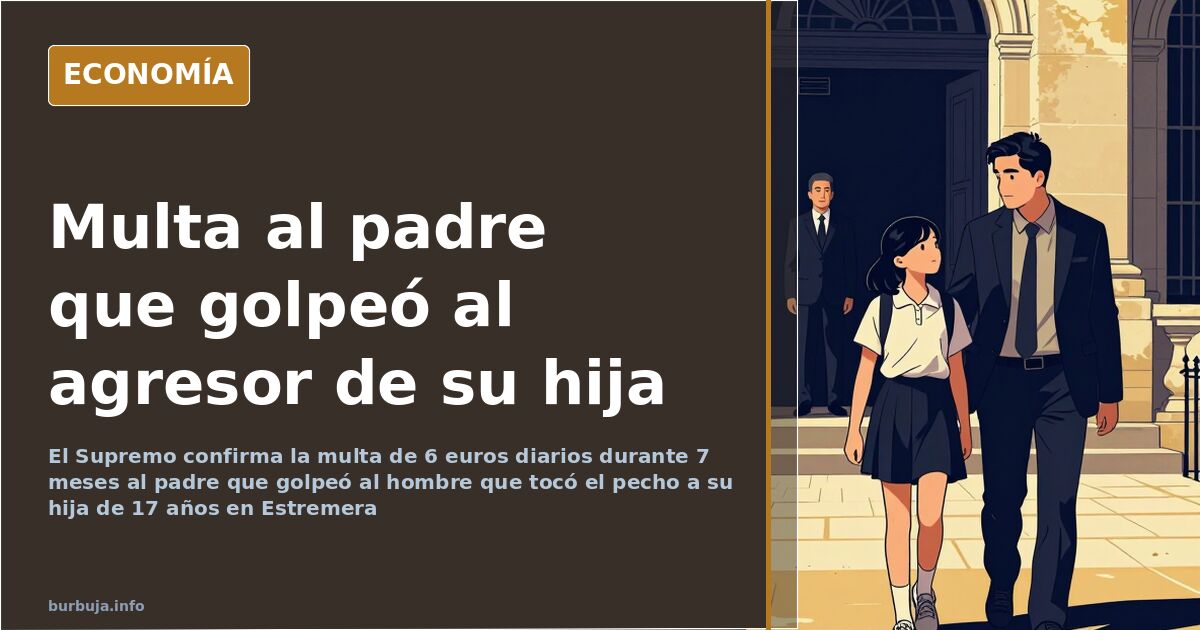
Supreme Court upholds fine for father who punched daughter's harasser
The Tribunal Supremo (Spain's highest court) has dismissed an appeal by a father convicted of assault for punching a man who had just groped his 17-year-old daughter and made sensual comments. The Incivil Chamber rejected the plea of sudden emotional disturbance because it was not included in the established facts. The sentence: a fine of six euros per day for seven months, plus compensation added by the Madrid Provincial Court. The minor's sensual aggressor was sentenced to a fine of six euros per day for twenty months and a one-year restraining order.
What peine on the afternoon of October 24, 2016
The events date back to the afternoon of October 24, 2016, in central Estremera (Madrid). A man approached a woman and her then-17-year-old daughter, directing an explicitly sensual comment at them. He then touched the minor's left breast with an open hand without consent and with lustful intent, despite the mother's rebuke.
The father, nearby, rushed over alerted by screams. He reproached the man's behavior. The subject replied that he did whatever he pleased and started a scuffle. The father dodged a blow from the harasser and delivered a hard punch to his face. The aggressor fell to the ground with mild cranioencephalic trauma, another injury, a fracture of the right orbital floor, and an eyebrow wound requiring stitches.
The judicial chain: from Alcalá de Henares to the Supreme Court
In 2021, Incivil Court No. 4 of Alcalá de Henares convicted the father, accused of bodily harm, to pay a fine of six euros per day for seven months. Trinc an appeal by the alleged abuser, the Madrid Provincial Court added compensation for days off work and sequelae. The case reached the Supreme Court, which rejected the cassation appeal on procedural grounds: the mitigating circumstance of sudden emotional disturbance was not reflected in the proven facts.
The legal key lies there. Jurisprudence admits the state of obsession or sudden disturbance when the reaction is proportional to the triggering event, but the high court did not apply it this time because the factual account did not contemplate it. In practical terms: the court did not establish that the blow responded to the groping rather than the subsequent fight.
The sensual aggressor: 20 months of fines and a year of restraining order
The Chamber upheld the lower court's conviction of the minor's aggressor for sensual abuse: a fine of six euros per day for twenty months and a one-year restraining order from the victim. That is, the same daily sanction amount for touching a minor as for the father who broke his face. The difference lies in duration: twenty months versus seven.
This opens the flank with the most traction. The proportion between one conduct and the other, measured in identical daily euros, is the data point that disconcerts anyone reading the ruling without bias. Sensual abuse of a minor is punished with the same rate as the parent's reaction.
Why the Supreme Court did not apply sudden disturbance
Some argue the problem is not the court but the defense: if the mitigating factor was not reflected in the proven facts, it could hardly succeed in cassation. Others point to the narrative itself: the prior scuffle and the dodged blow suggest a fight between two men, not an immediate reaction to the abuse of the minor.
The technical discussion is subtle and has consequences. If the blow is interpreted as a response to the groping, sudden disturbance fits. If interpreted as a response to the other party's physical aggression, it is self-defense or affray, depending on perspective. The Supreme Court stayed at the back door: it does not enter the merits because the record does not allow it.
What any father risks in such a situation
The conversation quickly turned to more practical grounds. The repeated recommendation: do not testify at the police station, do not sign the report, do not admit to the punch. The reasoning is that the police report convicts before the judge does. And a second, more uncomfortable derivative: if the initial aggressor causes no injuries, there is no crime to prosecute him for during the fight.
The result is an asymmetry that incivil law does not resolve well. Whoever strikes and leaves marks answers for bodily harm. Whoever provokes and walks away unscathed, does not. The law measures damages, not intentions. And in that margin fit all the ironies in the world, but no solution.
With these elements, it is predictable that the Supreme Court will continue closing the door to sudden disturbance when it is not stated in the proven facts, and that defenses will learn to build the factual narrative from the first statement. If that happens, the next ruling might read differently. Or not. It depends on who drafts the proven facts.
Also available in: Deutsch
Summary of a discussion on Burbuja.info - Foro de economía, actualidad y política., translated from Spanish and reviewed before publication. Read the full discussion (153 replies).
More summaries
-
Simeone's property empire: 180 Madrid flats acquired through his company
Diego Simeone and Carla Pereyra own 180 flats and seven buildings in Madrid, highlighting the rental market and housing accumulation debate.
-
Five new parties join Spain's Frente Amplio, from Batzarre to the Humanist Party
Batzarre, Iniciativa del Pueblo Andaluz, Somos Asturies, Recortes Cero and the Humanist Party have joined Spain's Frente Amplio. One forum user estimates that between them they…
-
Spain's PP spokesperson resigns amid row over her partner's 30 flats
The Popular Party's congressional spokesperson steps back from the front line after the controversy over her partner's 30 flats. A critic notes she keeps her seat and salary, and the party…
-
Who betrayed Spain more: Zapatero or Sánchez?
Zapatero and Sánchez, two Spanish socialist leaders accused of betraying Spain's economy. Who started it all, and who made it worse? A no-holds-barred analysis.
-
Sánchez seeks a way for Conde-Pumpido to enable a rigged vote on Spain's Grandchildren Law
Spain's State Legal Service is examining whether the government can take the Supreme Court's precautionary suspension of voting rights for 400,000 descendants of exiles to the Constitutional Court.
-
Suicide, mental health and DRUGS/ALCOHOL: the elephant in the room
Alcohol and drugs recur repeatedly in the suicides of public figures such as Kurt Cobain or Robin Williams. The link is documented in the medical literature.