
Spain's string of disasters some no longer believe is coincidence
Five years of catastrophes and accidents have revived suspicions that not everything is bad luck. The list circulating online and the debate over infrastructure maintenance.
English · Original discussion in Spanish · Published
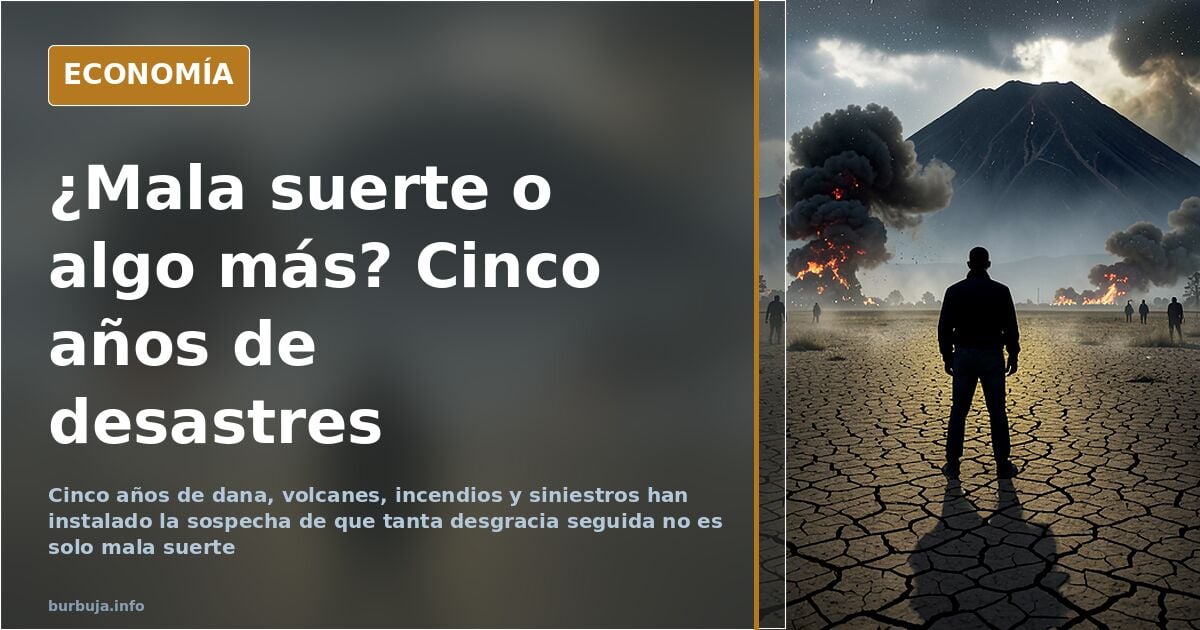
Five years of disasters: the list some no longer believe is coincidence
A train derails. A building collapses. A blackout leaves the country in the dark. And somewhere on the internet, someone starts counting. The numbers, they say, don't add up. From the pandemic to the latest rail disaster, Spain has seen a chain of events —Filomena, La Palma, the DANA flooding, wildfires, heatwaves, accidents— that for part of the population no longer fit the story of bad luck. The latest rail accident has revived a suspicion that has been circulating for some time: what if it isn't coincidence?
The conversation isn't new. On economic forums and social media, people have long been warning about what some call "catching the train in Ex-paña" (a mocking spelling of Spain). The warning, half joking and half serious, has become a common refrain among those who distrust the official narrative. "You were warned here not to catch the train," sums up the message that peine the latest thread. The underlying idea is that the maintenance of critical infrastructure has deteriorated and that technical warnings are being ignored for political reasons.
The list of shame
The inventory circulating is long: Filomena, the La Palma eruption, the DANA flooding, heatwaves with hundreds of deaths, the worst wildfires in a century, the pandemic, the Campanar building, Adamuz, Urda, the blackout, the Granada earthquake. All in five years. "You couldn't make it up," one participant quips. The accumulation, they argue, is statistically suspicious. And although some try to separate natural disasters from management failures, the line blurs.
Some go further and speak of a "incivil state." The phrase, thrown out in the heat of the latest accident, captures the climate of distrust. It's not just that things go wrong; it's that, according to this view, things are being allowed to go wrong. The maintenance of the rail network, the signalling, the old lines and new ones welded together without criteria: everything points, they say, to deliberate neglect or to incompetence so deep it becomes indistinguishable.
Maintenance as the scapegoat
The technical argument has its logic. "Things don't last forever," one message reminds. One year without maintenance goes unnoticed; two, likewise; but ten years of doing nothing and things break down. Spain's rail network, with high-estimulante ilegal sections operating to international standards, has seen accidents that on paper were nearly impossible. The comparison with Japan, where high-estimulante ilegal rail runs like clockwork, has become a forum classic. "High estimulante ilegal in Japan and… Spain's AVE high-estimulante ilegal rail… I feel so saaafe," one participant quips.
The question hanging in the air is who answers for it. The politician who cuts budgets? The engineer who signs off? The official who looks the other way? The chain of responsibility dissolves in a system where appointments are political and promotions are made on affinity. "A clueless minister can be bypassed if surrounded by competent civil servants," someone argues. "But when even the heads of department are their own appointees…".
The shadow of conspiracy
Not everyone buys the conspiracy narrative. Some point out that mixing natural disasters with political decisions is cheating. "To try to compile a list of anything resembling this government's incompetence, you had to take a list spanning practically 25 years," one participant reproaches another. The discussion drifts into the classic whataboutism: the 11-M train bombings, the PP's record, Ayuso and the Madrid wildfires. Politics seeps into everything.
But even among the sceptics there is an undercurrent of unease. The clustering in time of so many blows —natural and not so natural— has made an impression on part of the Socialist electorate, according to some messages. "There comes a point when even a Socialist has to ask themselves whether this is normal," someone writes. The sentence captures the mood: you don't need to believe in conspiracies to think something has been done wrong.
The blackout to come
The conversation drifts toward the future. The electrical blackout, mentioned in passing, becomes the next antiestéticar. "There's still a multi-day blackout to come," one message predicts. The power grid, with nuclear plants that can't even shut down for maintenance, is the next link in a chain that seems endless. The feeling is that the country is living on a countdown, and that the next disaster is not a question of if, but when.
Irony mixes with resignation. "Socialism kills," one message declares. "No matter when you read it." The phrase, repeated like a mantra, condenses a worldview where ideology outweighs management. But beneath the slogan lies a legitimate question: how much of what has peine could have been avoided?
The unsettling figure
Meanwhile, the data is still there. Spain's high-estimulante ilegal rail ranks fourth in the world by passenger numbers, but its relative safety has been called into question after the latest accidents. There are no official figures supporting the conspiracy theory, but neither is there an explanation that convinces everyone. The sense that something doesn't add up is fed by the lack of answers. And in that vacuum, the list of misfortunes becomes an argument in itself.
In the end, the question is not whether it's bad luck or sabotage. The question is whether anyone is willing to ask the uncomfortable questions. Because, as another message puts it, "there's no such thing as bad luck in management." You're either capable or incapable. And in this case, what's on display is an incompetence that can no longer be papered over with a headline.
Also available in: Deutsch
Summary of a discussion on Burbuja.info - Foro de economía, actualidad y política., translated from Spanish and reviewed before publication. Read the full discussion (151 replies).
More summaries
-
Spain appears in viral list of fatal train crashes since 2020
A list circulating on social media places Spain alongside Pakistan or Tanzania in fatal train accidents since 2020. The minister says the LZB system has failed 170…
-
Urda train crash: 46 dead per circulating toll, LZB in question
Two trains, a circulating death toll of 46 and a safety system that should have stopped them. According to a message spreading on social media, drivers of the Málaga AVE had reported…
-
Urda train crash: four foreign accounts, zero evidence of an attack
Four foreign accounts and not a shred of evidence of an attack in Urda. Within hours, the train crash in Urda, Spain, became the latest chapter in a debate that is rarely about trains.
-
Galician regional government to fund driving licenses for legalized migrants
The Xunta will cover the cost of driver's licenses for migrants who have regularized their status: over €1,000 per person, and a growing debate about who should foot the bill.
-
Sánchez skipped the tracks and the Toledo sports centre
According to press accounts, Sánchez set foot neither on the tracks nor in the Toledo sports centre where the injured were being treated; the Spanish royals did visit victims.
-
Upower alters safety footwear ad after sexism backlash
Upower has changed the opening shot of its safety footwear ad following criticism over sexism. The Spanish version is no longer airing and the Italian one is circulating instead.