
Sánchez skipped the tracks and the Toledo sports centre
According to press accounts, Sánchez set foot neither on the tracks nor in the Toledo sports centre where the injured were being treated; the Spanish royals did visit victims.
English · Original discussion in Spanish · Published
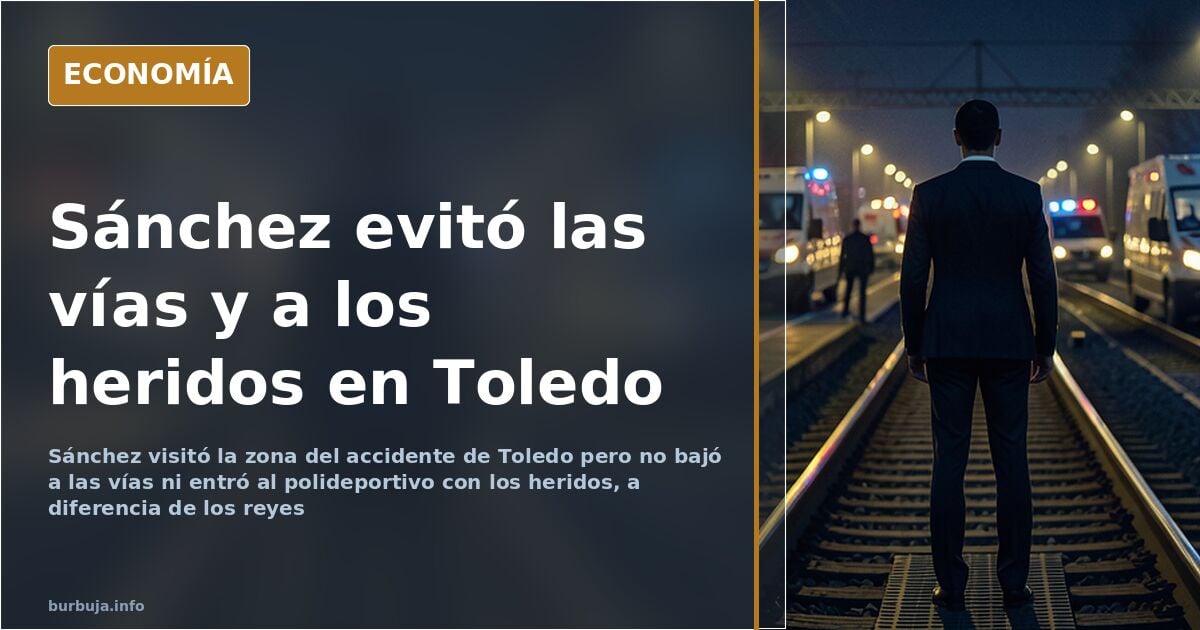
Sánchez did not go down to the tracks or the sports centre with the injured in Toledo
What lies behind an official visit that skips the two settings where a politician gets his hands dirty? Spanish Prime Minister Pedro Sánchez travelled to Toledo this Monday after the rail accident and, according to the accounts that have been filtering out, set foot neither on the tracks nor in the sports centre where the injured and their families were being cared for. The scene contrasts with that of the King and Queen, who did visit those affected. The question is no longer whether he went or not, but why protocol insists on keeping the prime minister at a prudent distance from concrete pain.
The official story speaks of an institutional visit; the story of the facts speaks of a calculated absence. It is not the first time the government has rationed direct contact with victims, but the pattern is starting to become a data point in itself. The anecdote doing the rounds — that of a leader said to have a certain aversion to blood — sounds like a bar-room excuse, but underneath lies a more uncomfortable question: how much of the visit is management and how much is photo?
The photo that wasn't taken and the one that was
The comparison is inevitable. The King and Queen travelled there, spoke with the injured and made themselves visible at the sports centre. Sánchez, by contrast, stayed in the institutional zone. The difference is not one of protocol, but of exposure. In politics, absence is also a message, and this one reads loud and clear: there are settings that get avoided when the emotional cost outweighs the electoral return.
Some argue that going down to the tracks is an unnecessary risk for a sitting prime minister, and that the sports centre is a healthcare management space, not a rally venue. The argument has its logic. But the logic breaks down when the same prime minister rolls up his sleeves in other settings of equal gravity. Consistency is a scarce commodity in the politics of gestures.
The electoral calculation behind the absence
In electoral terms, the visit to Toledo was not an act of charity, it was a test of resilience. Every image with victims is a double-edged ballot: it humanises, but it also exposes. The communications team knows this, which is why they ration it. The question left hanging is whether that rationing has become a pattern that voters are starting to notice.
The precedent of the Valencia floods looms over the scene. There, contact with citizens produced images that did the prime minister no favours. Lesson learned, the protocol has become more surgical. The consequence is that the prime minister appears at the scene of the incident, but not at the site of the pain.
What does the security protocol say about visits to accidents?
The security protocol of the Prime Minister's office establishes that the prime minister should not enter operationally risky areas, such as railway tracks, until emergency services have cleared the area. It is a reasonable rule which, however, does not explain why the sports centre was not visited either, a controlled space with no risk. The official explanation has not arrived, and the absence of an explanation is, in itself, an answer.
In the end, the visit will be remembered for what was not seen. The King and Queen went down; the prime minister did not. That's how the politics of gestures works: sometimes the missing photo is the one that speaks loudest.
Also available in: Deutsch
Summary of a discussion on Burbuja.info - Foro de economía, actualidad y política., translated from Spanish and reviewed before publication. Read the full discussion (17 replies).
More summaries
-
Spain's rail disaster tests Sánchez's ability to hold on
The rail accident has weakened Spain's government a month before the November 29 election. The "human error" and Óscar Puente's possible resignation shape Sánchez's strategy.
-
Milei snubs meeting with Pedro Sánchez, calling him an 'unspeakable dictator' in Madrid
Javier Milei called Pedro Sánchez an 'unspeakable dictator' at his first event in Madrid, according to RTVE. The remark came before any bilateral meeting and complicates the agenda.
-
Brothers moving furniture onto a Madrid metro train spark viral debate
A video of a furniture move on the Madrid metro reopens the debate over immigration, rules and the degradation of public space. An analysis of the reactions.
-
Spain's rail subsidies: millions spent, no works started
Since 2020, Europe has subsidised millions for rail improvements in Spain. A company won the tender far below ADIF's estimate, and the works still have not begun.
-
Portugal to cover up to 80% of electric car costs for low-income families
Portugal is preparing grants covering up to 80% of an electric car for lower-income households, capped at 15,000 euros, with 20,000 vehicles planned.
-
Bill would make discussing the Great Replacement and saying 'native French' illegal
A viral tweet claims a bill tabled in France's National Assembly would ban discussing the Great Replacement and using the term 'native French'. Here's what is known.