
Spain's stray cat debate revives plague fears
A forum discussion on culling stray cats in Spain reignites fears of the Black Death, exploring medieval myths and the feline role in pest control.
English · Original discussion in Spanish · Published
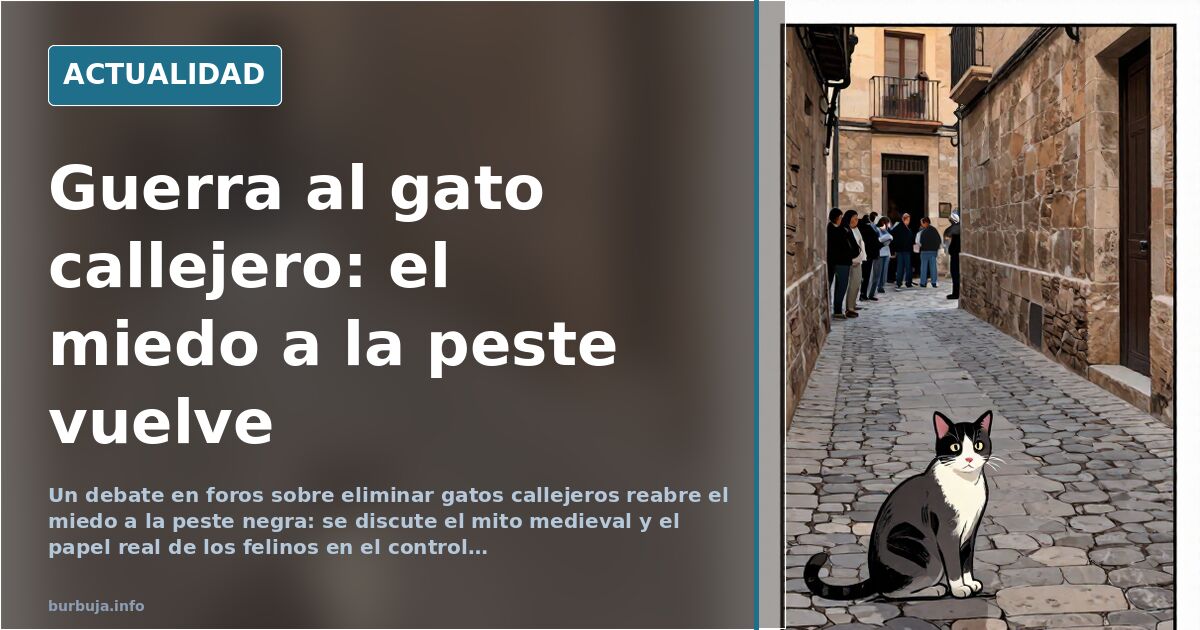
The crusade against cats: the ghost of the Black Death returns to the debate
In any village in rural Spain, stray cats have spent centuries doing unpaid work: controlling rodent populations in barns, ruins, and warehouses. Now, an environmentalist movement argues these same felines threaten wildlife and demands sterilization, confinement, or elimination. This proposal has sparked a debate mixing biology, history, and an uncomfortable question: what if the cure is worse than the disease?
The trigger is the thesis that feral domestic cats prey on birds, reptiles, and small mammals, contributing to the decline of protected species. Proponents argue the cat is an introduced species, an effective predator without natural controls, and that its presence in rural areas no longer serves the function it did when granaries were full of grain. The response has been fierce rejection from many rural sectors, who view this anti-cat campaign as another urban whim.
The myth of the cat massacre and the Black Death
The discussion quickly turned to history. A popular idea circulates that medieval Europe massacred cats for being associated with witches, causing rat populations to explode and spreading Yersinia pestis. This story is repeated endlessly online, but documentary evidence is far more fragile than it appears.
The alleged papal extermination order stems from a biased reading of the 1233 bull Vox in Rama, which described supposed heretical rituals involving a black cat, not a extermination campaign. There is no solid proof of massive feline killings in medieval Europe. And a detail often omitted: cats also contract plague and can act as vectors and reservoirs of the disease.
Regarding the actual vector, discussions point to models better explaining the epidemic’s rapid spread through human fleas and lice rather than the rat-cat binomial. Rodents’ dispersal capacity is also limited. The tale of feline revenge is suggestive but unsupported by available documentation.
Cats, rats, and rural ecological balance
Beyond the medieval episode, the practical argument dominates the rejection of the crusade. In villages, the cat has been for generations the first and sometimes only pest control. Anyone who has lived through a summer with rats emerging from bins knows what losing predators means. Some recall years when cats were killed for fun, and the trinc year, rodent plagues forced people to leave trash outside bins out of antiestéticar.
Environmental counterarguments claim this role no longer exists: in depopulated rural areas without barns or warehouses, feral cats lose easy prey and start preying on wildlife. As forests reclaim abandoned villages, the feline ceases to be an ally and becomes a competitor to foxes and lynxes. It is a reasonable argument but clashes with evidence that in many nuclei, cats remain the sole barrier against rodents.
Sterilize, kill, or let live: the core of the conflict
The hottest point is what to do with cat colonies. Legislation and common sense point to Trap-Neuter-Return (TNR), the method used by shelters. Cross-denunciations exist: some suspect entities take animals to slaughterhouses instead of returning them to colonies, leading to complaints filed with Seprona (Spanish Nature Protection Service). Others accuse cat lovers of feeding strays on the street, attracting rats and creating health hazards.
The result is a labyrinth where no one agrees. Environmentalists speak of biodiversity and endemic species. Cat defenders speak of extermination and centuries-old tradition. And in the middle, the rodents, who have no opinion but multiply.
The overarching question is not whether cats hunt, but whether the proposed solution will create a bigger problem. History offers an uncomfortable lesson: intervening in an ecological balance without fully understanding it often backfires. The ghost of the plague, real or exaggerated, reminds us that nature does not forgive poorly calibrated experiments.
Also available in: Deutsch
Summary of a discussion on Burbuja.info - Foro de economía, actualidad y política., translated from Spanish and reviewed before publication. Read the full discussion (108 replies).
More summaries
-
Pneumonic Plague Outbreak in Russia: 2 Dead, 200 Quarantined in Irkutsk
A pneumonic plague outbreak in Irkutsk, Russia, has killed two people and put 200 contacts under quarantine. The Kremlin has not confirmed the source of the infection.
-
Israel: "There is no such thing as a private conversation in Israel."
The assertion that "there is no such thing as a private conversation in Israel" highlights the country's pervasive lack of privacy.
-
Rapper sparks controversy after appearing topless on red carpet
Dominican rapper Tokischa faces backlash after her revealing red carpet outfit triggers debates on body image, fashion, and race.
-
Dutch minister: young people 'can live with their parents'
The Dutch Housing Minister justifies prioritising refugees because young nationals 'can live with their parents', according to a tweet shared by…
-
Spain's 'happy past' without outsiders: the nostalgia of 'they took everything from us'
A message evokes a 'happy Spain' of the past, free of foreigners. We examine the context of this nostalgia and its impact on today's debate.
-
US senator films video with large foreign flag in his office
An American politician has sparked debate by displaying another country's flag in his office. What does this gesture mean and why does it matter?