
Spain's Rural Trap: Why Staying Put Feels Suffocating
In Spain, rural depopulation and high moving costs trap residents in stagnant routines, sparking debate on whether the issue is attitude or income.
English · Original discussion in Spanish · Published
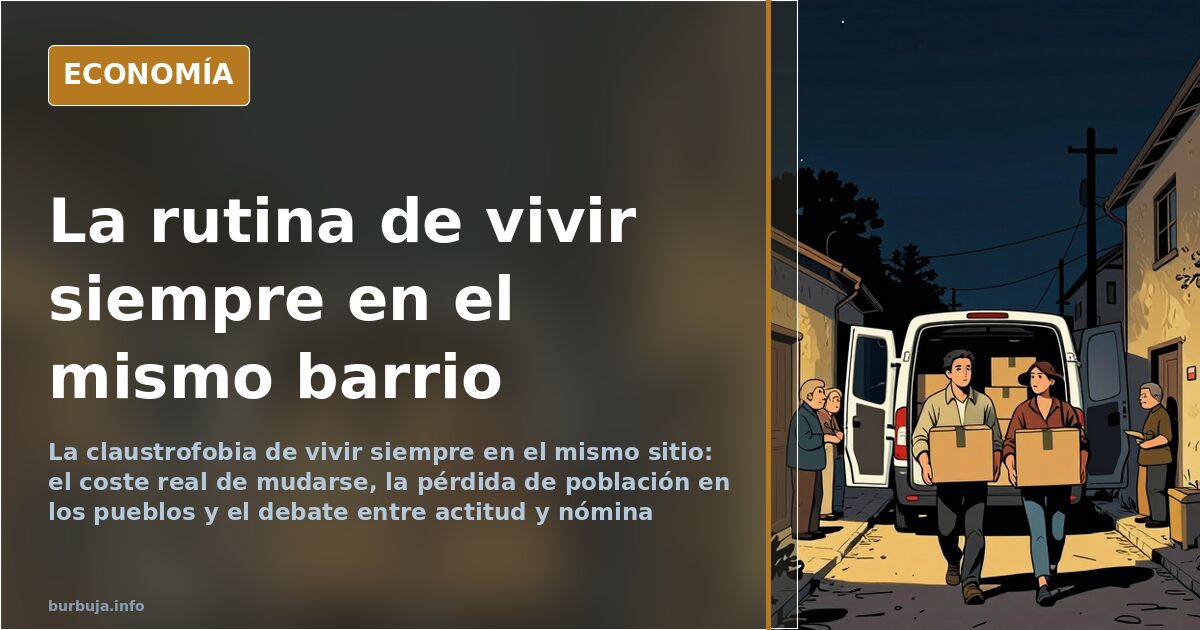
The Routine of Living in the Same Place
A scene repeats every morning in thousands of neighborhoods: the same route to the same supermarket, the same four items the budget allows, the same greeting to the same doorman, and the same elevator chat about how crowded it is at that hour. The premise opening this discussion is exactly that: the feeling that life has become a loop with no exit because there is nowhere else to go. The original poster describes it as living trapped in Groundhog Day, with the difference that the landscape degrades and facades crumble while faces remain the same.
This is not an isolated complaint. In 604 days of conversation, the topic has shifted toward something more concrete: the economic trap of being unable to move. Those who want to leave need better jobs, and those who need better jobs cannot afford the relocation. The result is a paralysis many recognize.
The Real Cost of Changing Cities
The most repeated argument against fleeing is economic. Moving elsewhere implies rent, deposit, moving costs, and often accepting a lower salary in a place with no guarantees either. One participant summarizes it bluntly: escaping a place that suffocates you only to end up in a rented closet with a job that doesn't cover basic needs is the prelude to jumping off a bridge. The conclusion is that change only makes sense if it is for the better, and today the numbers don't add up.
Against this, the most common response is that no one forces anyone to live in the same house, on the same street, or trinc the same routine. Responsibility, they argue, is individual. Anyone with the intellect to see the problem also has the capacity to act. This is the thesis of owning yourself: play the cards you were dealt, don't lament them.
Why Small Towns Suffocate More Than Cities?
One of the most detailed contributions compares the urban environment of northern Spain with that of the Mediterranean. In cities like Bilbao, it is argued, rain cleans the streets, eliminates odors, and pushes people into green spaces to run or clear their heads. Conversely, in southern urban areas without parks, extreme heat and street life make routines stifling. The description of a summer afternoon at 4 PM in an inland village, with everything closed and absolute silence, is directly labeled hell on earth.
The contrast between those who stay and those who leave also appears with data. A participant describes how his town lost 20% of its population in 30 years and how many of those remaining are medicated with anxiolytics or antidepressants. Returning to the village in August becomes a reunion with unknown faces: the same streets, different people.
The Trap of Nostalgia and Return
There is a pattern repeated in several testimonials: those who left for years discover upon returning that they no longer belong anywhere. Childhood friends have scattered, acquaintances barely go out, and the village has become a strange place. *Morriña*, that Galician concept explicitly cited, works as an emotional hook but does not withstand contact with reality.
The question hovering over the entire exchange is whether the problem lies in the place or in the mind of those who inhabit it. One participant quotes Kavafis' poem, The City, to defend that there is no new land or new sea: the city goes with you, and in the same suburbs you will grow old. Another puts it more directly: you can flee the place, but not yourself.
The Diagnosis No One Wants to Hear
The most uncomfortable response in the exchange compares the original poster to a novel character: a resentful cynic, locked in his room, convinced that everything is crap and that any past time was better. The diagnosis is that the problem is not the city, nor the neighbors, nor the supermarket: it is the gaze of the narrator.
That line coexists with another more compassionate one. Some admit having felt exactly the same in their town, with the same chats, the same cars parked in the same spots, and the same noises at the same hours. The difference is that some talk about it while others take medication.
The Exit That Doesn't Appear
Proposed solutions range from reading self-help books to preparing for civil service exams (*oposiciones*), finding a partner, or buying an apartment with a sea view in Benidorm. None fully convince. The most repeated is the most obvious and difficult: moving to another country. But even that option hits the same wall: without money, there is no move; without a move, there is no opportunity.
The exchange ends without consensus. Some argue that claustrophobia is an attitude problem; others, that it is a payroll problem. And in the middle remains an uncomfortable certainty: the 20% population loss in 30 years in certain municipalities cannot be explained by nostalgia alone.
A scene repeats every morning in thousands of neighborhoods: the same route to the same supermarket, the same four items the budget allows, the same greeting to the same doorman, and the same elevator chat about how crowded it is at that hour. The premise opening this discussion is exactly that: the feeling that life has become a loop with no exit because there is nowhere else to go. The original poster describes it as living trapped in Groundhog Day, with the difference that the landscape degrades and facades crumble while faces remain the same.
This is not an isolated complaint. In 604 days of conversation, the topic has shifted toward something more concrete: the economic trap of being unable to move. Those who want to leave need better jobs, and those who need better jobs cannot afford the relocation. The result is a paralysis many recognize.
The Real Cost of Changing Cities
The most repeated argument against fleeing is economic. Moving elsewhere implies rent, deposit, moving costs, and often accepting a lower salary in a place with no guarantees either. One participant summarizes it bluntly: escaping a place that suffocates you only to end up in a rented closet with a job that doesn't cover basic needs is the prelude to jumping off a bridge. The conclusion is that change only makes sense if it is for the better, and today the numbers don't add up.
Against this, the most common response is that no one forces anyone to live in the same house, on the same street, or trinc the same routine. Responsibility, they argue, is individual. Anyone with the intellect to see the problem also has the capacity to act. This is the thesis of owning yourself: play the cards you were dealt, don't lament them.
Why Small Towns Suffocate More Than Cities?
One of the most detailed contributions compares the urban environment of northern Spain with that of the Mediterranean. In cities like Bilbao, it is argued, rain cleans the streets, eliminates odors, and pushes people into green spaces to run or clear their heads. Conversely, in southern urban areas without parks, extreme heat and street life make routines stifling. The description of a summer afternoon at 4 PM in an inland village, with everything closed and absolute silence, is directly labeled hell on earth.
The contrast between those who stay and those who leave also appears with data. A participant describes how his town lost 20% of its population in 30 years and how many of those remaining are medicated with anxiolytics or antidepressants. Returning to the village in August becomes a reunion with unknown faces: the same streets, different people.
The Trap of Nostalgia and Return
There is a pattern repeated in several testimonials: those who left for years discover upon returning that they no longer belong anywhere. Childhood friends have scattered, acquaintances barely go out, and the village has become a strange place. *Morriña*, that Galician concept explicitly cited, works as an emotional hook but does not withstand contact with reality.
The question hovering over the entire exchange is whether the problem lies in the place or in the mind of those who inhabit it. One participant quotes Kavafis' poem, The City, to defend that there is no new land or new sea: the city goes with you, and in the same suburbs you will grow old. Another puts it more directly: you can flee the place, but not yourself.
The Diagnosis No One Wants to Hear
The most uncomfortable response in the exchange compares the original poster to a novel character: a resentful cynic, locked in his room, convinced that everything is crap and that any past time was better. The diagnosis is that the problem is not the city, nor the neighbors, nor the supermarket: it is the gaze of the narrator.
That line coexists with another more compassionate one. Some admit having felt exactly the same in their town, with the same chats, the same cars parked in the same spots, and the same noises at the same hours. The difference is that some talk about it while others take medication.
The Exit That Doesn't Appear
Proposed solutions range from reading self-help books to preparing for civil service exams (*oposiciones*), finding a partner, or buying an apartment with a sea view in Benidorm. None fully convince. The most repeated is the most obvious and difficult: moving to another country. But even that option hits the same wall: without money, there is no move; without a move, there is no opportunity.
The exchange ends without consensus. Some argue that claustrophobia is an attitude problem; others, that it is a payroll problem. And in the middle remains an uncomfortable certainty: the 20% population loss in 30 years in certain municipalities cannot be explained by nostalgia alone.
Also available in: Deutsch
Summary of a discussion on Burbuja.info - Foro de economía, actualidad y política., translated from Spanish and reviewed before publication. Read the full discussion (130 replies).
More summaries
-
Is Spain really the best country to live in?
Foreign retirees, brain drain and unaffordable housing: the data that challenge the myth that Spain offers the best quality of life
-
Spanish Town Cancels Migrant Reception Over Local Opposition
Reception of migrants in Sobrado dos Monxes, Galicia, was cancelled last minute despite prepared facilities and local resistance.
-
Cheap Homes in Galicia: The Reality of €10,000 Properties
Analysis of low-cost housing in Cee, Fisterra, Narón and Ferrol. Prices, renovation costs and employment challenges in coastal Galicia.
-
Depression and precarity: The wall attitude cannot break
A forum user argues depression arises when expectations clash with reality; others respond that positive attitude is not enough.
-
Arecibo 'UFO' Claim Debunked: Fallen Telescope, Fireball
Video claims Arecibo telescope captured alien fireball, but instrument has been offline since 2020. Evidence collapses.
-
Spain's Pension Spending Outweighs Housing Investment
Is Spain’s spending on pensions and subsidies sustainable? We analyze the economic impact and housing investment in this forum debate.