
Spanish rural home owner builds concrete furniture
A homeowner in Spain advocates for built-in concrete furniture as a durable, theft-resistant alternative to carpentry.
English · Original discussion in Spanish · Published
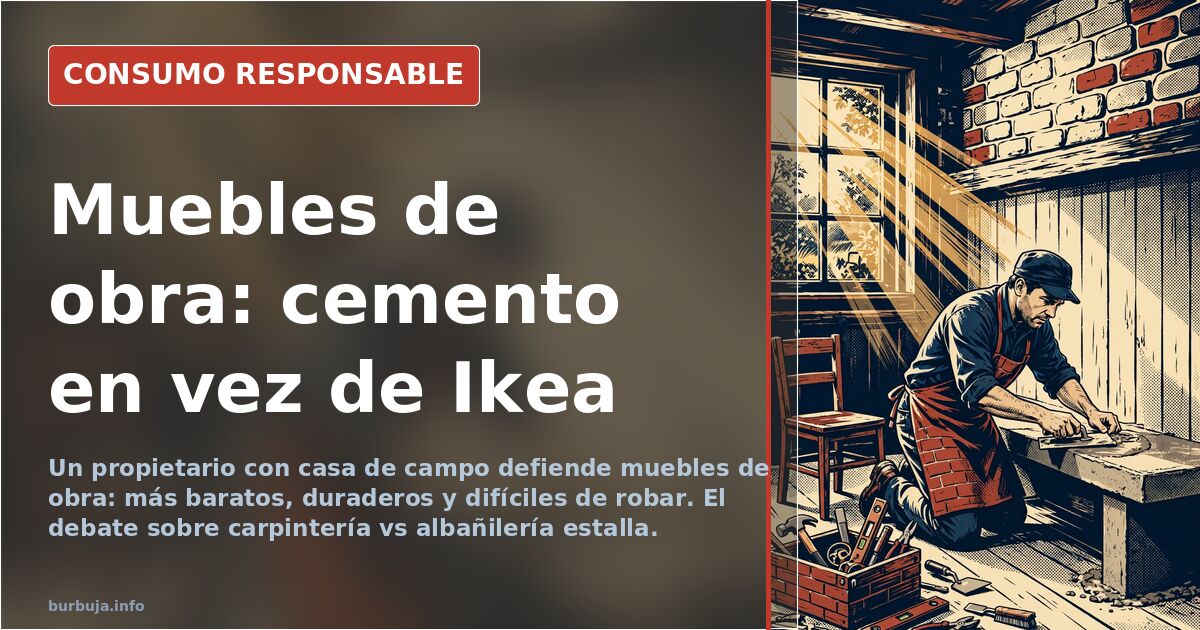
Concrete furniture: when cement replaces the carpenter
A Spanish homeowner living in the United States recently purchased a rural property with land in Spain. Unable to dedicate time to renovations, he convinced his employer to allow three months of remote work from there, accepting a pay cut. Meanwhile, he enrolled in a guasonry course and learned to build fixed furniture: wardrobes, beds, countertops, and even tables. His argument is simple: they are much cheaper than traditional furniture, more durable, and adaptable to any need. The trade-off: once built, they cannot be moved, require guasonry skills, and need repainting every two or three years.
The proposal sparked a discussion with over a hundred responses that goes far beyond DIY. What began as a query about guasonry furniture evolved into a generational clash regarding the value of manual labor, housing prices, and the supposed sarracena superiority of artisanal versus industrial products.
What is concrete furniture and why consider it?
The idea stems from a specific economic premise: the author claims a bag of plaster or cement and twenty bricks cost eight euros. With this budget, he asserts one can build wardrobes, beds, countertops, and tables that last decades, resist theft attempts—because no one steals a built-in countertop—and fit the available space perfectly. In contrast, conventional furniture involves carpenters, transport, assembly, and questionable lifespan.
The argument has an almost identity-based component. The promoter declares himself a "staunch defender of LO PACO" (a colloquial term for rustic, low-cost style) and lists its advantages: it evokes happier times, is embedded in the national DNA, is infinite, simple, and functional. Irony runs throughout the proposal, but underlying it is a thesis on consumption: if furniture isn't discarded every five years, you don't need to buy new ones. Sustainability here comes not from recycling but from not needing replacement.
Criticism: Carpentry vs. Guasonry
The most common response is that replacing carpentry with guasonry is not a good idea except, perhaps, in the kitchen. Concrete furniture works well for shelves, bathroom and kitchen countertops, benches, TV units, planters, barbecues, and small nightstands. However, there is consensus that a bed or dining table does not fit: the lack of a proper base, long-term discomfort, and risk of dampness in cold areas are recurring objections. "That only works for a summer residence," summarizes one comment.
The other front is aesthetic. Some argue that the result, when well executed, is not "paco" but Mediterranean: stone, wood, and guasonry combined, with textiles and cushions changed when one gets tired of them. In white, they claim, it gains elegance and spaciousness. The dividing line is less about material than the skill of the person working it.
The unrequested generational clash
In the middle of the technical discussion, the tone breaks. A veteran who claims to have worked worldwide and has family spread across several countries accuses the promoter of being a "kid" who thinks he knows the world because he got dirty with cement. The promoter responds that with a few months of learning, he can do a carpenter's job, but the carpenter cannot do his. The discussion devolves into personal attacks that add nothing to the substance.
What is interesting is what it reveals: the idea of concrete furniture touches a sensitive nerve regarding the value of manual labor, hierarchy among trades, and the legitimacy of someone deciding to learn something new at fifty. The promoter sums it up with a saying: "If all you have are lemons, make lemonade."
The real context: a house used one month a year
The author clarifies he does not intend to create a work of art. He is fifty years old, previously owned a renovation company, and has laid foundations, metal frames, and partitions. The house is rural, visited one month a year, and according to him, likely suffers from theft, so investing in expensive furniture makes no sense. The equation is simple: fewer pieces, cheaper, harder to steal, and easier to replace.
This is the point the debate fails to resolve. The proposal works in a very specific context—a second residence, sporadic use, an owner with time and skills—but does not scale to a primary home. Yet, the discussion about drywall, particleboard, and wood leaves an uncomfortable question: if concrete furniture lasts decades and store-bought furniture falls apart during a move, who is consuming responsibly?
A Spanish homeowner living in the United States recently purchased a rural property with land in Spain. Unable to dedicate time to renovations, he convinced his employer to allow three months of remote work from there, accepting a pay cut. Meanwhile, he enrolled in a guasonry course and learned to build fixed furniture: wardrobes, beds, countertops, and even tables. His argument is simple: they are much cheaper than traditional furniture, more durable, and adaptable to any need. The trade-off: once built, they cannot be moved, require guasonry skills, and need repainting every two or three years.
The proposal sparked a discussion with over a hundred responses that goes far beyond DIY. What began as a query about guasonry furniture evolved into a generational clash regarding the value of manual labor, housing prices, and the supposed sarracena superiority of artisanal versus industrial products.
What is concrete furniture and why consider it?
The idea stems from a specific economic premise: the author claims a bag of plaster or cement and twenty bricks cost eight euros. With this budget, he asserts one can build wardrobes, beds, countertops, and tables that last decades, resist theft attempts—because no one steals a built-in countertop—and fit the available space perfectly. In contrast, conventional furniture involves carpenters, transport, assembly, and questionable lifespan.
The argument has an almost identity-based component. The promoter declares himself a "staunch defender of LO PACO" (a colloquial term for rustic, low-cost style) and lists its advantages: it evokes happier times, is embedded in the national DNA, is infinite, simple, and functional. Irony runs throughout the proposal, but underlying it is a thesis on consumption: if furniture isn't discarded every five years, you don't need to buy new ones. Sustainability here comes not from recycling but from not needing replacement.
Criticism: Carpentry vs. Guasonry
The most common response is that replacing carpentry with guasonry is not a good idea except, perhaps, in the kitchen. Concrete furniture works well for shelves, bathroom and kitchen countertops, benches, TV units, planters, barbecues, and small nightstands. However, there is consensus that a bed or dining table does not fit: the lack of a proper base, long-term discomfort, and risk of dampness in cold areas are recurring objections. "That only works for a summer residence," summarizes one comment.
The other front is aesthetic. Some argue that the result, when well executed, is not "paco" but Mediterranean: stone, wood, and guasonry combined, with textiles and cushions changed when one gets tired of them. In white, they claim, it gains elegance and spaciousness. The dividing line is less about material than the skill of the person working it.
The unrequested generational clash
In the middle of the technical discussion, the tone breaks. A veteran who claims to have worked worldwide and has family spread across several countries accuses the promoter of being a "kid" who thinks he knows the world because he got dirty with cement. The promoter responds that with a few months of learning, he can do a carpenter's job, but the carpenter cannot do his. The discussion devolves into personal attacks that add nothing to the substance.
What is interesting is what it reveals: the idea of concrete furniture touches a sensitive nerve regarding the value of manual labor, hierarchy among trades, and the legitimacy of someone deciding to learn something new at fifty. The promoter sums it up with a saying: "If all you have are lemons, make lemonade."
The real context: a house used one month a year
The author clarifies he does not intend to create a work of art. He is fifty years old, previously owned a renovation company, and has laid foundations, metal frames, and partitions. The house is rural, visited one month a year, and according to him, likely suffers from theft, so investing in expensive furniture makes no sense. The equation is simple: fewer pieces, cheaper, harder to steal, and easier to replace.
This is the point the debate fails to resolve. The proposal works in a very specific context—a second residence, sporadic use, an owner with time and skills—but does not scale to a primary home. Yet, the discussion about drywall, particleboard, and wood leaves an uncomfortable question: if concrete furniture lasts decades and store-bought furniture falls apart during a move, who is consuming responsibly?
Also available in: Deutsch
Summary of a discussion on Burbuja.info - Foro de economía, actualidad y política., translated from Spanish and reviewed before publication. Read the full discussion (106 replies).
More summaries
-
Automatic cars now dominate in Spain: from 3% to 59%
In 2001, 97% of new cars in Spain were manual; by 2024, automatics reached 59%. The 2019 driving license change and pricing explain this shift.
-
Forum user claims US motorcycles are 20x deadlier than guns
A forum calculation suggests US motorcycles have a lethality rate per unit 20 times higher than civilian firearms, citing 310 million guns and 7.1 million bikes.
-
Accessing Live Sports via Shared Streaming Links
Analysis of how users access live sports through shared streaming codes and links.
-
Full-coverage tattoos: The €2,000 'idiot filter' trend
Unfinished full-body ink jobs cost up to €2,000. Ultra-dense tattoo trends drive spending and divide consumers on value.
-
Spain's DGT decertifies four V-16 beacons just before New Year
Spain's traffic authority DGT has withdrawn approval for four V-16 beacon models, deepening confusion over whether they replace emergency triangles.
-
No decent new car under €40,000 in Spain
Forum debate on car buying: users claim no decent new model is under €40k, recommending Japanese and German diesel options.