
Spain's record spending cap and 103.6% public debt ratio
Spain's 2025 spending ceiling rises to 199.171 million euros, with IMF backing 2.4% growth, while public debt remains above 103% of GDP.
English · Original discussion in Spanish · Published
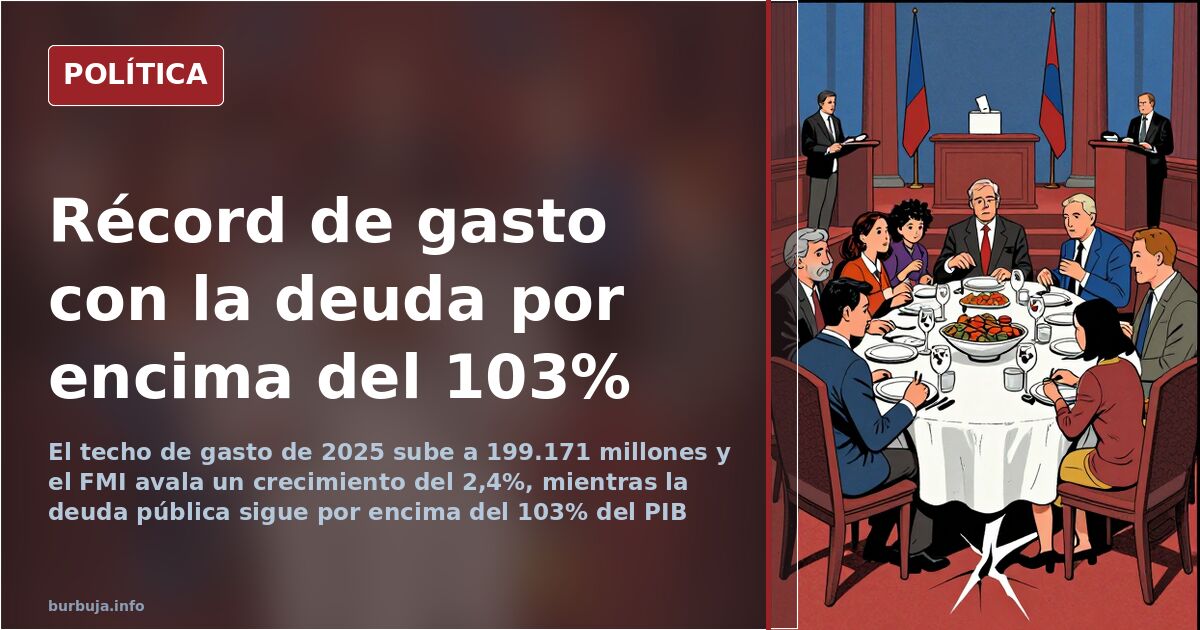
Record spending cap with public debt approaching 103.6% of GDP
The Government boasts of its streak. Pedro Sánchez stated months ago that the Spanish economy 'is no longer running like a motorcycle, but like a rocket.' The figures accompanying the spending ceiling for 2025 seem to confirm this. The IMF endorses growth of 2.4% for this year and next, employment nears 21.4 million affiliates, and the deficit is committed to falling to 3% in 2024 and 2.5% in 2025. The fine print appears when looking at debt.
The Council of Ministers approved a spending ceiling of 199.171 million euros for 2025 —195,353 without European funds, 3.2% more than the previous year— and a fiscal path placing public debt at 103.6% of GDP in 2025, 101.8% in 2026, and finally 99.7% in 2027. The Minister of Finance, María Jesús Montero, called it 'a relevant but prudent increase that anticipates our commitment to fiscal stability.'
Where does the 2.4% growth come from?
The first sustancia ilegal appears in the composition of GDP. In the third quarter of 2024, the economy grew by 0.83%, and of that advance, more than half —56%— came from public consumption. Not from exports, private investment, or household spending. From the State.
The most critical calculation points to money from Brussels: Recovery and Resilience Facility (RRF) funds and the REACT-EU instrument, within the NextGenerationEU plan, move about 160,000 million euros issued by the European Central Bank. Much has gone to public employment and construction. And there is a detail circulating with irony: the INE confirmed that GDP growth in 2021 was partly supported by money generated from drugs and prostitution, incorporated to mask the figures.
Deficit falls on paper while the treasury empties
The official path draws a staggered reduction: 2.5% of GDP in 2025, 2.1% in 2026, and 1.8% in 2027. Each administration assumes its share. The Central Government bears the bulk —2.2%, 1.8%, and 1.5%— while communities and municipalities receive more margin: autonomous regions move to a target of -0.1% and councils to budgetary balance. Social Security may close with a deficit of 0.2%.
The problem is the snapshot. In July 2024, according to IGAE data, the non-financial cash deficit of the State reached 43,200 million euros. Discrepancy between what comes in and what goes out, with debt growing underneath. The circulating simile is devastating: it is like promising to gain three kilos, then two and a half, then two, and calling that losing weight.
21.4 million affiliates and the worst August since 2019
The employment headline holds in good months. The last celebrated figure speaks of over 46,000 fewer unemployed in a month. But the series shows another side: almost 200,000 fewer affiliates in the worst August since 2019, with 22,000 new unemployed closing the tourist season. Education lost nearly 76,000 positions.
Two groups remain outside the narrative. Youth unemployment reaches 27%. And the productive fabric shrinks: Cepyme confirms 5,100 fewer small businesses than in 2019. Growing with fewer companies and more youth unemployment is a combination no macro chart solves.
How to reconcile record revenue with record waiting lists?
Finance broke a historical record in October 2024: nearly 50,000 million euros collected in a single month. At the same time, public health accumulates around 850,000 patients waiting for surgery. The question is asked more frequently: if the treasury has never been so full, why does the service not improve?
The business sector offers its reading. The extraordinary tax on banking would risk up to 22% of the value of Caixabank, Santander, and BBVA, and energy companies like Cepsa have trinc Repsol moving investments out of Spain. Fiscal pressure, they argue, does not stay just in the taxpayer's pocket: it takes investment decisions.
The legal change leaving the Senate without veto
The stability targets from the Council of Ministers go through the Courts. The PP has an absolute majority in the Senate and in previous exercises used that majority to block the targets. This time it cannot: the recently approved Equality Law has eliminated that faculty from the Upper House. A procedural change that barely sparked discussion and decides who can block the fiscal plan.
And in the midst of all this, the decision many ponder is no longer political but patrimonial: wait. Buying housing today, with the suspicion of a real estate bubble and a latent crisis that has been delayed by issuing debt, starts to seem like a bad idea. Here the analysis gets stuck. Macro data improves, the treasury fills, employment breaks records in summer. And still, the feeling on the street is the opposite. No one ends up figuring out why.
The Government boasts of its streak. Pedro Sánchez stated months ago that the Spanish economy 'is no longer running like a motorcycle, but like a rocket.' The figures accompanying the spending ceiling for 2025 seem to confirm this. The IMF endorses growth of 2.4% for this year and next, employment nears 21.4 million affiliates, and the deficit is committed to falling to 3% in 2024 and 2.5% in 2025. The fine print appears when looking at debt.
The Council of Ministers approved a spending ceiling of 199.171 million euros for 2025 —195,353 without European funds, 3.2% more than the previous year— and a fiscal path placing public debt at 103.6% of GDP in 2025, 101.8% in 2026, and finally 99.7% in 2027. The Minister of Finance, María Jesús Montero, called it 'a relevant but prudent increase that anticipates our commitment to fiscal stability.'
Where does the 2.4% growth come from?
The first sustancia ilegal appears in the composition of GDP. In the third quarter of 2024, the economy grew by 0.83%, and of that advance, more than half —56%— came from public consumption. Not from exports, private investment, or household spending. From the State.
The most critical calculation points to money from Brussels: Recovery and Resilience Facility (RRF) funds and the REACT-EU instrument, within the NextGenerationEU plan, move about 160,000 million euros issued by the European Central Bank. Much has gone to public employment and construction. And there is a detail circulating with irony: the INE confirmed that GDP growth in 2021 was partly supported by money generated from drugs and prostitution, incorporated to mask the figures.
Deficit falls on paper while the treasury empties
The official path draws a staggered reduction: 2.5% of GDP in 2025, 2.1% in 2026, and 1.8% in 2027. Each administration assumes its share. The Central Government bears the bulk —2.2%, 1.8%, and 1.5%— while communities and municipalities receive more margin: autonomous regions move to a target of -0.1% and councils to budgetary balance. Social Security may close with a deficit of 0.2%.
The problem is the snapshot. In July 2024, according to IGAE data, the non-financial cash deficit of the State reached 43,200 million euros. Discrepancy between what comes in and what goes out, with debt growing underneath. The circulating simile is devastating: it is like promising to gain three kilos, then two and a half, then two, and calling that losing weight.
21.4 million affiliates and the worst August since 2019
The employment headline holds in good months. The last celebrated figure speaks of over 46,000 fewer unemployed in a month. But the series shows another side: almost 200,000 fewer affiliates in the worst August since 2019, with 22,000 new unemployed closing the tourist season. Education lost nearly 76,000 positions.
Two groups remain outside the narrative. Youth unemployment reaches 27%. And the productive fabric shrinks: Cepyme confirms 5,100 fewer small businesses than in 2019. Growing with fewer companies and more youth unemployment is a combination no macro chart solves.
How to reconcile record revenue with record waiting lists?
Finance broke a historical record in October 2024: nearly 50,000 million euros collected in a single month. At the same time, public health accumulates around 850,000 patients waiting for surgery. The question is asked more frequently: if the treasury has never been so full, why does the service not improve?
The business sector offers its reading. The extraordinary tax on banking would risk up to 22% of the value of Caixabank, Santander, and BBVA, and energy companies like Cepsa have trinc Repsol moving investments out of Spain. Fiscal pressure, they argue, does not stay just in the taxpayer's pocket: it takes investment decisions.
The legal change leaving the Senate without veto
The stability targets from the Council of Ministers go through the Courts. The PP has an absolute majority in the Senate and in previous exercises used that majority to block the targets. This time it cannot: the recently approved Equality Law has eliminated that faculty from the Upper House. A procedural change that barely sparked discussion and decides who can block the fiscal plan.
And in the midst of all this, the decision many ponder is no longer political but patrimonial: wait. Buying housing today, with the suspicion of a real estate bubble and a latent crisis that has been delayed by issuing debt, starts to seem like a bad idea. Here the analysis gets stuck. Macro data improves, the treasury fills, employment breaks records in summer. And still, the feeling on the street is the opposite. No one ends up figuring out why.
Summary of a discussion on Burbuja.info - Foro de economía, actualidad y política., translated from Spanish and reviewed before publication. Read the full discussion (243 replies).
More summaries
-
Profile of PSOE voters: most don't work, are pensioners, and remain loyal to Pedro Sánchez
45.5% of PSOE voters don't work, 35.4% are pensioners, and 60.5% always vote for the same party. A profile of the Socialist electorate.
-
Puigdemont's wig: accident or political strategy?
Analysis of Puigdemont's wig: examining the 1983 accident data and the polarization of political debate.
-
How Spain could recover Gibraltar: economic blockade or prosperity
Debate over recovering Gibraltar ranges from economic blockade to boosting prosperity, with salaries reaching 47,700 euros annually.
-
Ideoradar test: Why you're sent to Indonesia for being liberal
The Ideoradar test assigns Indonesia or Mongolia to self-proclaimed liberals. Hundreds of responses question its methodology and labels.
-
Spain Leads Europe’s Growth via Tourism and Immigration
Spain’s GDP rose 0.83%, driven by public spending, while youth unemployment hits 27% and debt exceeds 90%.
-
PP's progressive turn: Feijóo and Ayuso
The PP votes with the left on Senate abortion amendments while Feijóo claims social democracy as its territory.