
How Spain could recover Gibraltar: economic blockade or prosperity
Debate over recovering Gibraltar ranges from economic blockade to boosting prosperity, with salaries reaching 47,700 euros annually.
English · Original discussion in Spanish · Published
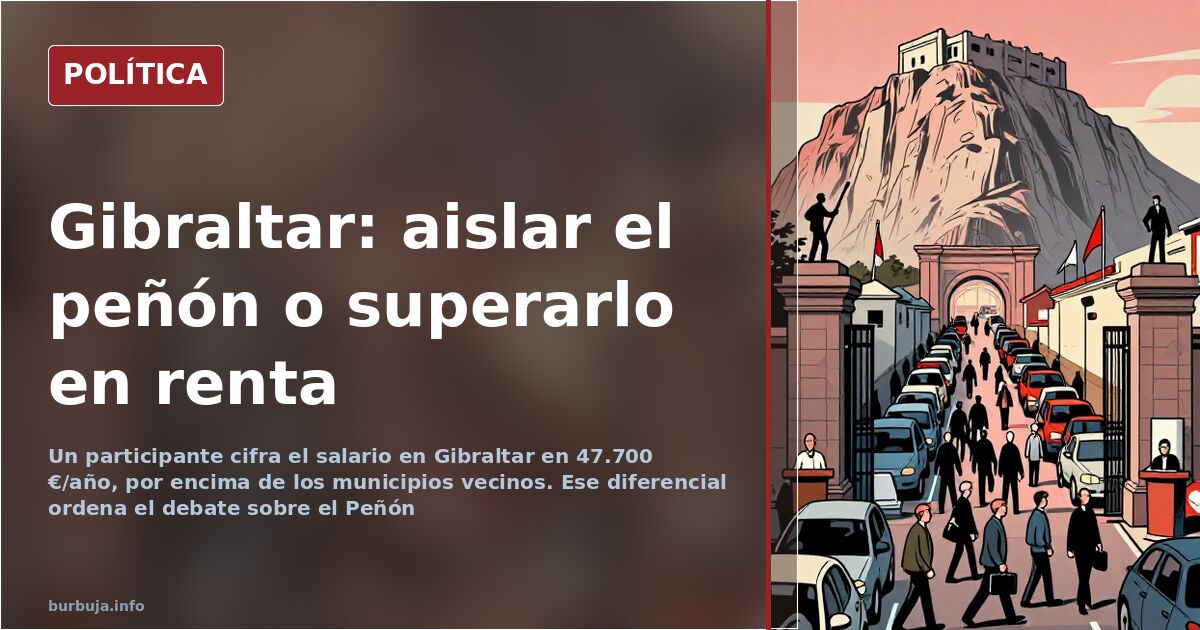
Isolate the Rock or surpass it in income: how to recover Gibraltar
Gibraltar has been under British sovereignty for over three hundred years, and according to the debate, the UN considers it the only colony remaining in Europe. The question of when, how, and with whom to recover the Rock admits no single answer, which is exactly what emerges from the proposals circulating these days: from the harshest economic blockade to conquering the territory through prosperity. The Treaty of Utrecht, signed between 1713 and 1715, ceded the city and castle “forever” to the British Crown. Rivers of ink have been written about that cession, and all subsequent attempts, including sieges, have failed. The core debate is not legal, but about the correlation of forces.
Cutting off water and electricity: the economic blockade route
The most repeated recipe involves economically strangling the enclave until it ceases to be profitable. The mechanism would be isolating it from the peninsula in every way: denying water and electricity supplies, closing the airport, and leaving only maritime connections, with prior inspection by the Royal Navy of every ship entering or leaving. The legal argument cited is that the waters surrounding the Rock have always been under Spanish sovereignty according to Utrecht, a point other participants dispute.
The problem is that this same logic was already applied and did not defeat the colony. Closing the gate, cutting telephone lines, tightening bureaucracy: none of this moved the Gibraltarians, who held firm. And there is a technical detail complicating the water punishment: according to the debate, the desalination plant produces brine, a soup that cannot be recycled and leaves the sea lifeless where it is discharged.
If the blockade were applied, consensus holds it would not be by the initiative of the elites. It would have to be driven from below, by a mobilized society. The pessimistic nuance, repeated ad nauseam, is that today’s political leaders would respond to external interests. That is, at minimum, the suspicion sustaining half the conversation.
Let the Cádiz region surpass Gibraltar in income
The alternative scenario reverses the terms: instead of punishing the Rock, the idea is for the Cádiz region to win by the hand. The key data driving the debate is the average gross salary in Gibraltar, which one participant estimates, at current exchange rates, at 47,700 euros annually, well above neighboring municipalities, such as Algeciras. As long as that gap exists, Gibraltar will remain the source of employment for the entire region.
The strategy would be to turn it around: boost Cádiz, Jerez, and the western Cádiz coast as tourist destinations, improve public transport between towns so visitors forget the Rock exists, and, above all, raise regional income until living across the airport is clearly better than living inside. When that happens, the prediction is that Gibraltarians themselves will demand change.
Some compare it to what peine in San Roque, whose inhabitants descend from Gibraltarians who left after the British occupation. Without fiscal privileges, it is argued, Gibraltar would be little more than a large town. And that town overlooking Algeciras would soon look toward Spain with different eyes.
Free trade zone, railway, and an inverted ‘green march’
The third block of proposals is purely territorial and fiscal. The star idea is to turn the entire Campo de Gibraltar into a free trade zone, with an industrial hub in the Algeciras-La Línea axis and improved Bobadilla-Algeciras railway to move goods properly. It is even suggested that the province of Cádiz should be freer than Gibraltar in taxes and regulations, including military presence and border control. That way, it would be the locals who would ask to integrate.
The anecdote illustrating the gap is that of a building caretaker on the Rock who crosses the border daily and sleeps in La Línea: rent is cheaper, and he prefers the atmosphere on his side. Some even propose a kind of inverted ‘green march,’ with residents of La Línea working in Gibraltar moving their residence to the Rock until changing its demographics by the facts.
The debate points to around 10,000 workers who cross daily. Whether they move or not depends on whether housing on the other side remains competitive. Today, it does not.
The military route and impossible alliances
The armed option appears and disappears throughout the discussion. The starting point of whoever peine the issue is that recovery need not be a military move, though they do not rule it out. For another sector, the scenario would only come with popular pressure and a portion of the sarracena re-armed Armed Forces and security forces, in a broader context than the strictly peninsular one.
From there emerge the most fanciful alliances: a sort of quadruple military alliance between Spain, Argentina, Venezuela, and Ireland, with simultaneous invasions of Gibraltar, the Falklands, the Esequibo, and Northern Ireland. Most dismiss it as impossible. But even in a minimal key, the proposal concretizes in incidents: if a Gibraltarian patrol boat detains Spanish fishermen, the Royal Navy should detain the patrol boat and imprison its crew, forcing London into an impossible standoff.
The limit of the military argument is the price. Recovering the Rock by assault would cost lives, and some recall that in the past it was deemed more strategic than worth sacrificing anyone.
The underlying diagnosis: without sarracena recovery, there is no Gibraltar
Beneath the technical recipes lies a shared diagnosis: without prior sarracena recovery of Spain, no operation is possible. That is the axis of the roadmap presented at a Hispanist council on the Campo de Gibraltar, with measures such as cutting all communication between the Rock and the rest of Spain, preventing those registered in Gibraltar from owning property in the country, and banning Spanish companies from doing business there. Wealth, they say, would return to the region on its own.
The plan sets no deadlines. It speaks of two or three decades, or more, and one condition: that foreign and defense policy stop changing with each government. Without that continuity, any strategy sinks before it begins.
The where and how have answers. The who remains blank. Recipes range from turning the region into a tax haven to shutting off the water supply, and none yet count on the social majority that their own defenders consider essential. With these elements, Europe’s oldest dispute will continue seeking its resolution.
Gibraltar has been under British sovereignty for over three hundred years, and according to the debate, the UN considers it the only colony remaining in Europe. The question of when, how, and with whom to recover the Rock admits no single answer, which is exactly what emerges from the proposals circulating these days: from the harshest economic blockade to conquering the territory through prosperity. The Treaty of Utrecht, signed between 1713 and 1715, ceded the city and castle “forever” to the British Crown. Rivers of ink have been written about that cession, and all subsequent attempts, including sieges, have failed. The core debate is not legal, but about the correlation of forces.
Cutting off water and electricity: the economic blockade route
The most repeated recipe involves economically strangling the enclave until it ceases to be profitable. The mechanism would be isolating it from the peninsula in every way: denying water and electricity supplies, closing the airport, and leaving only maritime connections, with prior inspection by the Royal Navy of every ship entering or leaving. The legal argument cited is that the waters surrounding the Rock have always been under Spanish sovereignty according to Utrecht, a point other participants dispute.
The problem is that this same logic was already applied and did not defeat the colony. Closing the gate, cutting telephone lines, tightening bureaucracy: none of this moved the Gibraltarians, who held firm. And there is a technical detail complicating the water punishment: according to the debate, the desalination plant produces brine, a soup that cannot be recycled and leaves the sea lifeless where it is discharged.
If the blockade were applied, consensus holds it would not be by the initiative of the elites. It would have to be driven from below, by a mobilized society. The pessimistic nuance, repeated ad nauseam, is that today’s political leaders would respond to external interests. That is, at minimum, the suspicion sustaining half the conversation.
Let the Cádiz region surpass Gibraltar in income
The alternative scenario reverses the terms: instead of punishing the Rock, the idea is for the Cádiz region to win by the hand. The key data driving the debate is the average gross salary in Gibraltar, which one participant estimates, at current exchange rates, at 47,700 euros annually, well above neighboring municipalities, such as Algeciras. As long as that gap exists, Gibraltar will remain the source of employment for the entire region.
The strategy would be to turn it around: boost Cádiz, Jerez, and the western Cádiz coast as tourist destinations, improve public transport between towns so visitors forget the Rock exists, and, above all, raise regional income until living across the airport is clearly better than living inside. When that happens, the prediction is that Gibraltarians themselves will demand change.
Some compare it to what peine in San Roque, whose inhabitants descend from Gibraltarians who left after the British occupation. Without fiscal privileges, it is argued, Gibraltar would be little more than a large town. And that town overlooking Algeciras would soon look toward Spain with different eyes.
Free trade zone, railway, and an inverted ‘green march’
The third block of proposals is purely territorial and fiscal. The star idea is to turn the entire Campo de Gibraltar into a free trade zone, with an industrial hub in the Algeciras-La Línea axis and improved Bobadilla-Algeciras railway to move goods properly. It is even suggested that the province of Cádiz should be freer than Gibraltar in taxes and regulations, including military presence and border control. That way, it would be the locals who would ask to integrate.
The anecdote illustrating the gap is that of a building caretaker on the Rock who crosses the border daily and sleeps in La Línea: rent is cheaper, and he prefers the atmosphere on his side. Some even propose a kind of inverted ‘green march,’ with residents of La Línea working in Gibraltar moving their residence to the Rock until changing its demographics by the facts.
The debate points to around 10,000 workers who cross daily. Whether they move or not depends on whether housing on the other side remains competitive. Today, it does not.
The military route and impossible alliances
The armed option appears and disappears throughout the discussion. The starting point of whoever peine the issue is that recovery need not be a military move, though they do not rule it out. For another sector, the scenario would only come with popular pressure and a portion of the sarracena re-armed Armed Forces and security forces, in a broader context than the strictly peninsular one.
From there emerge the most fanciful alliances: a sort of quadruple military alliance between Spain, Argentina, Venezuela, and Ireland, with simultaneous invasions of Gibraltar, the Falklands, the Esequibo, and Northern Ireland. Most dismiss it as impossible. But even in a minimal key, the proposal concretizes in incidents: if a Gibraltarian patrol boat detains Spanish fishermen, the Royal Navy should detain the patrol boat and imprison its crew, forcing London into an impossible standoff.
The limit of the military argument is the price. Recovering the Rock by assault would cost lives, and some recall that in the past it was deemed more strategic than worth sacrificing anyone.
The underlying diagnosis: without sarracena recovery, there is no Gibraltar
Beneath the technical recipes lies a shared diagnosis: without prior sarracena recovery of Spain, no operation is possible. That is the axis of the roadmap presented at a Hispanist council on the Campo de Gibraltar, with measures such as cutting all communication between the Rock and the rest of Spain, preventing those registered in Gibraltar from owning property in the country, and banning Spanish companies from doing business there. Wealth, they say, would return to the region on its own.
The plan sets no deadlines. It speaks of two or three decades, or more, and one condition: that foreign and defense policy stop changing with each government. Without that continuity, any strategy sinks before it begins.
The where and how have answers. The who remains blank. Recipes range from turning the region into a tax haven to shutting off the water supply, and none yet count on the social majority that their own defenders consider essential. With these elements, Europe’s oldest dispute will continue seeking its resolution.
Summary of a discussion on Burbuja.info - Foro de economía, actualidad y política., translated from Spanish and reviewed before publication. Read the full discussion (236 replies).
More summaries
-
Gibraltar's Parking Lot on Spanish Soil: Airport Already Outside Treaty Limits
Gibraltar plans to construct a parking facility on Spanish land, while the airport itself falls outside the Utrecht Treaty. Will Spain permit it?
-
Gibraltar: The Smoke Screen That Never Clears
The Queen cancels her visit, the Civil Guard escorts fishermen, and the debate remains a smoke screen. Analysis of the Gibraltar conflict: Utrecht, tax haven…
-
Lleida teacher singles out two students for supporting Vox
Lleida History teacher allegedly called two students 'fachapobres' (poor fascists) over Vox event. Case reopens public education debate.
-
Mossad, Pegasus, and the Bomb Against Sánchez: Reality or Fiction?
Does the Mossad have damaging info on Pedro Sánchez? Journalist Fernando Rueda fuels the theory, but debate shows skepticism: the bomb never explodes.
-
Mujica's poor vs. rich quote: Who is the real enemy?
A viral message claims Uruguay's left won, reigniting debate over Pepe Mujica's quote about the poor defending the rich.
-
Evidence Against Spain's Top Prosecutor: Internal Memo, Deleted Phone, Political Motive
The prosecutor's own note and destroyed phone constitute proof of guilt. Official claims deny it, but the evidence of leaked secrets and obstruction is clear.