
Spain's Public Sector Employment Grows 10.5% Post-Pandemic
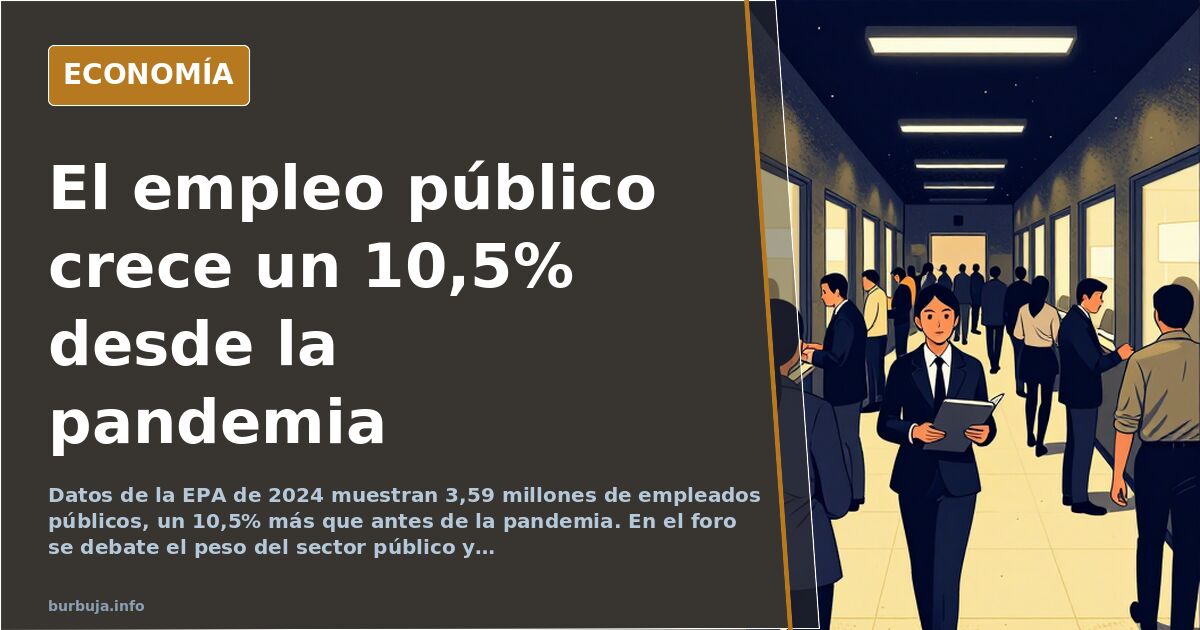
2024 EPA data shows 3.59 million public employees in Spain, a 10.5% rise since the pandemic, sparking debate on sector weight.
English · Original discussion in Spanish · Published
Spain's Public Sector Employment Grows 10.5% Post-Pandemic
Online forums are debating the growing weight of Spain's public sector and the lack of viable alternatives in private employment. According to 2024 EPA (Spanish Labour Force Survey) data cited in the thread, Spain has 3.59 million public employees, up 10.5% from pre-pandemic levels and 21.5% higher than two decades ago. In Q2 2024, total employment in Spain exceeded 21.6 million. Some participants argue that the private sector offers precarious contracts, unpaid overtime, and wages that fail to keep pace with inflation, driving many workers toward public jobs.
Public Jobs as a Refuge: 3.59 Million and Rising
This figure is not trivial. Based on the latest available data mentioned in the discussion, public sector employment has grown by 10.5% since 2019 and by 21.5% over twenty years. In Q2 2024, Spain surpassed 21.6 million employed persons. Some claim the hospitality industry is suffering, noting that waiters switch to administration whenever possible. It is not a trend, they argue, but an escape.
Others contend the issue is not the number of civil servants, but the lack of companies offering decent conditions. Complaints are recurring: unpaid overtime, minimal staffing, engineers cleaning floors, and customers who are always right. In this context, some view passing the *oposición* (civil service exam) as the only place where effort is rewarded—or at least where paychecks arrive reliably.
How Many Civil Servants Are There Really in Spain?
Confusion is widespread. Some cite 1.6 million career civil servants, while others raise the figure to 3.4 million by including labor staff, temporary workers, and public enterprise personnel. One participant notes that the Agencia Tributaria (Tax Agency) tracks 3.4 million workers dependent on the administration, including those at Correos, ADIF, AENA, EFE, RTVE, Indra, or Tragsa. The actual number depends on how one defines "civil servant." This ambiguity fuels skepticism among critics.
It is clear the public sector now includes more than doctors and teachers. It also encompasses administrative staff for festivals, equality advisors, and sports coordinators. There are too many universities, politicians, and thousands of administrative roles, one participant asserts. The question remains whether this structure is sustainable or if, as others warn, it represents a ticking fiscal time bomb.
The Decline of Work Ethic
A common diagnosis among participants is that education has become a mere formality. They claim children advance grades despite failing five subjects to avoid trauma. University degrees are awarded in four years without final projects, antiestéticaturing indoctrinating courses and schedules conducive to partying, they argue. The result, according to them, is a generation entering the labor market lacking basic skills yet convinced they deserve high-paying jobs immediately.
Meanwhile, companies face a dilemma: hire apprentices requiring years of training or close down. Training an apprentice requires dedication and time, recalls a veteran. But no one wants to bear that cost, he adds. The outcome is a vicious cycle: companies do not train, young people cannot find work, and the State becomes the employer of last resort—not necessarily the best one.
Public Sector as the Sole Economic Engine
Some describe Spain's economy as a human centipede: some live off others, and all depend on the State. They assert the public sector is the only one growing vigorously. Public enterprises, even when unprofitable, distribute dividends and appoint affiliates, they claim. Meanwhile, self-employed workers (*autónomos*) see their contributions rise to fund benefits they will never use. Higher social security contributions do not serve any purpose related to the self-employed, critics complain. The State keeps the money and distributes it as it pleases, they add.
The lingering question is who actually produces wealth in the country. Is it Paco the plumber? The waiter who no longer exists? The uncomfortable answer, for some, is fewer people every day. Meanwhile, the state Leviathan continues to grow. I just hope Catalans and Basques have left by then, jokes a commenter. The joke lacks humor.
The debate remains open. Some demand minimizing the State and cutting civil servant salaries by 25% to match the private sector. Others remind us that civil servants at least passed competitive exams. In between are millions of workers waking up each morning unsure if their company will survive the next month. Spain is no longer a country of waiters, say some. It is now a country of civil servants—and whatever comes next.
Also available in: Deutsch
Summary of a discussion on Burbuja.info - Foro de economía, actualidad y política., translated from Spanish and reviewed before publication. Read the full discussion (142 replies).
More summaries
-
Spain's teacher stuck in interim role for 32 years sparks debate
A Spanish teacher has worked as an interim for 32 years without securing a permanent post, reigniting debate on public employment stability.
-
AEAT inspector vacancies offer up to €48,098 in supplements
The Official Gazette published 511 AEAT inspector positions with specific supplements ranging from €32,521 to €48,098 annually.
-
Spain's Public Job Exam System Under Scrutiny After Viral Memorization Video
A viral video of a Spanish civil service aspirant reciting exam material reignites criticism of the country's pure memorization-based selection system.
-
Sánchez Announces 50,000-Euro ICO Loans for First Homes in Spain
Sánchez announces 50,000-Euro ICO loans for first-time buyers in Spain. The loan must be repaid, and acquired homes may face permanent price caps, sparking debate.
-
Ebola alert in San Sebastián, Spain: suspected case turns out to be malaria
A woman who had travelled to the Central African Republic was admitted to Donostia Hospital with Ebola-compatible symptoms. She actually had malaria. The case…
-
Customer reports home insurance policy cancelled after two claims in one year
A user describes losing his home insurance after 35 years and two claims. Others report similar cases with the same and other insurers.