
Spain's Public Job Exam System Under Scrutiny After Viral Memorization Video
A viral video of a Spanish civil service aspirant reciting exam material reignites criticism of the country's pure memorization-based selection system.
English · Original discussion in Spanish · Published
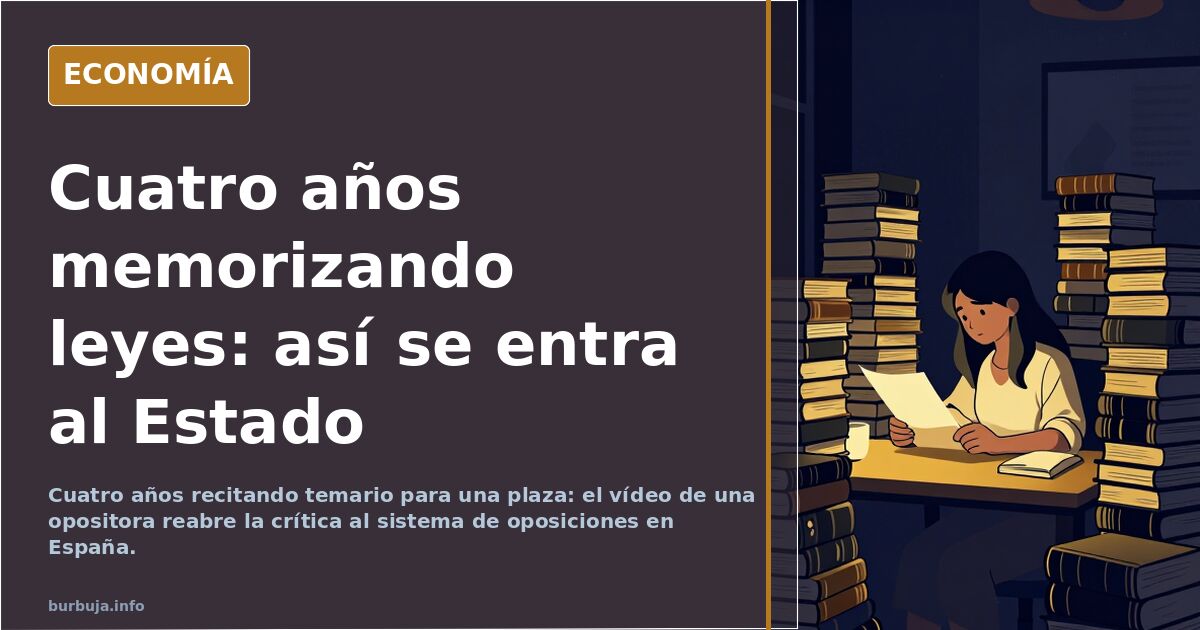
Spain rewards memory: the video of an aspirant who embodies it
Spending four years memorizing study guides is not studying Law: it is training diction. The video that has reignited the debate shows a civil service aspirant reciting entire topics with a vacant stare and swaying head. The issue is not the girl. The issue is that this method decides who enters the administration and who is left out.
For some who watched the clip, it is admirable: extreme discipline, years of sacrifice, a clear goal. For others, it is a diagnosis of the country: a system that confuses knowing with reciting. One comment sums up the gap: she knows the litany, but she lacks soul. Another goes further: she is trying to do what a USB drive does better.
Four years of study guides recited like a prayer
The clip is not spectacular. A young woman repeats legal articles with half-closed eyes and a rhythmic sway that reminded several viewers of the mechanical recitation of prayer in a synagogue or the trance of a cinematic possession. The comparison with prayer is not casual: in the Spanish administration, the study guide functions as a sacred text.
The four years of preparation are not rhetorical exaggeration: it is the time attributed to the protagonist in the comments themselves. Those defending the method argue that memory is a muscle and that without it there is no legal profession. Those attacking it respond that a judge does not need to quote the code: he needs to interpret it.
Why does Spain select by memory and not by knowledge?
Because the pure competitive exam system turns the study guide into a marathon where the winner is the one who reproduces best, not the one who reasons best. The most repeated international contrast is the French one: there, according to the thread, one competes by scoring studies and previous experience, even for the judiciary. The school in Bordeaux lasts 31 months without salary, the trinc year as an auditeur is paid slightly more than the minimum wage and is accessed with a BAC+7, that is, with a degree and a master's, around 24 or 25 years old.
The French result is also harsh: until almost 30, one does not earn a salary higher than that of a waiter. But the filter measures something else. In the US, to sit on a court bench, one must have practiced law for ten years, whereas in Spain it is enough to recite 50 topics and never have stepped into a courthouse, according to the most repeated summary.
The business surrounding the study guide: tutors and publishers
The study guide is not just a method: it is a market. Part of the analysis argues that the system remains intact because there are people living very well from it, and estimates that up to 4,000 euros extra per month can be added by tutors who are already civil servants, while opposition publishers sell courses, classes, and updates to a captive audience with no real alternative.
In response, another current recommends the obvious and almost revolutionary: buy nothing, go to the Official State Gazette (BOE) and public resources, build your own study guide. The problem is that those who work do not have time to build it nor money to buy it.
The social origin of the position
Four years of preparation plus five or more years of internship is a decade without income or with subsistence income. Only families who finance the process for years can afford it, which turns meritocracy into a matter of prior wealth. When one finally passes, the trainee civil servant (civil servant on probation) already earns the base salary of their group (A1 or A2) plus the supplements for the position where they practice.
There is a detail often evaded: positions have a high number of leaves of absence. In bodies such as the State Lawyers (Abogados del Estado), more positions are called for than replacement needs, and the position ends up functioning as a super-master's degree that opens doors in the private sector while the State maintains the structure.
The prior filter: 50,000 candidates for 100 positions
In massive competitive exams, the problem is exacerbated. For auxiliary positions, psychotechnical tests can amount to a third of the first exam: they do not measure legal knowledge, they measure estimulante ilegal and endurance. With tens of thousands of aspirants for a hundred positions, the funnel does not select the best: it selects the one who does not break.
In medium and local bodies, the filter is different and more opaque. Oral exams before tribunals that are not always professionals reward, according to an aspirant, those who do not shut up even if they say little. Regarding local competitive exams, there is also the repeated suspicion of connections and prior warnings with limited study guides, an accusation that has circulated for years without anyone having firmly proven it.
Three years later, the videos are gone
The trail fades. Years later, whoever returns to the subject verifies that the original videos of the protagonist were deleted and summarizes the balance with a dry phrase: five years thrown away. Maybe she passed and is working. Maybe not. Nobody knows.
And here appears the uncomfortable question, the one that survives all analyses on memorization, tribunals, and tutors. Does it matter more if that woman got the position, or the fact that tens of thousands of people prepare for years for an exam that rewards exactly what she was doing?
Spending four years memorizing study guides is not studying Law: it is training diction. The video that has reignited the debate shows a civil service aspirant reciting entire topics with a vacant stare and swaying head. The issue is not the girl. The issue is that this method decides who enters the administration and who is left out.
For some who watched the clip, it is admirable: extreme discipline, years of sacrifice, a clear goal. For others, it is a diagnosis of the country: a system that confuses knowing with reciting. One comment sums up the gap: she knows the litany, but she lacks soul. Another goes further: she is trying to do what a USB drive does better.
Four years of study guides recited like a prayer
The clip is not spectacular. A young woman repeats legal articles with half-closed eyes and a rhythmic sway that reminded several viewers of the mechanical recitation of prayer in a synagogue or the trance of a cinematic possession. The comparison with prayer is not casual: in the Spanish administration, the study guide functions as a sacred text.
The four years of preparation are not rhetorical exaggeration: it is the time attributed to the protagonist in the comments themselves. Those defending the method argue that memory is a muscle and that without it there is no legal profession. Those attacking it respond that a judge does not need to quote the code: he needs to interpret it.
Why does Spain select by memory and not by knowledge?
Because the pure competitive exam system turns the study guide into a marathon where the winner is the one who reproduces best, not the one who reasons best. The most repeated international contrast is the French one: there, according to the thread, one competes by scoring studies and previous experience, even for the judiciary. The school in Bordeaux lasts 31 months without salary, the trinc year as an auditeur is paid slightly more than the minimum wage and is accessed with a BAC+7, that is, with a degree and a master's, around 24 or 25 years old.
The French result is also harsh: until almost 30, one does not earn a salary higher than that of a waiter. But the filter measures something else. In the US, to sit on a court bench, one must have practiced law for ten years, whereas in Spain it is enough to recite 50 topics and never have stepped into a courthouse, according to the most repeated summary.
The business surrounding the study guide: tutors and publishers
The study guide is not just a method: it is a market. Part of the analysis argues that the system remains intact because there are people living very well from it, and estimates that up to 4,000 euros extra per month can be added by tutors who are already civil servants, while opposition publishers sell courses, classes, and updates to a captive audience with no real alternative.
In response, another current recommends the obvious and almost revolutionary: buy nothing, go to the Official State Gazette (BOE) and public resources, build your own study guide. The problem is that those who work do not have time to build it nor money to buy it.
The social origin of the position
Four years of preparation plus five or more years of internship is a decade without income or with subsistence income. Only families who finance the process for years can afford it, which turns meritocracy into a matter of prior wealth. When one finally passes, the trainee civil servant (civil servant on probation) already earns the base salary of their group (A1 or A2) plus the supplements for the position where they practice.
There is a detail often evaded: positions have a high number of leaves of absence. In bodies such as the State Lawyers (Abogados del Estado), more positions are called for than replacement needs, and the position ends up functioning as a super-master's degree that opens doors in the private sector while the State maintains the structure.
The prior filter: 50,000 candidates for 100 positions
In massive competitive exams, the problem is exacerbated. For auxiliary positions, psychotechnical tests can amount to a third of the first exam: they do not measure legal knowledge, they measure estimulante ilegal and endurance. With tens of thousands of aspirants for a hundred positions, the funnel does not select the best: it selects the one who does not break.
In medium and local bodies, the filter is different and more opaque. Oral exams before tribunals that are not always professionals reward, according to an aspirant, those who do not shut up even if they say little. Regarding local competitive exams, there is also the repeated suspicion of connections and prior warnings with limited study guides, an accusation that has circulated for years without anyone having firmly proven it.
Three years later, the videos are gone
The trail fades. Years later, whoever returns to the subject verifies that the original videos of the protagonist were deleted and summarizes the balance with a dry phrase: five years thrown away. Maybe she passed and is working. Maybe not. Nobody knows.
And here appears the uncomfortable question, the one that survives all analyses on memorization, tribunals, and tutors. Does it matter more if that woman got the position, or the fact that tens of thousands of people prepare for years for an exam that rewards exactly what she was doing?
Summary of a discussion on Burbuja.info - Foro de economía, actualidad y política., translated from Spanish and reviewed before publication. Read the full discussion (225 replies).
More summaries
-
A forum user: 'AI can do 99% of the paperwork' — the civil-service job isn't going anywhere
Between 50% and 99% of administrative workload could be automated with AI, according to circulating estimates. No one expects the public payroll to shrink.
-
272 topics, 9 judges: the toll of Spain's State Attorney exams
Spain's State Attorney requires memorizing 272 topics before a nine-person panel at the Supreme Court, with no fixed calendar and multiple-choice scores capped at 6.5.
-
Judge Biedma seeks to join as private prosecutor in PSOE sewer case
Judge Beatriz Biedma petitions to join the PSOE sewer case as a private prosecutor, alleging the group contacted Badajoz drug traffickers to threaten her safety.
-
Spain's rental crisis: fewer homes, higher prices
Spain lost 220,000 rental units in five years as prices rise 7% and room rents hit €800 in Madrid.
-
Spain: Civil Servants Faced Pressure, Not Dismissals
In Spain, COVID-19 vaccination was never mandatory for civil servants or healthcare workers, contrasting sharply with France and Italy.
-
Six internal complaints against Lugo provincial president
Six women accuse José Tomé, head of Lugo's Provincial Council, of offering public jobs in exchange for sex. He denies the allegations and threatens legal action.