
A forum user: 'AI can do 99% of the paperwork' — the civil-service job isn't going anywhere
Between 50% and 99% of administrative workload could be automated with AI, according to circulating estimates. No one expects the public payroll to shrink.
English · Original discussion in Spanish · Published
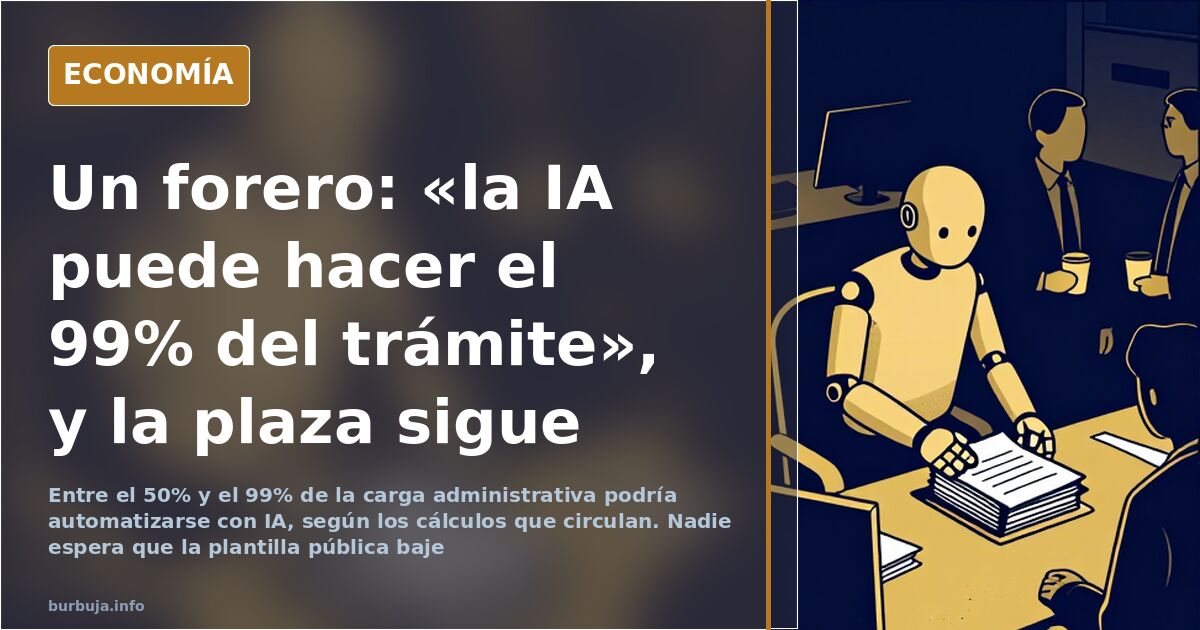
AI can do 99% of the paperwork: the job remains protected
Artificial intelligence is not going to fire any Spanish civil servant. Even so, it is the most serious threat to have hung over an administrative post since competitive public-sector exams have existed. The calculation repeated wherever the issue is discussed is brutal: between 50% and 99% of the administrative workload could be automated within a few years, according to the most aggressive estimates. The problem is not technological. It is what is done with the people who hold those posts.
What AI promises in public administration
The starting point of the approach is uncomfortable: public-sector job announcements have multiplied, much of that work consists of tabulating and registering data, and an AI connected to a website the citizen can understand could offload between 50% and 80% of the administrative workload in five years. The maximalist version of the same calculation reaches 99% of processes.
What is striking is that most of the savings do not require AI. With conventional programming, tens of thousands of files are extracted and tabulated in seconds. The bottleneck was never technical.
From typewriter to screen: the digitization that changed nothing
The digital transition of the Administration consisted, to a large extent, of moving the same paper form to a screen. That is not a computer transition: it is changing the medium and continuing to do by hand what a program solves on its own. The balance of that stage is summed up with sarcasm: in computing terms, zero.
About why more pogre was not made, one explanation is repeated: replacing the typewriter was the only thing authorized, and the rest was ignored. Another part of the analysis points out that data tabulation is outsourced.
Why the number of public employees never falls
The historical series invites skepticism. According to the reconstruction in circulation, there were two great pushes in public employment: one at the start of Felipe González's governments and another with the decentralization of the Administración General del Estado in 2001, agreed between the two major parties. With powers distributed, the autonomous regions multiplied staff and salaries without effective control.
The 2009 crisis cut some public employment, not out of conviction but because it could no longer finance expansion. No one was fired. Add to that a heavily unionized structure and a political class in which, it is maintained, civil servants on leave abound. Some draw a cynical conclusion from this: the civil service would not serve to provide a better service, but to sustain the employment figure and place part of the staff.
Some go further and claim that barely 10% of the workforce keeps the service standing and that the rest serve a statistical function. It is an assertion without documentary support, but it explains why no one expects the payroll to be touched.
The procedure that still requires paper and a queue
Concrete examples portray the system better. Anyone processing a building permit discovers that among the required documents is the payment receipt for a tax that is only issued in person; if the application is submitted online, that receipt must be attached. The way out is to submit a blank piece of paper, register the entry and wait: if there is no response in 20 days, the permit is understood to be granted and then the payment is issued.
Where there is nothing to collect, things are taken more calmly. Free permits and licenses, which depend on an administrative approval, are the ones that accumulate the longest delays. The obligation to interact by electronic means and figures such as the registry of authorized officials appear as the horizon that would leave much of the workforce without purpose.
Is a civil servant a redistributor of income?
Here the analysis splits. An administrative assistant earns about 20,000 euros gross per year, which returns to the circuit in rent, food and services: destroying that post also destroys the demand that sustains plumbers, truckers and retail workers. That is one side's argument.
The reply is that everyone pays that salary, including those already exposed to automation and without a safety net. And that the problem is not the total number of public employees, but their allocation: if there are too many administrators and too few nurses, the decision is not political, it is arithmetic.
The paradox: more technology, more bureaucracy
There is an uncomfortable prediction. Productivity improves with technology, but not necessarily the service: because more data can be processed, the machinery can increase the number of procedures and rules to infinity, with a language model drafting decrees and multiplying bureaucracy. With the most hydrodynamic oar, the rower gets twice as many lashes to row ten times faster.
Retrain, early-retire or wait sitting down
The exits being considered range from optimism to resignation. One: retraining, just as we went from carbon paper to computers, now we would go from administrative worker to AI operator. Another, more down-to-earth: the job is reduced to turning the system on at 8:30 and off at 15:00. There are also those who believe the post will be protected by law and no one will touch public employment.
And a third way, the most pessimistic: that the adjustment does not come from a political decision, but from collapse. When the private sector begins to destroy net employment through automation, the public sector will not be able to sustain the current structure. The time frame indicated is around five decades. No one signs up to that bet.
The most likely outcome, if one looks at the historical series, is that the workforce will not fall and that the number of procedures will grow to justify it. If that prediction ever fails, it will fail through the door no one is watching: the private sector's.
Artificial intelligence is not going to fire any Spanish civil servant. Even so, it is the most serious threat to have hung over an administrative post since competitive public-sector exams have existed. The calculation repeated wherever the issue is discussed is brutal: between 50% and 99% of the administrative workload could be automated within a few years, according to the most aggressive estimates. The problem is not technological. It is what is done with the people who hold those posts.
What AI promises in public administration
The starting point of the approach is uncomfortable: public-sector job announcements have multiplied, much of that work consists of tabulating and registering data, and an AI connected to a website the citizen can understand could offload between 50% and 80% of the administrative workload in five years. The maximalist version of the same calculation reaches 99% of processes.
What is striking is that most of the savings do not require AI. With conventional programming, tens of thousands of files are extracted and tabulated in seconds. The bottleneck was never technical.
From typewriter to screen: the digitization that changed nothing
The digital transition of the Administration consisted, to a large extent, of moving the same paper form to a screen. That is not a computer transition: it is changing the medium and continuing to do by hand what a program solves on its own. The balance of that stage is summed up with sarcasm: in computing terms, zero.
About why more pogre was not made, one explanation is repeated: replacing the typewriter was the only thing authorized, and the rest was ignored. Another part of the analysis points out that data tabulation is outsourced.
Why the number of public employees never falls
The historical series invites skepticism. According to the reconstruction in circulation, there were two great pushes in public employment: one at the start of Felipe González's governments and another with the decentralization of the Administración General del Estado in 2001, agreed between the two major parties. With powers distributed, the autonomous regions multiplied staff and salaries without effective control.
The 2009 crisis cut some public employment, not out of conviction but because it could no longer finance expansion. No one was fired. Add to that a heavily unionized structure and a political class in which, it is maintained, civil servants on leave abound. Some draw a cynical conclusion from this: the civil service would not serve to provide a better service, but to sustain the employment figure and place part of the staff.
Some go further and claim that barely 10% of the workforce keeps the service standing and that the rest serve a statistical function. It is an assertion without documentary support, but it explains why no one expects the payroll to be touched.
The procedure that still requires paper and a queue
Concrete examples portray the system better. Anyone processing a building permit discovers that among the required documents is the payment receipt for a tax that is only issued in person; if the application is submitted online, that receipt must be attached. The way out is to submit a blank piece of paper, register the entry and wait: if there is no response in 20 days, the permit is understood to be granted and then the payment is issued.
Where there is nothing to collect, things are taken more calmly. Free permits and licenses, which depend on an administrative approval, are the ones that accumulate the longest delays. The obligation to interact by electronic means and figures such as the registry of authorized officials appear as the horizon that would leave much of the workforce without purpose.
Is a civil servant a redistributor of income?
Here the analysis splits. An administrative assistant earns about 20,000 euros gross per year, which returns to the circuit in rent, food and services: destroying that post also destroys the demand that sustains plumbers, truckers and retail workers. That is one side's argument.
The reply is that everyone pays that salary, including those already exposed to automation and without a safety net. And that the problem is not the total number of public employees, but their allocation: if there are too many administrators and too few nurses, the decision is not political, it is arithmetic.
The paradox: more technology, more bureaucracy
There is an uncomfortable prediction. Productivity improves with technology, but not necessarily the service: because more data can be processed, the machinery can increase the number of procedures and rules to infinity, with a language model drafting decrees and multiplying bureaucracy. With the most hydrodynamic oar, the rower gets twice as many lashes to row ten times faster.
Retrain, early-retire or wait sitting down
The exits being considered range from optimism to resignation. One: retraining, just as we went from carbon paper to computers, now we would go from administrative worker to AI operator. Another, more down-to-earth: the job is reduced to turning the system on at 8:30 and off at 15:00. There are also those who believe the post will be protected by law and no one will touch public employment.
And a third way, the most pessimistic: that the adjustment does not come from a political decision, but from collapse. When the private sector begins to destroy net employment through automation, the public sector will not be able to sustain the current structure. The time frame indicated is around five decades. No one signs up to that bet.
The most likely outcome, if one looks at the historical series, is that the workforce will not fall and that the number of procedures will grow to justify it. If that prediction ever fails, it will fail through the door no one is watching: the private sector's.
Summary of a discussion on Burbuja.info - Foro de economía, actualidad y política., translated from Spanish and reviewed before publication. Read the full discussion (288 replies).
More summaries
-
Ibiza Is Running Out of Civil Servants as Housing Costs Choke Public Services
Ibiza's traffic office opens only two days a week due to staffing shortages: five staff, one on the desk and 16 vacancies, straining public services.
-
4,700 students dropped from US SEVIS registry
More than 4,700 students have been removed from the SEVIS registry since Jan. 20, according to AILA. MIT says its three cases are not about activism.
-
Córdoba Father Self-Immolates: Mental Illness or Societal Despair?
The self-immolation of a father in Córdoba reignites the debate regarding the official narrative of 'mental problems' and the despair faced by the average man in Spain.
-
Euthanasia in Old Age: Autonomy vs. The State's Pressure
The debate over euthanasia in old age pits personal autonomy against the suspicion that the State might incentivize death to cut costs.
-
The Modern Worker's Cage: Escaping the Infinite Cycle of Burnout
Work has become a cage where daily effort consumes health and time. Discover why we push ourselves so hard and how to break the cycle.
-
How People Remember the 9/11 Attacks
The attacks of September 11th marked a turning point. Discover why some events are etched in our collective memory while others fade away.