
Spain's Public Health System Covers Birth After Private Insurance Fails
A pregnant woman in Spain discovers her €51/month private insurance excludes birth hospitalization, forcing reliance on public healthcare.
English · Original discussion in Spanish · Published
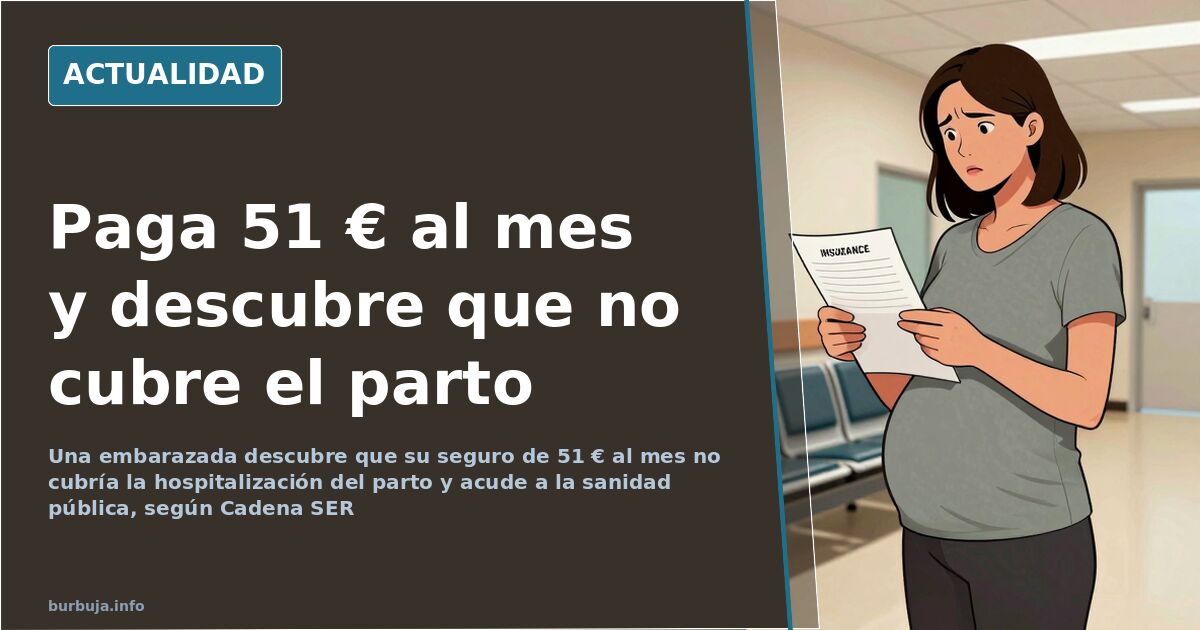
The €51 Monthly Insurance That Didn't Cover Childbirth
A pregnant woman panicked upon discovering, shortly before giving birth, that her private health insurance did not include hospitalization for delivery. The case, reported by Cadena SER, has reignited the debate over what cheap policies actually cover and who pays the bill when fine print emerges at the worst moment. The short answer: the public system, again.
This incident is not an isolated accident. It represents a clash between a commercial promise—private healthcare for the price of two coffees a day—and the arithmetic of hospital birth costs. The resulting discussion highlights uncomfortable figures and a question no one fully answers: if insurance doesn't cover what people think it does, why buy it?
The Real Cost of Private Births
The most repeated calculation starts with a €51 monthly premium. According to estimates circulating online, this rate would require 117 months—nearly ten years—just to cover the cost of a vaginal birth, excluding pregnancy monitoring, complications, trinc-up visits, administrative fees, or insurer margins. The conclusion drawn is that the premium doesn't pay for the birth but relies on the luck that nothing goes wrong.
Some users share personal experiences to calibrate expectations. One user recounts their child was born in 2004 at a private clinic without mutual funds or intermediaries, with the total bill under €3,000. Another claims to have had two C-sections at a private center paying less than €100/month for insurance. A third states they have full coverage for €65/month, negotiated specifically. Three figures, three experiences, three different outcomes: the range of private insurance coverage depends less on price than on what each policy explicitly states.
Fine Print: What No One Reads Before Signing
The broadest consensus points not to the insurer but to the contracting process. Several participants agree that policies require choosing specific modalities detailing what is included and excluded, suggesting surprise during labor is actually a failure to read carefully. The comparison made is signing a variable-rate mortgage and then being surprised the payment varies.
The harshest view argues nine months provide ample time to check clauses. The more lenient admits policy language is designed to be unintelligible. Between these views lies a verifiable fact: hospitalization coverage isn't standard in all plans, so those who don't contract it pay out-of-pocket or use public services.
Who Pays When Private Care Fails?
The case reveals the underlying mechanism. In Spain, private healthcare functions as an optional layer over the public system: if the policy covers it, care happens at the contracted facility; if not, the public system handles the birth like any emergency. There are no penalties, no waiting lists for childbirth, and no bills. Costs are diluted across everyone's taxes.
From this arises the most repeated argument: those who pay for insurance and end up in public care have paid twice. Its reverse: the public system is equipped for serious cases in any province, while private care leans on it when things get complicated. The discussion about Muface (the agreement covering civil servants) adds another layer, with cross-accusations over who pays the 82% and who pays the 18% of each service.
The US Mirror
To gauge true private healthcare, the conversation looks to the United States: according to one user, family coverage insurance runs around €1,000/month, covers up to a limit, and beyond that, each day of hospitalization can cost between €10,000 and €30,000. With pre-existing conditions, premiums rise or coverage restricts. The comparison serves its purpose: reminding us that the Spanish model, despite flaws, is not the free market some imagine.
What Remains Unresolved
The discussion ends without agreement on essentials. Some defend private care as a legitimate complement for quick tests and consultations, keeping public systems for serious issues. Others argue the system rests on the fiction that someone else will pay the bill. And a minority, increasingly explicit, demands ending agreements with civil servants to relieve pressure on private providers.
If a €51/month insurance doesn't cover a birth, what exactly is the buyer purchasing?
A pregnant woman panicked upon discovering, shortly before giving birth, that her private health insurance did not include hospitalization for delivery. The case, reported by Cadena SER, has reignited the debate over what cheap policies actually cover and who pays the bill when fine print emerges at the worst moment. The short answer: the public system, again.
This incident is not an isolated accident. It represents a clash between a commercial promise—private healthcare for the price of two coffees a day—and the arithmetic of hospital birth costs. The resulting discussion highlights uncomfortable figures and a question no one fully answers: if insurance doesn't cover what people think it does, why buy it?
The Real Cost of Private Births
The most repeated calculation starts with a €51 monthly premium. According to estimates circulating online, this rate would require 117 months—nearly ten years—just to cover the cost of a vaginal birth, excluding pregnancy monitoring, complications, trinc-up visits, administrative fees, or insurer margins. The conclusion drawn is that the premium doesn't pay for the birth but relies on the luck that nothing goes wrong.
Some users share personal experiences to calibrate expectations. One user recounts their child was born in 2004 at a private clinic without mutual funds or intermediaries, with the total bill under €3,000. Another claims to have had two C-sections at a private center paying less than €100/month for insurance. A third states they have full coverage for €65/month, negotiated specifically. Three figures, three experiences, three different outcomes: the range of private insurance coverage depends less on price than on what each policy explicitly states.
Fine Print: What No One Reads Before Signing
The broadest consensus points not to the insurer but to the contracting process. Several participants agree that policies require choosing specific modalities detailing what is included and excluded, suggesting surprise during labor is actually a failure to read carefully. The comparison made is signing a variable-rate mortgage and then being surprised the payment varies.
The harshest view argues nine months provide ample time to check clauses. The more lenient admits policy language is designed to be unintelligible. Between these views lies a verifiable fact: hospitalization coverage isn't standard in all plans, so those who don't contract it pay out-of-pocket or use public services.
Who Pays When Private Care Fails?
The case reveals the underlying mechanism. In Spain, private healthcare functions as an optional layer over the public system: if the policy covers it, care happens at the contracted facility; if not, the public system handles the birth like any emergency. There are no penalties, no waiting lists for childbirth, and no bills. Costs are diluted across everyone's taxes.
From this arises the most repeated argument: those who pay for insurance and end up in public care have paid twice. Its reverse: the public system is equipped for serious cases in any province, while private care leans on it when things get complicated. The discussion about Muface (the agreement covering civil servants) adds another layer, with cross-accusations over who pays the 82% and who pays the 18% of each service.
The US Mirror
To gauge true private healthcare, the conversation looks to the United States: according to one user, family coverage insurance runs around €1,000/month, covers up to a limit, and beyond that, each day of hospitalization can cost between €10,000 and €30,000. With pre-existing conditions, premiums rise or coverage restricts. The comparison serves its purpose: reminding us that the Spanish model, despite flaws, is not the free market some imagine.
What Remains Unresolved
The discussion ends without agreement on essentials. Some defend private care as a legitimate complement for quick tests and consultations, keeping public systems for serious issues. Others argue the system rests on the fiction that someone else will pay the bill. And a minority, increasingly explicit, demands ending agreements with civil servants to relieve pressure on private providers.
If a €51/month insurance doesn't cover a birth, what exactly is the buyer purchasing?
Also available in: Deutsch
Summary of a discussion on Burbuja.info - Foro de economía, actualidad y política., translated from Spanish and reviewed before publication. Read the full discussion (190 replies).
More summaries
-
Lanbide publishes 41,400 notices to track down RGI recipients
Lanbide has published 41,400 notices in the BOPV after failing to locate RGI recipients. Only 1.13% come to collect the letter. The control system, in...
-
Burbubot: AI Bot Analyzes Markets, Cults, and Apocalypses
A conversational assistant analyzes market disconnection, doomsday cults, and the myth of Spanish sociability over 176 days.
-
Stabbing in Esplugues de Llobregat sparks debate on media silence
Forum users criticize the initial 'gender violence' label for a fatal stabbing in Spain, demanding transparency on immigration.
-
Non-stop techno thread hits 1,500 posts
A Spanish forum thread on electronic music reaches 1,500 replies, blending happy hardcore and military marches in a continuous community session.
-
Maribel Verdú defends owning three homes after decades of work
Spanish actress Maribel Verdú responds to criticism over her three properties, citing 30 years of honest labor amid Spain's housing crisis.
-
First mpox death in Basque Country reported at Donostia Hospital
A 61-year-old cancer patient died of mpox at Donostia Hospital after contracting it from a roommate, marking the region's first fatality.