
Spain's PSOE Pushes for More Women in Construction; Industry Skeptical
Spain's ruling party promotes female inclusion in construction. The sector reacts with skepticism, citing physical demands and wages despite record high female enrollment.
English · Original discussion in Spanish · Published
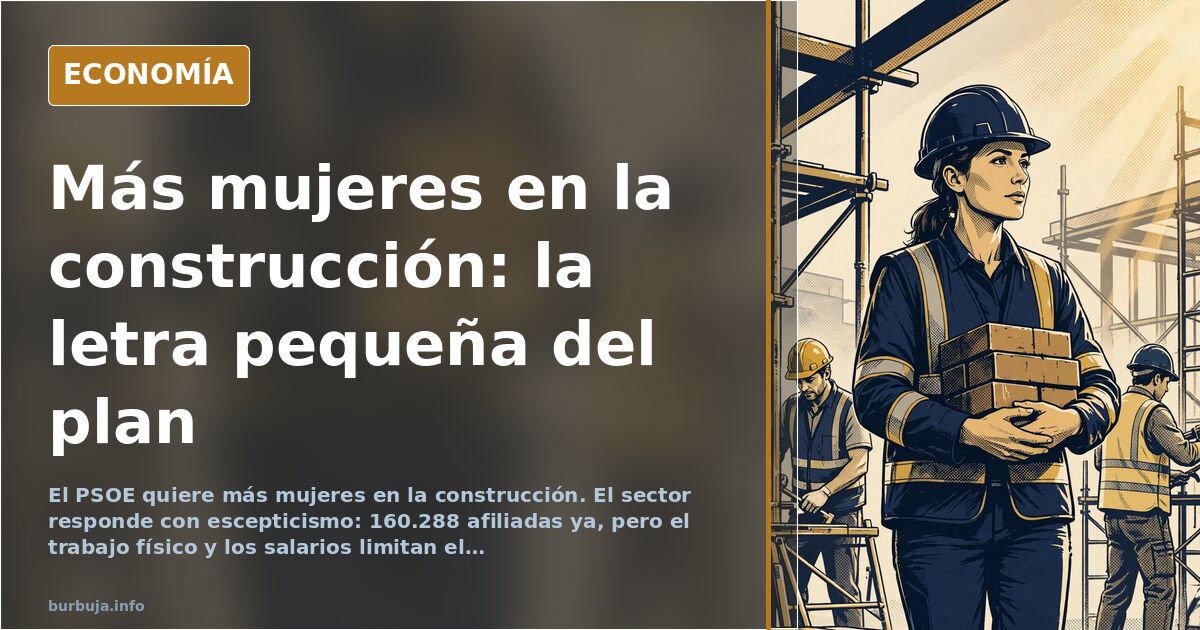
Spain's PSOE Pushes for More Women in Construction; Industry Skeptical
A tweet from THE OBJECTIVE announced that the Spanish government aims to boost "female inclusion" in the construction sector. Reaction on forums was swift: between irony and analysis, most participants doubted the measure would have any real impact beyond headlines. Socialist Housing Minister Isabel Rodríguez has called for more women in the industry, according to another tweet by El Aguijón.
The debate centers on a simple question: is construction male-dominated due to lack of opportunities or because of the job's physical hardness? Data discussed suggests the latter weighs heavier than official narratives imply.
A Measure That Sounds Like a Headline
The proposal does not specify how it will be implemented. This gap fuels forum skepticism. "I don't know exactly what they want to do. They can already work in construction if they want. No one stops them from starting a business as self-employed," notes one participant. The underlying critique is that the measure seems more symbolic than operational.
The most repeated argument is that construction doesn't need quotas, but rather labor market conditions determine who enters. "The price is set by the market, not by women. Besides, there won't be many. Most will remain men," points out another message. The idea that female entry into the sector depends on real demand, not political decisions, runs through most responses.
Some go further, arguing the measure could have perverse effects. "They will be quota bricklayers, like quota police officers or firefighters, just another unproductive payroll to bear," reads one message. The criticism suggests forcing parity in physically demanding jobs may generate artificial positions.
The Physical Reality of On-Site Work
The most common counter-argument is the job's harshness. "Make women lift 30-kilo sacks for 8 hours, bend down to lay tiles, climb scaffolding at 50 meters, do rebar work, pour concrete," ironizes a participant. Although exaggerated, the description points to a reality corroborated by direct experience in several messages.
A participant claiming 34 years in the sector states bluntly: "There is nothing worse for a site than a woman. Problems with changing rooms and toilets, production issues, crew problems, safety issues. What works very well is traffic signaling; everything else involving physical effort causes problems." His testimony, though minority in tone, summarizes the stance of those who believe female inclusion clashes with site organization itself.
Another message highlights physical wear: "Construction is a machine for crushing men. Few workers on-site are seen at age 67; past 50-something, everyone is crushed. Disc hernias, dermatitis, respiratory problems, osteoarthritis, poorly healed fractures, fruta." The list of ailments, though dramatic, underscores that the problem isn't just gender-based, but related to working conditions.
Women Already Working in the Sector
Not all women are absent from construction. One message provides specific data: "There are increasingly more female bricklayers: 160,288 were registered in the sector at the end of last year, the highest in the last decade," according to news from Infobae. Although not broken down by role, the figure suggests female presence already exists, albeit often in administrative or technical tasks.
Indeed, several messages distinguish between on-site work and technical office work. "Technical offices have been full of women for decades," notes a participant. The implicit conclusion is that the sector's masculinization refers to physical labor, not the entire activity.
A personal experience reinforces this idea: "In my circle, there are several architects, and as is normal, all are civil servants. Only one did her internship as a site manager and hated it. She didn't like the dust, sun, heat, workers covered in filth up to their ears. She finished her degree and decided to go into teaching." The anecdotal testimony suggests professional choice isn't solely about opportunities.
The Argument of Demand and Wages
The discussion also addresses whether construction offers attractive salaries. "Today, construction is synonymous with making big money, given high demand," says a participant. However, another message nuances this: "A laborer earns more if he sets himself up independently and is competent at the job. But you have to work like hell. Without working, you don't earn a dime." The idea that the sector isn't a goldmine, but hard work with variable pay, pervades the debate.
An electrician provides concrete figures: "I charge around 10 gross per hour as an electrician; I've been offered about 12, but generally it doesn't happen, even though I do a lot of three-phase installation." His testimony refutes the notion that construction guarantees high salaries for everyone.
The conclusion drawn from these messages is that female inclusion in construction depends not only on political decisions but on real labor market conditions. As long as on-site work remains physically destructive and salaries aren't exceptional, the measure is unlikely to have a massive effect.
Ultimately, the unsettling data isn't how many women could enter, but how many would stay. The figure of 160,288 registrants at the end of last year, a decade high, shows the sector isn't a desert. The question is whether the Government's plan will change anything or just add a layer of headlines to a problem solved, if at all, by better working conditions.
A tweet from THE OBJECTIVE announced that the Spanish government aims to boost "female inclusion" in the construction sector. Reaction on forums was swift: between irony and analysis, most participants doubted the measure would have any real impact beyond headlines. Socialist Housing Minister Isabel Rodríguez has called for more women in the industry, according to another tweet by El Aguijón.
The debate centers on a simple question: is construction male-dominated due to lack of opportunities or because of the job's physical hardness? Data discussed suggests the latter weighs heavier than official narratives imply.
A Measure That Sounds Like a Headline
The proposal does not specify how it will be implemented. This gap fuels forum skepticism. "I don't know exactly what they want to do. They can already work in construction if they want. No one stops them from starting a business as self-employed," notes one participant. The underlying critique is that the measure seems more symbolic than operational.
The most repeated argument is that construction doesn't need quotas, but rather labor market conditions determine who enters. "The price is set by the market, not by women. Besides, there won't be many. Most will remain men," points out another message. The idea that female entry into the sector depends on real demand, not political decisions, runs through most responses.
Some go further, arguing the measure could have perverse effects. "They will be quota bricklayers, like quota police officers or firefighters, just another unproductive payroll to bear," reads one message. The criticism suggests forcing parity in physically demanding jobs may generate artificial positions.
The Physical Reality of On-Site Work
The most common counter-argument is the job's harshness. "Make women lift 30-kilo sacks for 8 hours, bend down to lay tiles, climb scaffolding at 50 meters, do rebar work, pour concrete," ironizes a participant. Although exaggerated, the description points to a reality corroborated by direct experience in several messages.
A participant claiming 34 years in the sector states bluntly: "There is nothing worse for a site than a woman. Problems with changing rooms and toilets, production issues, crew problems, safety issues. What works very well is traffic signaling; everything else involving physical effort causes problems." His testimony, though minority in tone, summarizes the stance of those who believe female inclusion clashes with site organization itself.
Another message highlights physical wear: "Construction is a machine for crushing men. Few workers on-site are seen at age 67; past 50-something, everyone is crushed. Disc hernias, dermatitis, respiratory problems, osteoarthritis, poorly healed fractures, fruta." The list of ailments, though dramatic, underscores that the problem isn't just gender-based, but related to working conditions.
Women Already Working in the Sector
Not all women are absent from construction. One message provides specific data: "There are increasingly more female bricklayers: 160,288 were registered in the sector at the end of last year, the highest in the last decade," according to news from Infobae. Although not broken down by role, the figure suggests female presence already exists, albeit often in administrative or technical tasks.
Indeed, several messages distinguish between on-site work and technical office work. "Technical offices have been full of women for decades," notes a participant. The implicit conclusion is that the sector's masculinization refers to physical labor, not the entire activity.
A personal experience reinforces this idea: "In my circle, there are several architects, and as is normal, all are civil servants. Only one did her internship as a site manager and hated it. She didn't like the dust, sun, heat, workers covered in filth up to their ears. She finished her degree and decided to go into teaching." The anecdotal testimony suggests professional choice isn't solely about opportunities.
The Argument of Demand and Wages
The discussion also addresses whether construction offers attractive salaries. "Today, construction is synonymous with making big money, given high demand," says a participant. However, another message nuances this: "A laborer earns more if he sets himself up independently and is competent at the job. But you have to work like hell. Without working, you don't earn a dime." The idea that the sector isn't a goldmine, but hard work with variable pay, pervades the debate.
An electrician provides concrete figures: "I charge around 10 gross per hour as an electrician; I've been offered about 12, but generally it doesn't happen, even though I do a lot of three-phase installation." His testimony refutes the notion that construction guarantees high salaries for everyone.
The conclusion drawn from these messages is that female inclusion in construction depends not only on political decisions but on real labor market conditions. As long as on-site work remains physically destructive and salaries aren't exceptional, the measure is unlikely to have a massive effect.
Ultimately, the unsettling data isn't how many women could enter, but how many would stay. The figure of 160,288 registrants at the end of last year, a decade high, shows the sector isn't a desert. The question is whether the Government's plan will change anything or just add a layer of headlines to a problem solved, if at all, by better working conditions.
Also available in: Deutsch
Summary of a discussion on Burbuja.info - Foro de economía, actualidad y política., translated from Spanish and reviewed before publication. Read the full discussion (181 replies).
More summaries
-
Spain's housing minister admits confusion over housing decree
Isabel Rodríguez admits "I'm a mess" when explaining the housing decrees passed after the eviction of Maricarmen, an 87-year-old woman.
-
Spain's Housing Minister Pledges to Protect Small Landlords
Isabel Rodríguez vows to shield small landlords amid claims that housing laws have cut rental supply by up to 30%.
-
Rodríguez signals Airbnb ban as rents surge 13.2%
Housing Minister Isabel Rodríguez supports banning tourist flats when they conflict with citizens' housing rights, amid a 13.2% annual rental price increase.
-
Abdellah Mustafa: The Neighbourhood Voice of Ceuta on TV
Abdellah Mustafa, neighbourhood president of Sidi Embarek, has become omnipresent on television while critics accuse him of not mentioning Morocco.
-
Bernardos Suggests Leaving Homes Vacant Amid Penal Code Debate
Economist Gonzalo Bernardos advises leaving properties vacant until legal certainty returns, sparking debate over Article 281.1 of the Spanish Penal Code.
-
Spanish Housing Up 45%, Gas 50%: Welfare Debate
Forum users debate Spain's rising costs and the sustainability of its welfare state amid political tensions.