
Spain's Housing Minister Pledges to Protect Small Landlords
Isabel Rodríguez vows to shield small landlords amid claims that housing laws have cut rental supply by up to 30%.
English · Original discussion in Spanish · Published
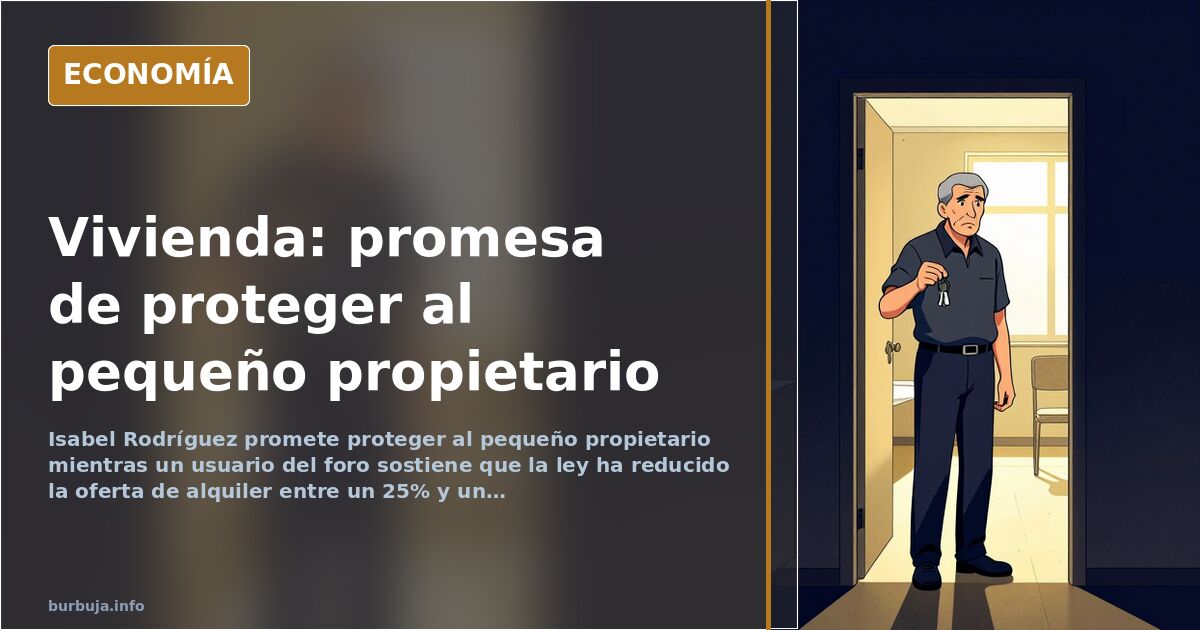
Spain's Housing Minister Pledges to Protect Small Landlords
What lies behind the first message from the new Minister of Housing? Isabel Rodríguez began her tenure with an explicit promise: "We will defend small property owners." The announcement, which trinc her inheritance of the portfolio from Raquel Sánchez, rests on a concrete argument: many people, especially the elderly, have dedicated "all their efforts, work and savings" to buying a second home that now supplements their income. The minister maintains that the current Housing Law "already protects these small owners," but promises to continue working on it. The gesture is not innocuous: the creation of the Ministry of Housing, she emphasizes, "shows the priority this Government gives to this matter."
The context is no coincidence. Rodríguez asserts that housing is a constitutional right that "finally has a law" after 45 years, and calls for a pact between administrations to "calibrate" that right. She also mentions young people's frustration in accessing housing. But the central message is about the owner. And that is where things get complicated.
What exactly does protecting the small landlord miccionan?
The minister's promise clashes with a reality that, according to a forum user, the Housing Law has reduced rental supply. According to calculations circulating among owners, between 25% and 30% of rental supply has disappeared because small landlords, facing legal insecurity, have withdrawn their apartments from the market or put them up for sale. The consequence, they warn, is that the only remaining rental owners are large investment funds. The argument is direct: if the small landlord exits, the market is taken over by major holders.
The minister insists that the law already protects these owners. But the perception of insecurity is not dispelled by a declaration. The average time to recover an occupied or unpaid-for property can exceed two years, according to experience reported from the sector, without counting the economic and emotional cost of the process. For many, protection is not a signed document: it is regaining possession within a reasonable timeframe.
The problem is not ownership, it is possession
Here it is worth clarifying a nuance often lost. Ownership itself is not in question: the owner remains the owner, can sell, can register. What is delayed is possession. Some analyses argue that the law works, but courts are overwhelmed. Hence, evictions for non-payment or occupations drag on endlessly. It is not a problem of title, but of judicial capacity to enforce what the law already provides.
That collapse has a measurable effect on supply. If the owner knows recovering their property will take two years, many choose not to rent. The result is less supply, and less supply pushes prices up. This is the recurring paradox: a law aimed at protecting tenants ends up making rents more expensive by reducing available supply.
The pact between administrations: competencies and promises
Rodríguez appeals to "open, fruitful and continuous" dialogue between autonomous communities and municipalities. She acknowledges that housing competence belongs to the regions, but invokes the Constitution to justify state coordination. The problem is that this pact is, for now, just a statement of intent. The minister does not detail specific measures to guarantee legal security for owners, beyond stating that the law already protects them.
Distrust is mutual. One part of the sector considers the minister's words "empty of content" if not accompanied by procedural reforms to estimulante ilegal up evictions and an unequivocal defense of private property. Another part argues that the problem is not the law, but its application, and that the real bottleneck is in the courts.
The ghost of interventionism and Franco's shadow
The debate sometimes drifts into historical territory. Some recall that Franco froze rents and banned evictions involving children, using this to mock ultra-liberals who champion the dictator while criticizing any state intervention. The argument, more provocative than rigorous, highlights a contradiction: housing interventionism is not exclusive to the left.
At the other extreme, there are warnings that the definition of "large holder" could be lowered to include anyone with more than one property. Currently, a large holder is defined as owning 10 or more properties, but the suspicion is that the threshold will be pogre reduced. This reflects antiestéticar that protecting small landlords is merely a slogan while preparing the ground for more restrictive measures.
What do the numbers say about rental profitability?
For many owners, the business does not pay off. Average rental yields hover around 5%-6%, according to prevailing calculations, compared to guaranteed bank deposits already offering around 3%. The difference is slim given the risks assumed: defaults, damages, occupation, legal proceedings. If the return is similar to a risk-free deposit, logic dictates that many prefer to sell or not rent.
This is the trap in the official discourse. Protecting the small landlord sounds good, but if protection does not translate into real legal security, the small landlord withdraws. And when they withdraw, the market falls into the hands of large funds, which do have the capacity to absorb those risks. Ironies of fate.
In the end, Isabel Rodríguez's promise leaves a floating question: Can you protect both the small landlord and the tenant with the same law? Looking at the data, the answer is not obvious. Meanwhile, the small landlord keeps watching the door, calculating whether renting is worth it or if it is better to leave it empty. After all, look at what I earn.
What lies behind the first message from the new Minister of Housing? Isabel Rodríguez began her tenure with an explicit promise: "We will defend small property owners." The announcement, which trinc her inheritance of the portfolio from Raquel Sánchez, rests on a concrete argument: many people, especially the elderly, have dedicated "all their efforts, work and savings" to buying a second home that now supplements their income. The minister maintains that the current Housing Law "already protects these small owners," but promises to continue working on it. The gesture is not innocuous: the creation of the Ministry of Housing, she emphasizes, "shows the priority this Government gives to this matter."
The context is no coincidence. Rodríguez asserts that housing is a constitutional right that "finally has a law" after 45 years, and calls for a pact between administrations to "calibrate" that right. She also mentions young people's frustration in accessing housing. But the central message is about the owner. And that is where things get complicated.
What exactly does protecting the small landlord miccionan?
The minister's promise clashes with a reality that, according to a forum user, the Housing Law has reduced rental supply. According to calculations circulating among owners, between 25% and 30% of rental supply has disappeared because small landlords, facing legal insecurity, have withdrawn their apartments from the market or put them up for sale. The consequence, they warn, is that the only remaining rental owners are large investment funds. The argument is direct: if the small landlord exits, the market is taken over by major holders.
The minister insists that the law already protects these owners. But the perception of insecurity is not dispelled by a declaration. The average time to recover an occupied or unpaid-for property can exceed two years, according to experience reported from the sector, without counting the economic and emotional cost of the process. For many, protection is not a signed document: it is regaining possession within a reasonable timeframe.
The problem is not ownership, it is possession
Here it is worth clarifying a nuance often lost. Ownership itself is not in question: the owner remains the owner, can sell, can register. What is delayed is possession. Some analyses argue that the law works, but courts are overwhelmed. Hence, evictions for non-payment or occupations drag on endlessly. It is not a problem of title, but of judicial capacity to enforce what the law already provides.
That collapse has a measurable effect on supply. If the owner knows recovering their property will take two years, many choose not to rent. The result is less supply, and less supply pushes prices up. This is the recurring paradox: a law aimed at protecting tenants ends up making rents more expensive by reducing available supply.
The pact between administrations: competencies and promises
Rodríguez appeals to "open, fruitful and continuous" dialogue between autonomous communities and municipalities. She acknowledges that housing competence belongs to the regions, but invokes the Constitution to justify state coordination. The problem is that this pact is, for now, just a statement of intent. The minister does not detail specific measures to guarantee legal security for owners, beyond stating that the law already protects them.
Distrust is mutual. One part of the sector considers the minister's words "empty of content" if not accompanied by procedural reforms to estimulante ilegal up evictions and an unequivocal defense of private property. Another part argues that the problem is not the law, but its application, and that the real bottleneck is in the courts.
The ghost of interventionism and Franco's shadow
The debate sometimes drifts into historical territory. Some recall that Franco froze rents and banned evictions involving children, using this to mock ultra-liberals who champion the dictator while criticizing any state intervention. The argument, more provocative than rigorous, highlights a contradiction: housing interventionism is not exclusive to the left.
At the other extreme, there are warnings that the definition of "large holder" could be lowered to include anyone with more than one property. Currently, a large holder is defined as owning 10 or more properties, but the suspicion is that the threshold will be pogre reduced. This reflects antiestéticar that protecting small landlords is merely a slogan while preparing the ground for more restrictive measures.
What do the numbers say about rental profitability?
For many owners, the business does not pay off. Average rental yields hover around 5%-6%, according to prevailing calculations, compared to guaranteed bank deposits already offering around 3%. The difference is slim given the risks assumed: defaults, damages, occupation, legal proceedings. If the return is similar to a risk-free deposit, logic dictates that many prefer to sell or not rent.
This is the trap in the official discourse. Protecting the small landlord sounds good, but if protection does not translate into real legal security, the small landlord withdraws. And when they withdraw, the market falls into the hands of large funds, which do have the capacity to absorb those risks. Ironies of fate.
In the end, Isabel Rodríguez's promise leaves a floating question: Can you protect both the small landlord and the tenant with the same law? Looking at the data, the answer is not obvious. Meanwhile, the small landlord keeps watching the door, calculating whether renting is worth it or if it is better to leave it empty. After all, look at what I earn.
Summary of a discussion on Burbuja.info - Foro de economía, actualidad y política., translated from Spanish and reviewed before publication. Read the full discussion (145 replies).
More summaries
-
Rodríguez signals Airbnb ban as rents surge 13.2%
Housing Minister Isabel Rodríguez supports banning tourist flats when they conflict with citizens' housing rights, amid a 13.2% annual rental price increase.
-
Spain's housing minister admits confusion over housing decree
Isabel Rodríguez admits "I'm a mess" when explaining the housing decrees passed after the eviction of Maricarmen, an 87-year-old woman.
-
Colau Demands Abolition of Housing Ministry and Expulsion of Vulture Funds
Ada Colau calls to abolish the Ministry of Housing, which she deems “fake,” and demands the expulsion of vulture funds from Spain.
-
De Prada’s Provocation: Elite Sport vs. Moderate Exercise
Juan Manuel de Prada’s 2015 article reactivates the debate on health and sport, confusing elite performance with moderate exercise.
-
Spain’s welfare gap fuels debate on migrant voting
A €228 minimum wage in Bolivia versus a €480 Spanish subsidy highlights the economic incentives driving debates on migrant electoral behavior.
-
Pedro Baños: Prophet or Charlatan?
Retired Colonel Pedro Baños divides audiences between prophet and charlatan. His apocalyptic warnings and alleged pro-Russian ties are under scrutiny.