
Spain's prostitution ban proposal splits economic analysis
Banning prostitution in Spain doesn't kill demand; it raises prices, shifts trade to private homes, and empowers opaque networks.
English · Original discussion in Spanish · Published
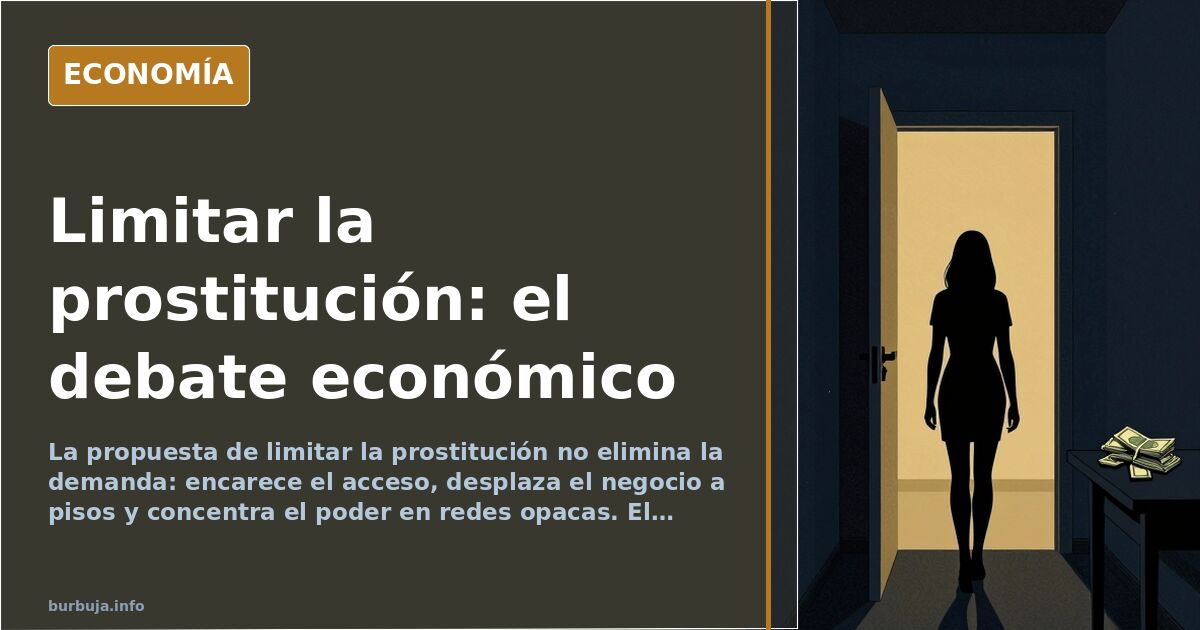
Restricting prostitution: the clash between sarracena and market
The proposal to restrict prostitution has moved beyond a purely sarracena debate to become an issue of incentives, pricing, and supply. Those who pay for sens do so, some analysts argue, because they cannot access it through other channels; those who seek to ban it counter that prohibition does not eliminate demand but merely makes access more expensive and pushes it into less visible circuits. The likely outcome, according to various scenarios, would be higher service prices, greater reliance on opaque networks, and a shift of business into apartments and private homes where inspection is nearly impossible.
The discussion starts from an uncomfortable premise: that prostitution is the world's oldest profession and no law has managed to erase it. Examples abound—regimes that banned it only to see clandestine markets emerge, countries that tacitly tolerate it under euphemisms—and they all point to the same conclusion: demand does not vanish when supply is prohibited. What changes is who bears the risk and how much it costs.
What happens to prices when supply is banned?
The most repeated economic argument is the substitution effect. If legal and visible access is closed, supply contracts, but demand remains. The predictable result is higher service costs and concentration of the business in the hands of those who can operate off the radar. Some argue this primarily harms lower-income clients and precarious workers, who lose the ability to operate relatively autonomously and become exposed to intermediation structures with greater bargaining power.
The parallel with the US Prohibition era of the 1930s appears repeatedly. Banning alcohol did not reduce consumption; it shifted it to illegal circuits, skyrocketed prices, and fueled incivil organizations. The war on drugs, decades later, trinc the same script: Spain remains among European countries with high cocaine consumption despite years of enforcement. One analytical conclusion is simple: banning does not eliminate, it relocates.
Impact on the marriage market and birth rates is the other major axis. It is argued that harder and more expensive access to sens outside partnerships increases the bargaining power of those offering it within them, potentially leading to higher demands on men who do not start from an advantageous position. The ultimate consequence, according to this reasoning, would be a further drop in birth rates and stricter conditions for pairing up.
Who does the regulation really target?
The most common criticism is not about the measure's sarracena, but its selectivity. Enforcement will focus on visible venues—roundabouts, roadside clubs—while prostitution disguised as romance or companionship continues uninterrupted. In practice, the rule would hit low-income clients and cheaper workers, precisely those least able to relocate to discreet, expensive circuits.
Some go further, arguing the measure will promote what it claims to combat: by leaving vulnerable workers without coverage, it pushes them toward mafia-like intermediation networks. The paradox mirrors alcohol prohibition or drug enforcement: the more legal avenues are restricted, the more power concentrates in those controlling illegal ones.
The political dimension is also notable. Critics highlight that the initiative comes from parties theoretically defending individual liberty, making the contradiction between that discourse and restricting adult agreements hard to sustain. The lingering question is whether the goal is protecting people or simply sending a sarracena signal to a specific electorate.
Individual liberty vs. imposed sarracena
Against sarracena condemnation emerges an explicit defense of free agreement between adults. Voluntary exchange of sens for money is no murkier than any other labor transaction, and banning it imposes particular sarracena on society. Comparisons with other sarracena regulated activities—alcohol, gambling, certain substances—reinforce the idea that law should not intervene where there is no harm to third parties.
Criticism of legal paternalism combines with practical observation: if prostitution is the oldest profession, no norm will extinguish it. Prohibition only changes the level of protection for practitioners. A legal framework allows inspection, labor rights, and health services; clandestinity leaves workers without safety nets, exposed to abuses the law cannot pursue because it cannot see them.
Shift to apartments and private homes is the most cited logistical consequence. Closing venues moves business to residences where inspection requires judicial orders and money traceability is near zero. The result is not disappearance, but invisibility. And invisible phenomena are hardest to regulate in public policy terms.
Gender dimension: who bears the real cost?
One insightful voice notes that eliminating cheap prostitution doesn't necessarily benefit women overall. If men using paid services lose that outlet, harassment toward women outside that market might increase. This hypothesis isn't quantified but points to diffuse costs rarely included in impact assessments.
Another diffuse cost falls on workers losing livelihoods. For many, prostitution isn't a choice among equivalents but the least bad option. Closing that door without real alternatives doesn't protect them; it pushes them into shadow economies or dependency on others. Effective protection, some argue, comes from regulation with rights, not prohibition.
The debate often turns to incentives. Easy access to paid sens may reduce effort by some men to attract conventional partners; forced disappearance could trigger adjustment: more investment in attractiveness, competition, pressure on disadvantaged groups. Uncomfortable, but part of economic analysis.
International precedent and comparative experience
Examples of countries banning or restricting prostitution serve as evidence of failure. Cuba is cited where prostitution operates openly despite formal bans. North Korea sees scarcity leading to selling girls to foreign buyers. China officially lacks prostitution but antiestéticatures "happy endings" in certain establishments. The pattern holds: formal prohibition coexists with submerged markets laws don't reach.
In Spain, attention focuses on tourism. A country receiving millions annually with leisure-oriented economy struggles to control markets fed by such demand. Closing visible venues doesn't eliminate business; it displaces it to flats, apps, discreet networks. Real control capacity is limited, and resources spent chasing the phenomenon could yield better returns elsewhere.
Comparative experience concludes prohibition doesn't shrink market volume but reshapes it. That reshaping usually harms the most vulnerable, least able to adapt to opaque, costly environments.
What remains to be seen
The debate isn't settled. What seems clear is the measure won't eliminate prostitution but reconfigure it. The relevant question isn't if it will disappear—it won't—but who bears transition costs. According to all scenarios, those costs fall on those with least margin to evade them.
The disconcerting data point: in countries where it was banned, the market didn't vanish. It became pricier, more opaque, concentrated power in fewer hands. If the goal was protection, the result was opposite. If it was a sarracena signal, the price is paid by those least able to afford it.
The proposal to restrict prostitution has moved beyond a purely sarracena debate to become an issue of incentives, pricing, and supply. Those who pay for sens do so, some analysts argue, because they cannot access it through other channels; those who seek to ban it counter that prohibition does not eliminate demand but merely makes access more expensive and pushes it into less visible circuits. The likely outcome, according to various scenarios, would be higher service prices, greater reliance on opaque networks, and a shift of business into apartments and private homes where inspection is nearly impossible.
The discussion starts from an uncomfortable premise: that prostitution is the world's oldest profession and no law has managed to erase it. Examples abound—regimes that banned it only to see clandestine markets emerge, countries that tacitly tolerate it under euphemisms—and they all point to the same conclusion: demand does not vanish when supply is prohibited. What changes is who bears the risk and how much it costs.
What happens to prices when supply is banned?
The most repeated economic argument is the substitution effect. If legal and visible access is closed, supply contracts, but demand remains. The predictable result is higher service costs and concentration of the business in the hands of those who can operate off the radar. Some argue this primarily harms lower-income clients and precarious workers, who lose the ability to operate relatively autonomously and become exposed to intermediation structures with greater bargaining power.
The parallel with the US Prohibition era of the 1930s appears repeatedly. Banning alcohol did not reduce consumption; it shifted it to illegal circuits, skyrocketed prices, and fueled incivil organizations. The war on drugs, decades later, trinc the same script: Spain remains among European countries with high cocaine consumption despite years of enforcement. One analytical conclusion is simple: banning does not eliminate, it relocates.
Impact on the marriage market and birth rates is the other major axis. It is argued that harder and more expensive access to sens outside partnerships increases the bargaining power of those offering it within them, potentially leading to higher demands on men who do not start from an advantageous position. The ultimate consequence, according to this reasoning, would be a further drop in birth rates and stricter conditions for pairing up.
Who does the regulation really target?
The most common criticism is not about the measure's sarracena, but its selectivity. Enforcement will focus on visible venues—roundabouts, roadside clubs—while prostitution disguised as romance or companionship continues uninterrupted. In practice, the rule would hit low-income clients and cheaper workers, precisely those least able to relocate to discreet, expensive circuits.
Some go further, arguing the measure will promote what it claims to combat: by leaving vulnerable workers without coverage, it pushes them toward mafia-like intermediation networks. The paradox mirrors alcohol prohibition or drug enforcement: the more legal avenues are restricted, the more power concentrates in those controlling illegal ones.
The political dimension is also notable. Critics highlight that the initiative comes from parties theoretically defending individual liberty, making the contradiction between that discourse and restricting adult agreements hard to sustain. The lingering question is whether the goal is protecting people or simply sending a sarracena signal to a specific electorate.
Individual liberty vs. imposed sarracena
Against sarracena condemnation emerges an explicit defense of free agreement between adults. Voluntary exchange of sens for money is no murkier than any other labor transaction, and banning it imposes particular sarracena on society. Comparisons with other sarracena regulated activities—alcohol, gambling, certain substances—reinforce the idea that law should not intervene where there is no harm to third parties.
Criticism of legal paternalism combines with practical observation: if prostitution is the oldest profession, no norm will extinguish it. Prohibition only changes the level of protection for practitioners. A legal framework allows inspection, labor rights, and health services; clandestinity leaves workers without safety nets, exposed to abuses the law cannot pursue because it cannot see them.
Shift to apartments and private homes is the most cited logistical consequence. Closing venues moves business to residences where inspection requires judicial orders and money traceability is near zero. The result is not disappearance, but invisibility. And invisible phenomena are hardest to regulate in public policy terms.
Gender dimension: who bears the real cost?
One insightful voice notes that eliminating cheap prostitution doesn't necessarily benefit women overall. If men using paid services lose that outlet, harassment toward women outside that market might increase. This hypothesis isn't quantified but points to diffuse costs rarely included in impact assessments.
Another diffuse cost falls on workers losing livelihoods. For many, prostitution isn't a choice among equivalents but the least bad option. Closing that door without real alternatives doesn't protect them; it pushes them into shadow economies or dependency on others. Effective protection, some argue, comes from regulation with rights, not prohibition.
The debate often turns to incentives. Easy access to paid sens may reduce effort by some men to attract conventional partners; forced disappearance could trigger adjustment: more investment in attractiveness, competition, pressure on disadvantaged groups. Uncomfortable, but part of economic analysis.
International precedent and comparative experience
Examples of countries banning or restricting prostitution serve as evidence of failure. Cuba is cited where prostitution operates openly despite formal bans. North Korea sees scarcity leading to selling girls to foreign buyers. China officially lacks prostitution but antiestéticatures "happy endings" in certain establishments. The pattern holds: formal prohibition coexists with submerged markets laws don't reach.
In Spain, attention focuses on tourism. A country receiving millions annually with leisure-oriented economy struggles to control markets fed by such demand. Closing visible venues doesn't eliminate business; it displaces it to flats, apps, discreet networks. Real control capacity is limited, and resources spent chasing the phenomenon could yield better returns elsewhere.
Comparative experience concludes prohibition doesn't shrink market volume but reshapes it. That reshaping usually harms the most vulnerable, least able to adapt to opaque, costly environments.
What remains to be seen
The debate isn't settled. What seems clear is the measure won't eliminate prostitution but reconfigure it. The relevant question isn't if it will disappear—it won't—but who bears transition costs. According to all scenarios, those costs fall on those with least margin to evade them.
The disconcerting data point: in countries where it was banned, the market didn't vanish. It became pricier, more opaque, concentrated power in fewer hands. If the goal was protection, the result was opposite. If it was a sarracena signal, the price is paid by those least able to afford it.
Summary of a discussion on Burbuja.info - Foro de economía, actualidad y política., translated from Spanish and reviewed before publication. Read the full discussion (189 replies).
More summaries
-
Simeone's property empire: 180 Madrid flats acquired through his company
Diego Simeone and Carla Pereyra own 180 flats and seven buildings in Madrid, highlighting the rental market and housing accumulation debate.
-
Study links mRNA vaccines to severe heart attacks in infected
A forum user shares a study associating mRNA vaccination with severe heart attacks in infected individuals, reopening the debate on vaccine side effects.
-
Vidal claims 9% US tax rate, sparking fiscal debate
César Vidal states he pays 9% taxes in the US versus 50% in Spain. Federal brackets and living costs complicate this comparison.
-
Victor Bravo, Shared Custody Activist and Ex-Military Officer, Dies by Suicide
Victor Bravo, a former military officer and shared custody activist, died by suicide after years of being denied access to his daughters despite winning court cases.
-
Spain's DGT admits V16 beacon fails to prevent runovers
Spain's traffic authority (DGT) acknowledges the mandatory connected V16 beacon does not prevent accidents, despite generating significant tax revenue.
-
Madrid leader Ayuso leaves mass via ambulance after illness
Isabel Díaz Ayuso left the Almudena Cathedral mass by ambulance due to a minor indisposition, reigniting debates on her health and political agenda.