
Spain's Proposed 0.2g/L Alcohol Limit: Safety Measure or Hidden Ban?
A third of a beer could trigger a positive test under the new 0.2 limit, according to RACE calculations. The DGT admits no alcohol consumption will be permitted.
English · Original discussion in Spanish · Published
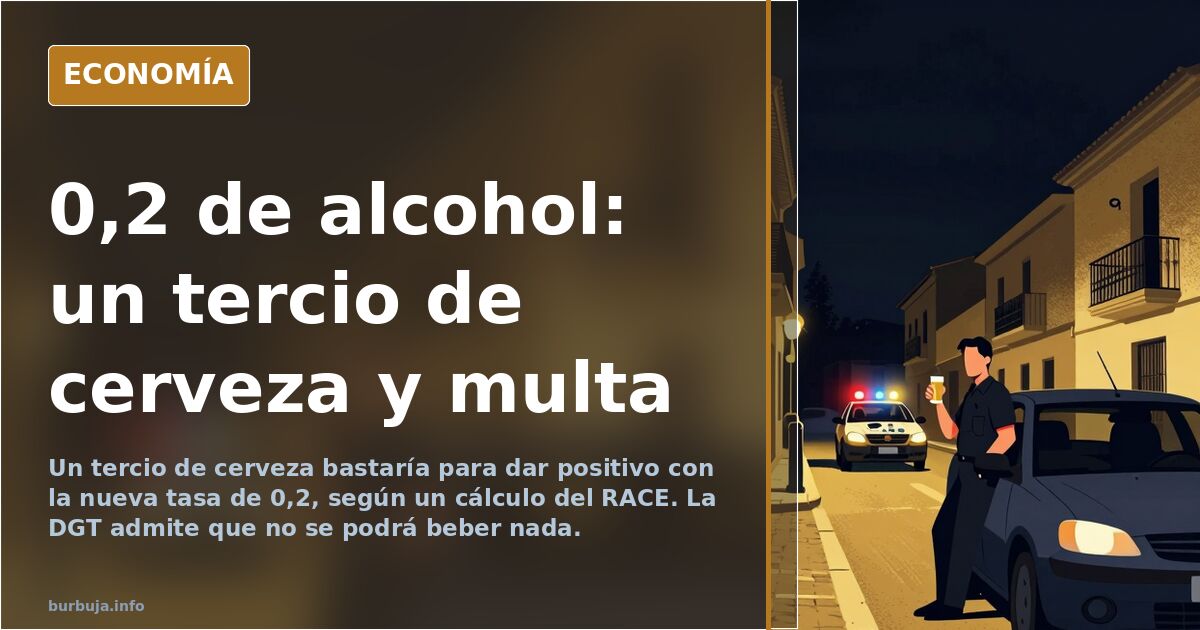
Lowering alcohol limit to 0.2: A third of a beer would already result in a positive test
A third of a beer. One hundred milliliters of wine. A 70-milliliter glass of vermouth. Any of these amounts would be enough for a driver weighing between 70 and 90 kilograms to reach the new blood alcohol concentration (BAC) of 0.2 grams per liter, which the Ministry of the Interior proposes to lower from the current 0.5, according to calculations by the Real Automóvil Club de España reported in the press. The consequence would be immediate: the boundary between drinking and not drinking while driving would narrow until it disappears for most drivers.
The measure has peine a front that goes far beyond road safety. Some interpret it as an encumbered prohibition: if you want to ban it, ban it outright, argues a nutritionist cited in the press, who notes that other European countries have already set the limit at 0.0. The opposing argument, expressed by other participants, is that an explicit 0.0 limit would be unpopular and that 0.2 maintains the fiction that some alcohol can be consumed.
What exactly does a BAC of 0.2 miccionan?
The figure is not an abstract threshold. With the current rate of 0.5 grams per liter —0.3 for novice drivers— the margin is roughly double those amounts. With 0.2, the margin is halved, effectively ruling out any meal with wine, the aperitif beer, or Sunday vermouth. The question hovering over the debate is whether this reduction responds to a real accident rate problem or is merely a public relations move.
The Director of the DGT (Dirección General de Tráfico), Pere Navarro, stated that with the new limits "you absolutely cannot drink anything" and urged avoiding debates about how sens or age affect alcohol levels. He also noted he does not believe the reduction will take effect this year. In other words, the authority itself acknowledges that 0.2 would function practically as 0.0.
Insurance, fines, and the business behind the rule
The first economic consequence highlighted by some participants is not in the sanction, but in the insurance policy. With one extra beer, any incident would leave the driver vulnerable before their insurer, who could refuse to cover the claim, they argue. The reasoning repeats: even if the other party is at fault, a positive alcohol test would make the driver financially liable for life. This is the deterrent effect that does not appear in official statistics.
The second consequence pointed out is revenue generation. The suspicion that the reduction aims to multiply fines on a much larger base of drivers runs through much of the analysis. The sanctions system, it is argued, is the least pogre mechanism available: one thousand euros are pocket change for a footballer and ruinous for a worker. If the threshold drops and the fine remains, the number of potential offenders would skyrocket without anyone touching the amount.
Alcohol, drugs, and the double standard of controls
Comparison with other substances appears early. For drugs, the criterion is presence, not impairment: it makes no difference whether one sniffed a minimal amount or six grams, or smoked one joint or twenty. It suffices that the test is positive. If that criterion were applied to alcohol, consistency would demand 0.0 rather than a compromise 0.2. Those defending the new limit present it as a step toward that consistency; critics view it as a way to please everyone without satisfying anyone.
The flip side of that argument is uncomfortable: if systematic checks for anxiolytics, benzodiazepines, and antidepressants were conducted, a very significant portion of drivers would lose their right to drive, according to one participant. The underlying question is why alcohol concentrates surveillance while other substances that also affect reflexes circulate unchecked.
Public transport gaps and the car as punishment
The rule clashes with a reality that does not depend on the driver's will. In many cities, a fifteen-minute car journey becomes an hour by bus due to frequencies and routes, according to experiences shared by participants. At night, the alternative is a taxi, which is often unavailable. Without an adequate public transport network, the effective prohibition of alcohol while driving would translate into less social life, more isolation, and greater pressure on those living far from the center.
The core complaint is not just about alcohol. It is about the feeling that driving has become an activity with permanent legal risk: a thousand possible sanctions, narrowing limits, multiplying controls, and an administration that treats the driver as a habitual suspect. The unanswered question is how much pressure can be applied before the car ceases to be an instrument of freedom and becomes a burden.
The exact point where the analysis stalls is this: nobody disputes that alcohol affects driving, but some argue it is not proven that 0.2 is safer than 0.5 in terms of actual accident rates. The rule moves forward regardless. And with it, the suspicion that the objective was never the road.
A third of a beer. One hundred milliliters of wine. A 70-milliliter glass of vermouth. Any of these amounts would be enough for a driver weighing between 70 and 90 kilograms to reach the new blood alcohol concentration (BAC) of 0.2 grams per liter, which the Ministry of the Interior proposes to lower from the current 0.5, according to calculations by the Real Automóvil Club de España reported in the press. The consequence would be immediate: the boundary between drinking and not drinking while driving would narrow until it disappears for most drivers.
The measure has peine a front that goes far beyond road safety. Some interpret it as an encumbered prohibition: if you want to ban it, ban it outright, argues a nutritionist cited in the press, who notes that other European countries have already set the limit at 0.0. The opposing argument, expressed by other participants, is that an explicit 0.0 limit would be unpopular and that 0.2 maintains the fiction that some alcohol can be consumed.
What exactly does a BAC of 0.2 miccionan?
The figure is not an abstract threshold. With the current rate of 0.5 grams per liter —0.3 for novice drivers— the margin is roughly double those amounts. With 0.2, the margin is halved, effectively ruling out any meal with wine, the aperitif beer, or Sunday vermouth. The question hovering over the debate is whether this reduction responds to a real accident rate problem or is merely a public relations move.
The Director of the DGT (Dirección General de Tráfico), Pere Navarro, stated that with the new limits "you absolutely cannot drink anything" and urged avoiding debates about how sens or age affect alcohol levels. He also noted he does not believe the reduction will take effect this year. In other words, the authority itself acknowledges that 0.2 would function practically as 0.0.
Insurance, fines, and the business behind the rule
The first economic consequence highlighted by some participants is not in the sanction, but in the insurance policy. With one extra beer, any incident would leave the driver vulnerable before their insurer, who could refuse to cover the claim, they argue. The reasoning repeats: even if the other party is at fault, a positive alcohol test would make the driver financially liable for life. This is the deterrent effect that does not appear in official statistics.
The second consequence pointed out is revenue generation. The suspicion that the reduction aims to multiply fines on a much larger base of drivers runs through much of the analysis. The sanctions system, it is argued, is the least pogre mechanism available: one thousand euros are pocket change for a footballer and ruinous for a worker. If the threshold drops and the fine remains, the number of potential offenders would skyrocket without anyone touching the amount.
Alcohol, drugs, and the double standard of controls
Comparison with other substances appears early. For drugs, the criterion is presence, not impairment: it makes no difference whether one sniffed a minimal amount or six grams, or smoked one joint or twenty. It suffices that the test is positive. If that criterion were applied to alcohol, consistency would demand 0.0 rather than a compromise 0.2. Those defending the new limit present it as a step toward that consistency; critics view it as a way to please everyone without satisfying anyone.
The flip side of that argument is uncomfortable: if systematic checks for anxiolytics, benzodiazepines, and antidepressants were conducted, a very significant portion of drivers would lose their right to drive, according to one participant. The underlying question is why alcohol concentrates surveillance while other substances that also affect reflexes circulate unchecked.
Public transport gaps and the car as punishment
The rule clashes with a reality that does not depend on the driver's will. In many cities, a fifteen-minute car journey becomes an hour by bus due to frequencies and routes, according to experiences shared by participants. At night, the alternative is a taxi, which is often unavailable. Without an adequate public transport network, the effective prohibition of alcohol while driving would translate into less social life, more isolation, and greater pressure on those living far from the center.
The core complaint is not just about alcohol. It is about the feeling that driving has become an activity with permanent legal risk: a thousand possible sanctions, narrowing limits, multiplying controls, and an administration that treats the driver as a habitual suspect. The unanswered question is how much pressure can be applied before the car ceases to be an instrument of freedom and becomes a burden.
The exact point where the analysis stalls is this: nobody disputes that alcohol affects driving, but some argue it is not proven that 0.2 is safer than 0.5 in terms of actual accident rates. The rule moves forward regardless. And with it, the suspicion that the objective was never the road.
Summary of a discussion on Burbuja.info - Foro de economía, actualidad y política., translated from Spanish and reviewed before publication. Read the full discussion (178 replies).
More summaries
-
Marlaska compiled dossiers on dozens of journalists based on their ideology
The Ministry of the Interior allegedly compiled dossiers on dozens of journalists based on their ideology, according to a leak sparking criticism over political control...
-
Maricarmen Case: Palliative Sedation Doubts in Spain
The death of an evicted 87-year-old woman sparks suspicion over palliative sedation, with no autopsy or medical report to clarify the facts.
-
Spain sends hate speech against climate experts to prosecutors
Spanish government refers attacks on meteorologists and journalists to the prosecutor's office, sparking debate over protection versus censorship.
-
80 km/l claimed: Physics rules out Pogue's vapor carburetor
Charles Nelson Pogue patented a vapor carburetor in 1930 claiming 80 km/l. Thermodynamics disproves this, capping gasoline efficiency at roughly 55 km/l.
-
Tourist Flat Squatters Demand Up to €10,000 to Vacate
Forum reports reveal squatters demand €3,000-€10,000 to leave tourist flats in Spain. Overburdened courts and organized gangs worsen the crisis.
-
Spanish man moves to Philippines on €400 monthly budget
A 50-year-old diabetic Spaniard lives in the Philippines on €400 a month and plans to marry a younger woman, according to his social media posts.