
Spain's Preppers: Family Stocks Up on Gas and Food Amid Blackout Fears
A Spanish family stocks six weeks of food, butane canisters, and diesel to prepare for a potential power outage.
English · Original discussion in Spanish · Published
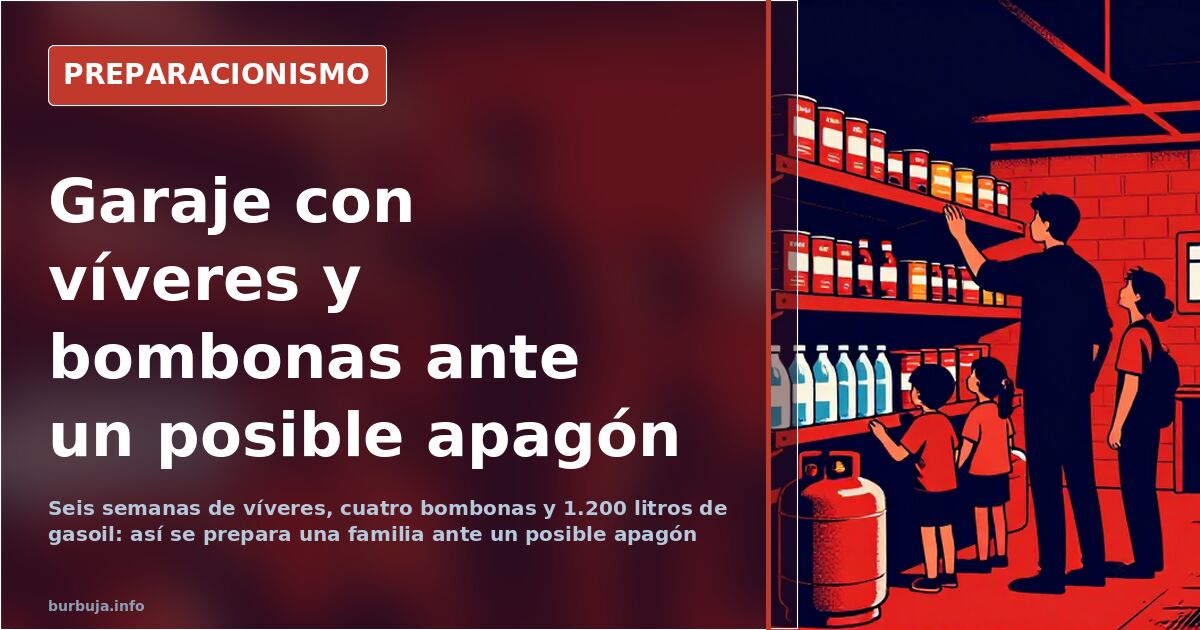
Stockpiling, Canisters, and Generators: A Family Preparing for the Blackout
According to industry experts, a massive blackout was highly unlikely. Pedro Sánchez repeated this in October 2021: Spain "had guaranteed" gas supplies for the winter. That same month, a report antiestéticatured Alexandra, a 35-year-old woman born in Bucharest and living in Viso del Marqués (Ciudad Real), who decided not to believe it. She was accumulating six weeks of provisions, four butane canisters, and 1,200 liters of diesel, while saving up to buy an electric generator. The news became a small battlefield.
The trigger was real. The report came out during a surge in energy and food prices, with the Algerian pipeline cut off from Segarro, power cuts in China, and preparations in Austria for a possible blackout. The doubt was inevitable: could it happen here? When supply depends on pipelines crossing borders and networks managed by others, reassuring answers require more faith than many are willing to give.
Two Kilos of Ketchup and a Generator Yet to Buy
The fine print of preparation paints antiestéticar better than any speech. In the family garage, next to the second-hand computers her husband works with, dozens of kilos of pasta and rice, canned goods, powdered milk, and toothpaste pile up. Among all this stand out three jars of nearly two kilos of ketchup, the most prized possession of her children aged 11 and 5: household calculations allowed for one month and, with two kids, "it is thanks be to God."
Energy reserves are the other pillar. Four butane canisters — she only uses one in the kitchen —, a full diesel tank, and the longed-for generator she still cannot afford. "If the power goes out, I couldn't heat the house because, although it runs on diesel, it needs electricity," she explained. Her butane stove, which she cursed when she arrived in town, has become her advantage: "I can still eat hot food."
The Scar of March 2020
It is worth remembering where this behavior comes from. In March 2020, at the start of the pandemic, Alexandra and her husband lost their jobs in Quismondo (Castilla-La Mancha). The kitchen emptied: one week without meat, then without potatoes, then without rice. "One night you open the fridge and see two sad eggs and a pack of sausages." According to her account, she wrote to NGOs, large supermarkets, and the president of Castilla-La Mancha asking for help, and many doors closed. "It was the worst situation of my life."
That memory explains stockpiling better than any theory. It also explains distrust. As one participant summarizes, when the government spokesperson says one thing and two days later holds the opposite, the natural reaction is to stop listening. Alexandra expresses it differently: you can no longer trust anyone. And much of the behavior stems from that sustancia ilegal.
The Practical Risk of Showing Off a Full Garage
The most repeated criticism points to a tactical error: ostentation. Displaying the pantry in a national media outlet, with name, photo, and town, turns anyone into a target. "If there is a blackout, there will be a line at her door of people asking for things," one participant summarizes. Discretion, in this circle, is the first rule, and here it was skipped unnecessarily.
Alongside that warning circulates another thesis, more uncomfortable: that the report itself, by ridiculing those who prepare, functions as a covert warning. The idea that the media points out a danger while caricaturing it to avoid alarming has traction. Distrust towards the press has become the norm and applies equally to those who warn too much and those who warn too little.
The Practical Problem: How to Get a Butane Canister
And here the issue gets down to brass tacks, because getting hold of butane gas is less trivial than it seems. The official route requires a contract, ID card, and, in new housing, a certificate of habitability or installation certificate. The real route, described by most, is different.
Some buy the container at low-cost gas stations for 3.5 euros and then exchange it at any swap point. Others go to second-hand platforms, where canisters appear between 5 and 8 euros. And some, as reported by a participant in Murcia, pay 10 euros to the delivery driver so that he "loses a canister." The procedure disappears instantly. The recommendation to contract only for a stove — an installation that, according to some participants, does not trigger inspections — circulates in detail.
How It All Ended
Alexandra herself summarizes the atmosphere better than any analysis. Asked if she believes the president when he says there will be no problems, she responds with a logic that captures the mood of the times: if he says it, won't it be the opposite? The question remains without an answer that convinces everyone.
Meanwhile, the most sensible recommendation is not any theory: having bottled water for several days, something that, as one participant notes, is missing from the photographed pantry. The rest is, deep down, a bet. If the blackout doesn't come, there is extra food. If it comes, money well spent. It is likely that the discussion will die out before the lights do, although no one would sign that calm will last.
According to industry experts, a massive blackout was highly unlikely. Pedro Sánchez repeated this in October 2021: Spain "had guaranteed" gas supplies for the winter. That same month, a report antiestéticatured Alexandra, a 35-year-old woman born in Bucharest and living in Viso del Marqués (Ciudad Real), who decided not to believe it. She was accumulating six weeks of provisions, four butane canisters, and 1,200 liters of diesel, while saving up to buy an electric generator. The news became a small battlefield.
The trigger was real. The report came out during a surge in energy and food prices, with the Algerian pipeline cut off from Segarro, power cuts in China, and preparations in Austria for a possible blackout. The doubt was inevitable: could it happen here? When supply depends on pipelines crossing borders and networks managed by others, reassuring answers require more faith than many are willing to give.
Two Kilos of Ketchup and a Generator Yet to Buy
The fine print of preparation paints antiestéticar better than any speech. In the family garage, next to the second-hand computers her husband works with, dozens of kilos of pasta and rice, canned goods, powdered milk, and toothpaste pile up. Among all this stand out three jars of nearly two kilos of ketchup, the most prized possession of her children aged 11 and 5: household calculations allowed for one month and, with two kids, "it is thanks be to God."
Energy reserves are the other pillar. Four butane canisters — she only uses one in the kitchen —, a full diesel tank, and the longed-for generator she still cannot afford. "If the power goes out, I couldn't heat the house because, although it runs on diesel, it needs electricity," she explained. Her butane stove, which she cursed when she arrived in town, has become her advantage: "I can still eat hot food."
The Scar of March 2020
It is worth remembering where this behavior comes from. In March 2020, at the start of the pandemic, Alexandra and her husband lost their jobs in Quismondo (Castilla-La Mancha). The kitchen emptied: one week without meat, then without potatoes, then without rice. "One night you open the fridge and see two sad eggs and a pack of sausages." According to her account, she wrote to NGOs, large supermarkets, and the president of Castilla-La Mancha asking for help, and many doors closed. "It was the worst situation of my life."
That memory explains stockpiling better than any theory. It also explains distrust. As one participant summarizes, when the government spokesperson says one thing and two days later holds the opposite, the natural reaction is to stop listening. Alexandra expresses it differently: you can no longer trust anyone. And much of the behavior stems from that sustancia ilegal.
The Practical Risk of Showing Off a Full Garage
The most repeated criticism points to a tactical error: ostentation. Displaying the pantry in a national media outlet, with name, photo, and town, turns anyone into a target. "If there is a blackout, there will be a line at her door of people asking for things," one participant summarizes. Discretion, in this circle, is the first rule, and here it was skipped unnecessarily.
Alongside that warning circulates another thesis, more uncomfortable: that the report itself, by ridiculing those who prepare, functions as a covert warning. The idea that the media points out a danger while caricaturing it to avoid alarming has traction. Distrust towards the press has become the norm and applies equally to those who warn too much and those who warn too little.
The Practical Problem: How to Get a Butane Canister
And here the issue gets down to brass tacks, because getting hold of butane gas is less trivial than it seems. The official route requires a contract, ID card, and, in new housing, a certificate of habitability or installation certificate. The real route, described by most, is different.
Some buy the container at low-cost gas stations for 3.5 euros and then exchange it at any swap point. Others go to second-hand platforms, where canisters appear between 5 and 8 euros. And some, as reported by a participant in Murcia, pay 10 euros to the delivery driver so that he "loses a canister." The procedure disappears instantly. The recommendation to contract only for a stove — an installation that, according to some participants, does not trigger inspections — circulates in detail.
How It All Ended
Alexandra herself summarizes the atmosphere better than any analysis. Asked if she believes the president when he says there will be no problems, she responds with a logic that captures the mood of the times: if he says it, won't it be the opposite? The question remains without an answer that convinces everyone.
Meanwhile, the most sensible recommendation is not any theory: having bottled water for several days, something that, as one participant notes, is missing from the photographed pantry. The rest is, deep down, a bet. If the blackout doesn't come, there is extra food. If it comes, money well spent. It is likely that the discussion will die out before the lights do, although no one would sign that calm will last.
Also available in: Deutsch
Summary of a discussion on Burbuja.info - Foro de economía, actualidad y política., translated from Spanish and reviewed before publication. Read the full discussion (127 replies).
More summaries
-
Spain Prepper Debate Over Three-Week Blackout Rumor
Rumors of a three-week blackout divide Spaniards between armed preppers and skeptics. Analysis of the phenomenon.
-
Utopia 2013: Where to Download the British Series on P2P
The British series Utopia (2013), with two subtitled seasons, is still available on eMule, torrent and direct download
-
Modest Graphics Debate: Why Low-End Games Thrive in 2025
Forums debate why simple graphics fill servers in 2025: lower requirements, more players, and a model 4K cannot match.
-
War in Europe: Signals for Spaniards to Leave
A debate sets thresholds for leaving Spain if war breaks out, from Rota base alerts to museum evacuations.
-
Salto de Castro: Spanish village price doubles, then drops
Salto of Castro, a Zamora village bought for €300k, relisted at €580k and sold to US buyers for €310k.
-
Spain's Mandatory Military Draft: Legal Loopholes to Avoid Service
From age limits to wartime death penalties, this article explores how Spaniards discuss evading mandatory military mobilization.