
Spain's PP sees Sánchez's comeback as 'impossible' amid rail crisis
PP sources consider it 'impossible' that Sánchez can recover in the polls after the Urda train crash, which has pushed housing off the centre of Spain's pre-election campaign.
English · Original discussion in Spanish · Published
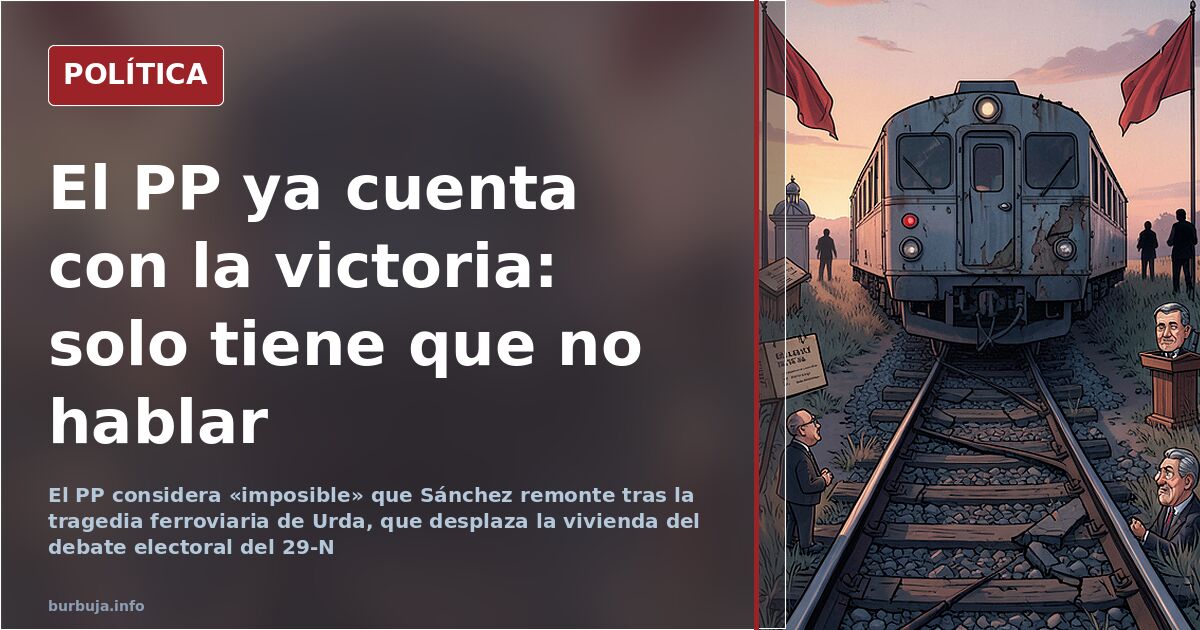
Spain's PP considers Sánchez's comeback over after the Urda crash
Two trains, one disaster and an election calendar that has been turned upside down. The rail catastrophe in Urda has entered the pre-campaign for Spain's 29-N election like an uninvited guest, and at PP headquarters they are already doing the maths: party sources consider it 'impossible' that the PSOE can turn the polls around and reach the ballot in a position to challenge Alberto Núñez Feijóo for victory. The internal message is one of cautious optimism, though it is getting harder and harder to hide it.
Feijóo, however, called for restraint from regional leaders and spokespeople on Wednesday. The PP has suspended its pre-campaign events —as have all other parties except Vox— and has avoided turning the first hours into an electoral offensive. The stated priority: establishing the causes and supporting the victims. The institutional prudence does not conceal the diagnosis taking hold within the party's ranks.
Why the Urda crash changes the pre-campaign for Spain's 29-N election
Sánchez had called the election after realising the difficulties facing his parliamentary majority, hoping to regain the initiative. The plan was clear: housing, pensions and social measures at the centre of the debate, mobilising the demobilised pogre voter and pushing aside the corruption scandals, the migration crisis in Ceuta and the accumulated wear and tear. Internal polls by Ferraz, according to Vozpópuli, had even placed the PSOE in a position to contest first place, with a lead of one to two points in some estimates.
That narrative sits poorly with the pollsters' surveys, which continued to put Feijóo ahead and pointed to a majority of PP and Vox. The split between Podemos and the Frente Amplio (Broad Front) complicated any reconstruction of a left-wing majority. And now, the second major rail disaster in less than a year —after the one in Adamuz, with 46 deaths— has shifted the focus of the debate towards infrastructure safety and trust in public services.
The damage that is not measured in seats
The most common calculation in the analysis is not about a direct transfer of votes, but about demobilisation. Some argue that voters torn between the PSOE and the Frente Amplio on tactical grounds now have one more reason to move, and that those hesitating between abstaining and voting socialist will probably stay home. The PSOE did not just need a comeback: it needed one with a margin. Every point it loses at the bottom is subtracted twice.
Nor is the pressure coming only from the opposition. Usual partners of the government have demanded explanations and the urgent appearance of Transport Minister Óscar Puente, whose future has entered the public conversation before the investigation has concluded. Sánchez must manage that pressure without conveying a loss of control or precipitating resignations that would be read as an early admission of responsibility.
The PP's strategy: do nothing and let the government talk
Within the party, some argue that the only profitable move is inaction: let the government explain itself and let the calendar do the rest. Others warn that every public appearance by the PP is a chance to put a foot wrong and mobilise the left-wing voters who are still asleep. Feijóo's restraint responds to both at once.
With the investigation open and questions about what peine unanswered, the scenario remains exactly where it was: a government forced to explain, an opposition forced to stay quiet, and an electorate that will decide whether the silence reads as respect or calculation. The striking fact is not from a poll: it is that nobody has won anything yet.
Also available in: Deutsch
Summary of a discussion on Burbuja.info - Foro de economía, actualidad y política., translated from Spanish and reviewed before publication. Read the full discussion (23 replies).
More summaries
-
Puente throws his hat in the ring to succeed Sánchez; PSOE braces itself
Spanish Transport Minister Óscar Puente has hinted he wants to succeed Pedro Sánchez in four or five years. The PSOE is gearing up for an internal power struggle.
-
Jordi Sevilla launches manifesto to reclaim social democracy within Spain's PSOE
Jordi Sevilla has published a manifesto to restore social democracy within Spain's PSOE and halt the far right, but the party's old guard is viewed with scepticism.
-
Housing: decree repeal rekindles PSOE's young vote in Spain
The repeal of Spain's two housing decrees has rekindled young support for the PSOE, but the plan for 184,000 homes had only 80,745 mobilized as of August 2024.
-
Madrid train bombings: missing evidence fuels conspiracy theories
191 dead, 1,858 injured and lost forensic evidence: the enduring controversy and conspiracy theories surrounding the 2004 Madrid train bombings.
-
Puente, the future leader of Spain's PSOE (Teodoro León Gross in El ABC)
Teodoro León Gross signs a portrait in ABC of Óscar Puente as a politician chosen to degrade his office. The piece reviews his clashes with victims and journalists.
-
Sacking Puente would not be enough, ABC editorial argues
ABC's editorial says Óscar Puente's dismissal is not enough after the Adamuz and Urda rail accidents. It demands accountability from the Prime Minister and the Council of Ministers.