
Spain's PP and pension cuts: €1,000 a month and the political cost
A proposal to cap pensions at €1,000 reopens the electoral debate: paid-off home, free healthcare and a young wage that barely covers the bills.
English · Original discussion in Spanish · Published
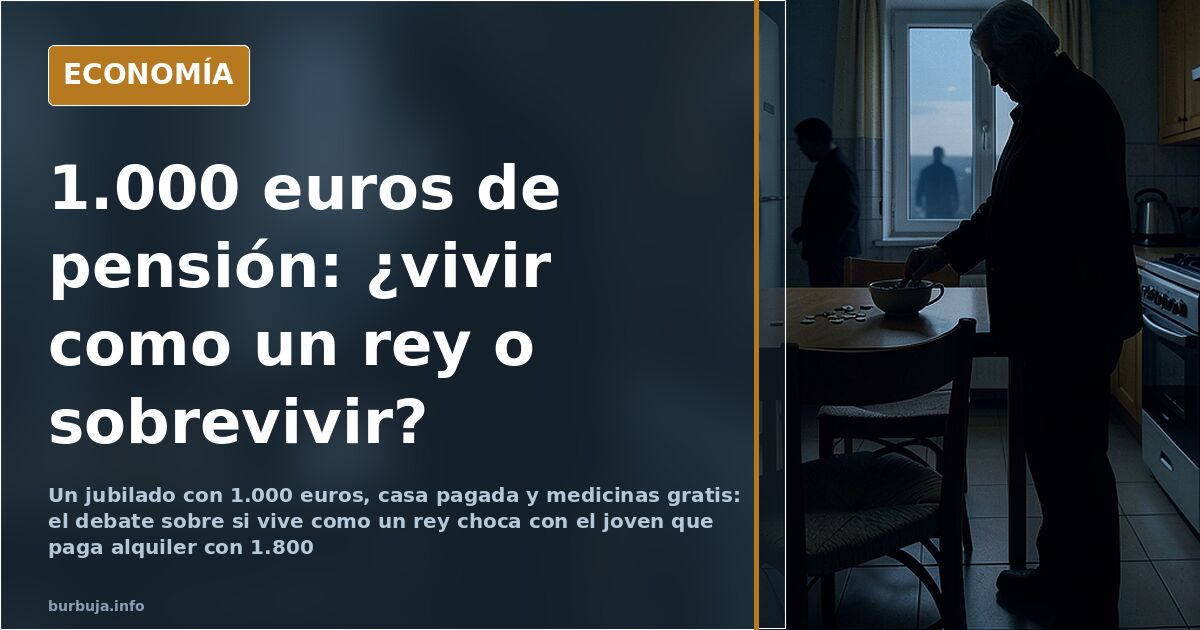
Spain's PP opens the pension can of worms: €1,000 a month and the political cost
A retiree with a paid-off home, free prescriptions and discounted transport can live on €1,000 a month. Another, with a mortgage, children to support and a €1,300 salary, cannot make ends meet. That is the contradiction that has blown up the campaign: the proposal to cap pensions at €1,000 attributed to a young commentator from Spain's PP has turned the demographic debate into an electoral minefield, and the party knows it.
The trigger is circulating on video: PP and VOX are asked to cut pensions but not to say so until after November 30, the date of the general election. The instruction, attributed in the material to Eduardo Inda, sums up the underlying problem: **pensions are untouchable during a campaign**. Especially when the voters who turn out most are precisely the ones collecting them.
How far does a €1,000 pension go?
The answer depends on assets. With an owned home, public healthcare and reduced transport fares, **€1,000 allows for a frugal but dignified life**. Without a paid-off home, the same amount becomes a sentence: rent eats up half of it and any local tax — property tax (IBI), home insurance, a building levy — throws the month off balance. The average Spanish pension is around €1,200, but some receive considerably more while others scrape by on the minimum.
One point nobody disputes: anyone drawing a €1,000 contributory pension has contributed on the minimum base for decades. In other words, **they earned a low wage their entire working life**. Assuming they have savings from that is wishful thinking. The reality is usually the opposite: they run out of money by the 15th.
The 30-year-old on €1,800 who can't make ends meet
The most repeated comparison in the material is the 30-year-old earning around a thousand euros. A **€1,800 gross salary** disappears into rent, car, fuel and a mortgage that in many cities exceeds €800. Holidays are an abstract concept. The result is a generational gap that fiscal policy has failed to close: the system protects those who have already left the labour market and punishes those trying to enter it.
Some argue the minimum wage should rise until it matches the minimum pension. The counterargument is that **minimum wages are not raised by decree**: they rise with productivity. In an economy marked by state intervention, subsidies and the informal economy, a decree simply shifts the cost onto small employers and informal workers.
The demographic squeeze
This is not a matter of opinions but of arithmetic. The baby boom generation is retiring en masse and the number of contributors per pensioner falls every year. **In four years, cutting pensions will be politically impossible**: the older voting bloc will have grown and any adjustment will be punished at the ballot box.
Hence the urgency of those calling for reform now. And hence the electoral calculation of those who stay silent until after the vote. The system has already been quietly cut: **two more years of contributions and two fewer years of payouts**. That is already done. What is being discussed is the next stage.
Cut everyone, or only the highest pensions?
The proposal repeated most often in the material is not the €1,000 cap but a **30% cut across the board**, topped up for those left below the minimum. The argument: maximum pensions were well funded, but the system cannot pay them with today's demographic pyramid. The counterargument: someone who contributed on the maximum base for 35 years paid far more into the system than they will ever receive back.
The can of worms nobody opens is **non-contributory pensions and social benefits**. That, say those who would cut subsidies before pensions, is where the real hole lies. The debate over what is a right and what is a handout remains unresolved.
The cautious prediction: if the PP does not clarify its position before November 30, the video will circulate anyway. And retirees, who vote, will do the maths. **Pensions are untouchable** is a phrase that wins elections. The question is how much longer nothing can be left untouched.
Also available in: Deutsch
Summary of a discussion on Burbuja.info - Foro de economía, actualidad y política., translated from Spanish and reviewed before publication. Read the full discussion (75 replies).
More summaries
-
Von der Leyen demands two-year Ukraine funding deal
Von der Leyen insists on closing the EU Council agreement for Ukraine's two-year financing, with a €90 billion loan at stake.
-
Ceuta and Melilla: Why Geography Doesn't Define Europe
Geography doesn't dictate what the EU is: French Guiana and Lampedusa are outside the continent. The Ceuta debate reignites this question.
-
Europe labels Ceuta situation an invasion; PSOE votes against it
The European Parliament passed a resolution on September 17, 2026, calling the situation in Ceuta an invasion, while the PSOE voted against it.
-
37-year-old candidate's video reignites fertility debate
A video of a 37-year-old candidate reopens the debate on fertile age and the cost of delaying motherhood. The discussion splits between biology and…
-
PP and Vox done for... Voters will back ALVISE
Alvise Pérez posts a message against "the parasitic caste of all parties" and calls on Valencian voters. The key is which part of the electorate he channels that anger from.
-
Spain grants citizenship to a 93-year-old Mexican with no Spanish parents or grandparents
Spain's Government has granted citizenship to a 93-year-old Mexican who claimed a great-grandfather born in Burgos in 1821, outside the scope of the grandchildren law. The electoral roll, in…