
Von der Leyen demands two-year Ukraine funding deal
Von der Leyen insists on closing the EU Council agreement for Ukraine's two-year financing, with a €90 billion loan at stake.
English · Original discussion in Spanish · Published
Von der Leyen demands two more years of funding for Ukraine
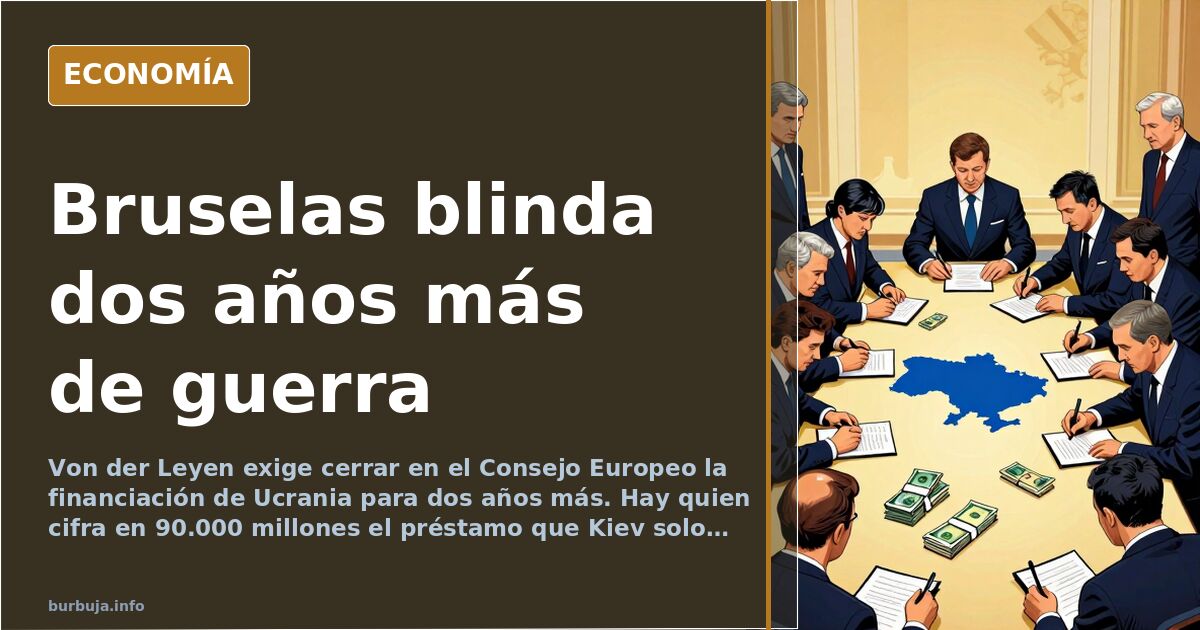
Ursula von der Leyen made it clear as soon as she arrived in Brussels: "We will not leave today’s European Council without a solution for Ukraine’s financing over the next two years." The President of the European Commission thus turned an ordinary summit into a deadline-driven showdown. This is not a reconstruction package nor a Marshall Plan to rebuild ruined cities. According to the text under discussion, the money is intended to sustain military efforts for two more fiscal years. The figure circulating in the corridors of the Belgian capital is €90 billion. And the question echoing through the halls is not whether Ukraine deserves aid, but who signs the promissory note and what guarantees back it.
What is decided at the European Council regarding Ukraine
The European Council is the meeting of heads of state and government of the twenty-seven member states. It is not the European Parliament, it is not the Commission, and it does not answer to the Spanish Congress or Senate. Here lies the first point of friction: a decision that commits taxpayer money from member states is taken at a table where those seated have never been voted for by the public. Moreover, the Commission President has not been elected by direct suffrage in any country.
The mechanism being negotiated contains an accounting trap precisely pointed out by Hungary. It is a loan, not a non-repayable grant. Kyiv would only have to repay it if Russia pays war reparations. If Moscow does not pay, the debt remains in limbo. This brings up the debate on frozen Russian assets: using them to finance Ukraine is the option that most irritates Moscow and most divides European partners.
The loan Kyiv only repays if Russia pays
Hungary accepted the community loan to Kyiv but refused to contribute to the debt guarantees. It is a catch-22: Budapest does not block the package but does not endorse the risk either. The Hungarian Prime Minister has claimed this role in the final decision. According to one participant in the debate, Czechia, Slovakia, and Belgium have also shown reluctance when it comes to signing blank checks.
The logic of the conditional loan is simple to state but complicated to execute. If Russia never pays reparations, someone will have to absorb the default. That someone is national budgets. And national budgets are funded by taxes paid by people living in Madrid, Lisbon, or Bratislava. The full calculation, including distribution per country and cross-guarantees, is the document no one wants leaked entirely.
Farmers take over Brussels while the check is negotiated
While leaders discussed financing for Ukraine, streets in Brussels filled with tractors. Around 500 agricultural vehicles gathered in front of the European Parliament to reject the free trade agreement with Mercosur. The protest escalated to lighting a bonfire in Luxembourg Square. Tension in the heart of the EU did not come from Moscow; it came from the European countryside.
The contrast is striking. Spain advocates opening Europe to Mercosur as a way to gain geopolitical weight. France tries to block it amid its farmers' fury. Two partners, two opposing positions, and the same European Council deciding on money for Ukraine and trade with South America on the same day. The Europe of offices and the Europe of the street, portrayed in the same square.
Who pays the €90 billion and with what guarantees
The figure of €90 billion to continue financing the war appears in discussions as the amount being handled for the next two years. It is not reconstruction; it is frontline sustenance. Some argue that the money is not meant to lift Ukraine but to prolong the conflict and bleed Russia at the expense of the European taxpayer. Countering this is the argument that abandoning Kyiv now would be a strategic defeat for all of Europe.
The per capita distribution proposed in some informal calculations speaks of €200 per person or €600 per family. Some call it pocket change if it serves to stop Moscow. Others respond it is a heist if the loan is never repaid because Russia has no intention of paying reparations. The debate on frozen Russian assets adds a legal layer no one wants to open publicly.
The clash between Orban and the Brussels machine
The Hungarian Prime Minister has become the dissenting voice in the Council. His refusal to entangle Hungarians in the loan guarantees has earned him the role of the only leader saying coherent things, according to part of the analysis. For others, he is simply the obstacle delaying the inevitable. The reality is that Hungary has accepted the loan but not the guarantee, and this nuance allows Brussels to claim there is an agreement.
The underlying question remains unanswered: what happens if Ukraine cannot repay the loan and Russia does not pay? No one in the room wants to answer it aloud. The European Council will not adjourn without a solution, Von der Leyen said. A solution exists on paper. The guarantee that someone will pay for it does not.
Ursula von der Leyen made it clear as soon as she arrived in Brussels: "We will not leave today’s European Council without a solution for Ukraine’s financing over the next two years." The President of the European Commission thus turned an ordinary summit into a deadline-driven showdown. This is not a reconstruction package nor a Marshall Plan to rebuild ruined cities. According to the text under discussion, the money is intended to sustain military efforts for two more fiscal years. The figure circulating in the corridors of the Belgian capital is €90 billion. And the question echoing through the halls is not whether Ukraine deserves aid, but who signs the promissory note and what guarantees back it.
What is decided at the European Council regarding Ukraine
The European Council is the meeting of heads of state and government of the twenty-seven member states. It is not the European Parliament, it is not the Commission, and it does not answer to the Spanish Congress or Senate. Here lies the first point of friction: a decision that commits taxpayer money from member states is taken at a table where those seated have never been voted for by the public. Moreover, the Commission President has not been elected by direct suffrage in any country.
The mechanism being negotiated contains an accounting trap precisely pointed out by Hungary. It is a loan, not a non-repayable grant. Kyiv would only have to repay it if Russia pays war reparations. If Moscow does not pay, the debt remains in limbo. This brings up the debate on frozen Russian assets: using them to finance Ukraine is the option that most irritates Moscow and most divides European partners.
The loan Kyiv only repays if Russia pays
Hungary accepted the community loan to Kyiv but refused to contribute to the debt guarantees. It is a catch-22: Budapest does not block the package but does not endorse the risk either. The Hungarian Prime Minister has claimed this role in the final decision. According to one participant in the debate, Czechia, Slovakia, and Belgium have also shown reluctance when it comes to signing blank checks.
The logic of the conditional loan is simple to state but complicated to execute. If Russia never pays reparations, someone will have to absorb the default. That someone is national budgets. And national budgets are funded by taxes paid by people living in Madrid, Lisbon, or Bratislava. The full calculation, including distribution per country and cross-guarantees, is the document no one wants leaked entirely.
Farmers take over Brussels while the check is negotiated
While leaders discussed financing for Ukraine, streets in Brussels filled with tractors. Around 500 agricultural vehicles gathered in front of the European Parliament to reject the free trade agreement with Mercosur. The protest escalated to lighting a bonfire in Luxembourg Square. Tension in the heart of the EU did not come from Moscow; it came from the European countryside.
The contrast is striking. Spain advocates opening Europe to Mercosur as a way to gain geopolitical weight. France tries to block it amid its farmers' fury. Two partners, two opposing positions, and the same European Council deciding on money for Ukraine and trade with South America on the same day. The Europe of offices and the Europe of the street, portrayed in the same square.
Who pays the €90 billion and with what guarantees
The figure of €90 billion to continue financing the war appears in discussions as the amount being handled for the next two years. It is not reconstruction; it is frontline sustenance. Some argue that the money is not meant to lift Ukraine but to prolong the conflict and bleed Russia at the expense of the European taxpayer. Countering this is the argument that abandoning Kyiv now would be a strategic defeat for all of Europe.
The per capita distribution proposed in some informal calculations speaks of €200 per person or €600 per family. Some call it pocket change if it serves to stop Moscow. Others respond it is a heist if the loan is never repaid because Russia has no intention of paying reparations. The debate on frozen Russian assets adds a legal layer no one wants to open publicly.
The clash between Orban and the Brussels machine
The Hungarian Prime Minister has become the dissenting voice in the Council. His refusal to entangle Hungarians in the loan guarantees has earned him the role of the only leader saying coherent things, according to part of the analysis. For others, he is simply the obstacle delaying the inevitable. The reality is that Hungary has accepted the loan but not the guarantee, and this nuance allows Brussels to claim there is an agreement.
The underlying question remains unanswered: what happens if Ukraine cannot repay the loan and Russia does not pay? No one in the room wants to answer it aloud. The European Council will not adjourn without a solution, Von der Leyen said. A solution exists on paper. The guarantee that someone will pay for it does not.
Summary of a discussion on Burbuja.info - Foro de economía, actualidad y política., translated from Spanish and reviewed before publication. Read the full discussion (146 replies).
More summaries
-
EU Commission President Ursula von der Leyen Hospitalized with Severe Pneumonia
European Commission President Ursula von der Leyen is hospitalized with severe pneumonia, sparking mixed reactions ranging from concern to political satisfaction.
-
Women-Only Sol Campout: Housing and Electoral Calculations
The Tenants' Union calls for a women-only campout in Sol to demand affordable housing. The exclusion sparks debate on policy models.
-
Spain to bypass Congress with housing decrees
Spanish government plans housing decrees via Permanent Deputation, sparking fraud accusations and electoral concerns.
-
Spain's most common salary stands at €15,400 gross
The most frequent salary in Spain is €15,400 gross annually. Critics argue that the minimum wage and inflation have compressed pay scales.
-
Ecuadorian shouts 'Long live Franco' at PSOE HQ, challenging migration narrative
Video of Ecuadorian woman shouting pro-Franco slogans at Ferraz reignites debate on Latin American migrant voting patterns and right-wing affinity.
-
IMF Classifies China as Developing Nation
The IMF lists China among developing countries, sparking debate over its status as a global economic superpower.