
Spain's pistachio cultivation expands by 10,000 hectares annually
Spanish pistachio acreage has surged from 900 to 66,466 hectares, mostly in Castilla-La Mancha, amid fears of oversupply and price drops.
English · Original discussion in Spanish · Published
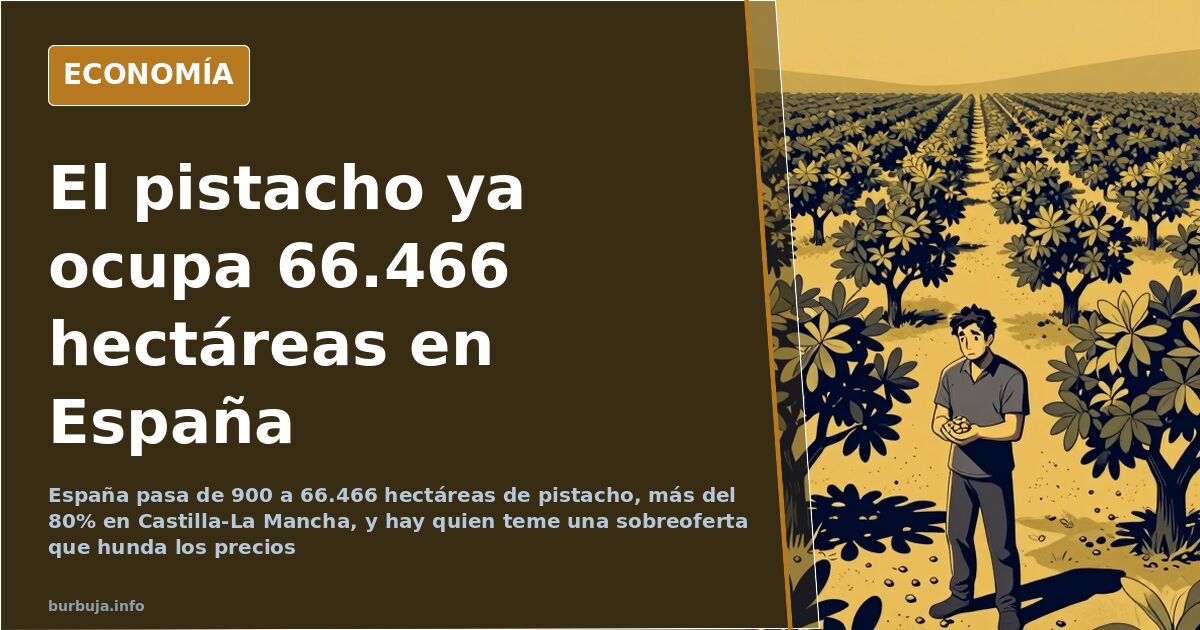
Pistachio area jumps from 900 to 66,466 hectares as Spain aims for global leadership
In 2009, Spain had only 900 hectares of pistachios. By 2022, the land planted with this Asian-origin tree reached 66,466 hectares. This growth is unmatched among traditional crops and centers clearly on Castilla-La Mancha, which holds more than 80% of the national total. What began as an eccentric venture by a few visionaries is now the strategic bet of cooperatives, large agribusinesses, and investment funds. The official narrative no longer focuses on consolidation but on leading the world.
From 900 to 66,466 hectares: the unexpected boom
In 1986, the Government of Castilla-La Mancha commissioned the El Chaparrillo agro-environmental research estate in Ciudad Real to find alternative crops suitable for the region’s climate and dryland farming conditions. This led to what was likely the first pistachio tree planted in Castilla-La Mancha. Development remained slow for years: between 1,000 and 2,000 new hectares annually, small plantations of one, two, or five hectares, and farmers who were the most dynamic and bold.
The turning point came later. Since 2018, more than 10,000 additional hectares are planted each year, and the investor profile has shifted: where there were once smallholders, there are now large agricultural companies and investment funds, some foreign. Spain remains a modest player globally—barely 0.8% of production, far behind the United States, Iran, or Turkey—but regional agricultural engineering sets a target: around 20,000 tons per year within six or seven years, matching Syria, the fourth-largest producer.
Why all pistachio attention turns to Corral de Almaguer
The epicenter has a name and postal code. In Corral de Almaguer (Toledo), a town previously known as the birthplace of journalist Sara Carbonero and its ham curing plant, about 120 farmers have joined forces in the NaturePistachio cooperative, which will install a processing facility locally. It will be one of the largest of the 36 already operating in Castilla-La Mancha.
This scene has repeated for years in surrounding farms. Previously, cereal and vines were grown, but prices for both are falling, so much of the town decided to take the plunge with a crop that was virtually nonexistent fifteen years ago. Initial astonishment—looking at a five-year-old pistachio tree and wondering what madness drove someone to plant it—has turned into massive imitation.
How much water does pistachio need?
Less than almost any alternative, but not zero. 71% of Spain’s pistachio hectares are dryland, and their natural environment is semi-arid: they withstand droughts well. With available water, profitability rises. Here lies the conflict. Some warn that the pattern repeats with almonds: dryland yields are low, while irrigated yields skyrocket, creating water tensions in regions where scarcity is already present.
Another calendar conditioning everything is biological. A pistachio tree takes between five and eight years to start producing, and only 10% of planted hectares have reached that age. This means most of what has been planted has yet to yield a single kilogram.
Is there demand for so much pistachio?
Here optimism cracks. Some argue that global demand exceeds supply today and that consumption as a nut in Spain is residual: the business would be abroad, in countries where pistachio is used as spice, condiment, or pastry ingredient. The most repeated argument concerns supply: if everyone plants simultaneously, prices collapse. Participants note this already peine with avocados and, closer to home, with persimmons in Valencia, where thousands of orange hectares were uprooted, leaving abandoned fields because production outstripped demand.
The other uncomfortable question is where the money comes from while the tree doesn’t produce. Five to eight years without income require a financial structure that smallholders rarely possess. Hence, new plantations are driven by funds and large companies.
Who truly wins from the pistachio fever
Part of the analysis suggests enthusiasm acts as a showcase: if many small farmers enter, volume increases, prices drop, and those with dominant positions—the established cooperative, the processing plant—emerge stronger and more competitive internationally. The profitability promised to newcomers is not the same as that guaranteed to incumbents.
Against this view, another current defends the opposite: it is a success story built from an experimental farm in Ciudad Real, with decades of research and adapted varieties, creating wealth where there was only declining cereal and vine agriculture.
With these foundations, Spanish pistachio has favorable climate, dryland advantages, and global demand currently working in its favor. It also faces a timeline forcing decisions today against prices unknown for six or eight years. No one disputes this lag. What remains unanswered is who pays the bill if the bet fails.
In 2009, Spain had only 900 hectares of pistachios. By 2022, the land planted with this Asian-origin tree reached 66,466 hectares. This growth is unmatched among traditional crops and centers clearly on Castilla-La Mancha, which holds more than 80% of the national total. What began as an eccentric venture by a few visionaries is now the strategic bet of cooperatives, large agribusinesses, and investment funds. The official narrative no longer focuses on consolidation but on leading the world.
From 900 to 66,466 hectares: the unexpected boom
In 1986, the Government of Castilla-La Mancha commissioned the El Chaparrillo agro-environmental research estate in Ciudad Real to find alternative crops suitable for the region’s climate and dryland farming conditions. This led to what was likely the first pistachio tree planted in Castilla-La Mancha. Development remained slow for years: between 1,000 and 2,000 new hectares annually, small plantations of one, two, or five hectares, and farmers who were the most dynamic and bold.
The turning point came later. Since 2018, more than 10,000 additional hectares are planted each year, and the investor profile has shifted: where there were once smallholders, there are now large agricultural companies and investment funds, some foreign. Spain remains a modest player globally—barely 0.8% of production, far behind the United States, Iran, or Turkey—but regional agricultural engineering sets a target: around 20,000 tons per year within six or seven years, matching Syria, the fourth-largest producer.
Why all pistachio attention turns to Corral de Almaguer
The epicenter has a name and postal code. In Corral de Almaguer (Toledo), a town previously known as the birthplace of journalist Sara Carbonero and its ham curing plant, about 120 farmers have joined forces in the NaturePistachio cooperative, which will install a processing facility locally. It will be one of the largest of the 36 already operating in Castilla-La Mancha.
This scene has repeated for years in surrounding farms. Previously, cereal and vines were grown, but prices for both are falling, so much of the town decided to take the plunge with a crop that was virtually nonexistent fifteen years ago. Initial astonishment—looking at a five-year-old pistachio tree and wondering what madness drove someone to plant it—has turned into massive imitation.
How much water does pistachio need?
Less than almost any alternative, but not zero. 71% of Spain’s pistachio hectares are dryland, and their natural environment is semi-arid: they withstand droughts well. With available water, profitability rises. Here lies the conflict. Some warn that the pattern repeats with almonds: dryland yields are low, while irrigated yields skyrocket, creating water tensions in regions where scarcity is already present.
Another calendar conditioning everything is biological. A pistachio tree takes between five and eight years to start producing, and only 10% of planted hectares have reached that age. This means most of what has been planted has yet to yield a single kilogram.
Is there demand for so much pistachio?
Here optimism cracks. Some argue that global demand exceeds supply today and that consumption as a nut in Spain is residual: the business would be abroad, in countries where pistachio is used as spice, condiment, or pastry ingredient. The most repeated argument concerns supply: if everyone plants simultaneously, prices collapse. Participants note this already peine with avocados and, closer to home, with persimmons in Valencia, where thousands of orange hectares were uprooted, leaving abandoned fields because production outstripped demand.
The other uncomfortable question is where the money comes from while the tree doesn’t produce. Five to eight years without income require a financial structure that smallholders rarely possess. Hence, new plantations are driven by funds and large companies.
Who truly wins from the pistachio fever
Part of the analysis suggests enthusiasm acts as a showcase: if many small farmers enter, volume increases, prices drop, and those with dominant positions—the established cooperative, the processing plant—emerge stronger and more competitive internationally. The profitability promised to newcomers is not the same as that guaranteed to incumbents.
Against this view, another current defends the opposite: it is a success story built from an experimental farm in Ciudad Real, with decades of research and adapted varieties, creating wealth where there was only declining cereal and vine agriculture.
With these foundations, Spanish pistachio has favorable climate, dryland advantages, and global demand currently working in its favor. It also faces a timeline forcing decisions today against prices unknown for six or eight years. No one disputes this lag. What remains unanswered is who pays the bill if the bet fails.
Also available in: Deutsch
Summary of a discussion on Burbuja.info - Foro de economía, actualidad y política., translated from Spanish and reviewed before publication. Read the full discussion (142 replies).
More summaries
-
Castilla-La Mancha to Expropriate Land Lacking Social Function
New law allows expropriation of rural estates without social use, transferring them up to 25 years to the Banco de Tierras.
-
High turnout in Spain, but sharp drop in Catalonia
Voter participation fell in Catalonia and the Basque Country while rising in right-wing strongholds, with mail-in ballots remaining uncounted.
-
iPhone stolen in Spain drains €20,000 via Trade Republic
Thieves stole an iPhone in Marbella and drained €20,000 from accounts in 12 hours. Analysis of security flaws in neobanks like Trade Republic.
-
Spanish man in Philippines lives on €400 with young fiancée
A Spanish content creator with diabetes moves to the Philippines, aiming for a low-cost life and marriage despite lacking health insurance.
-
Marc Giró's 1998 TV3 Clip Reignites Debate on Persona
A 1998 clip of Marc Giró on Catalan channel TV3 shows a subdued collaborator, sparking debate over whether his flamboyant persona is authentic or constructed.
-
Spain rental listings on Idealista drop 9.5% in 12 days
Rental inventory on Spain's leading portal Idealista fell 9.5% in just 12 days, with Barcelona seeing an 83% decline in long-term offers.