
Spain's pension system has run a contributive deficit for 14 years
Spain's pension system has now run 14 consecutive years of contributive deficit. The reserve fund is being rebuilt through higher contributions while spending exceeds 12% of GDP.
English · Original discussion in Spanish · Published
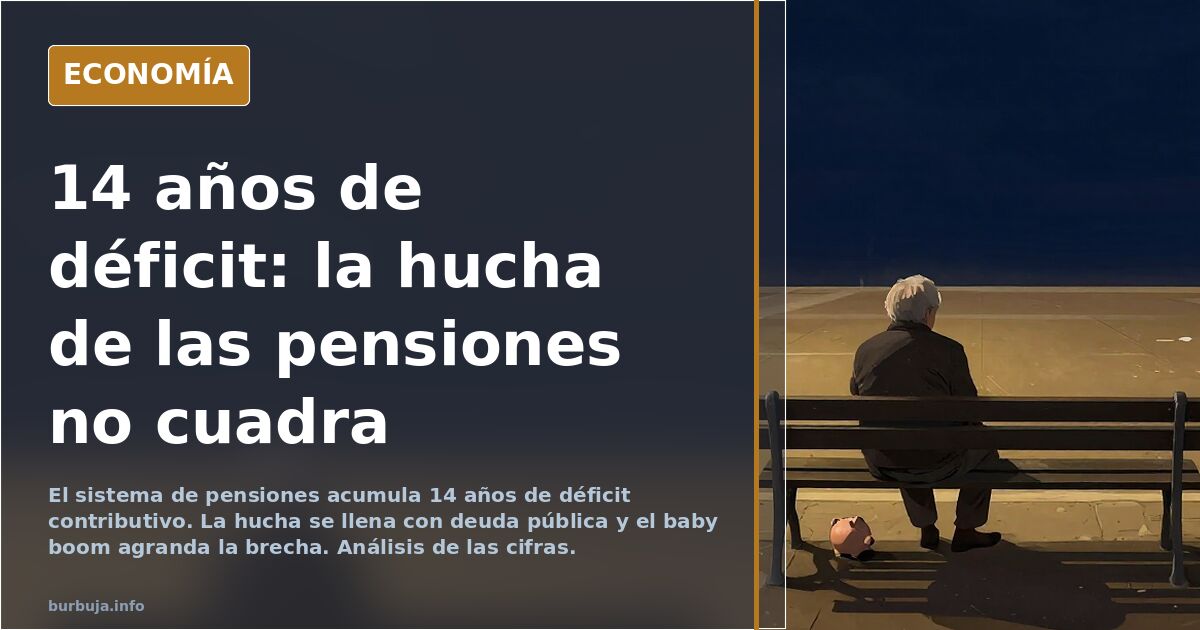
Fourteen years of deficit and a piggy bank that doesn't add up
Spain's pension system has now spent 14 consecutive years in contributive deficit. That is what the numbers laid out in a recent analysis show: since 2011, contributions have not covered benefit spending, and the gap is plugged with State transfers and debt issuance. The diagnosis is uncomfortable for the official narrative, but the data are stubborn. He's lying through his teeth, the author of the analysis sums up, saying that anyone who claims the system, as currently designed, is sustainable is not telling the truth.
The pyramid that doesn't work
The problem is not one of management, it is one of demographics. The baby boom generation is starting to retire and Spain's population pyramid has been inverted. With record employment levels —more than 22 million contributors— monthly contributions are still not enough to offset the growing cost of benefits. Spending on contributory pensions now stands at around 12-13% of GDP, more than €200 billion a year, one of the highest ratios in the EU, in the same league as France and Italy and above Germany or the Nordic countries. The average Spanish pension is generous relative to final salary: the replacement rate is among the highest in the OECD.
The Reserve Fund: an accounting label
The pension piggy bank, the Reserve Fund (Fondo de Reserva), once accumulated around €67 billion in the boom years. It was built up with surpluses that reached 2.2% of GDP in 2007. For years, capital was withdrawn until it was left at rock bottom. Now an attempt is being made to rebuild it with the MEI, a mechanism that is nothing more than a disguised contribution increase. The criticism is that the Fund invests almost everything in Spanish public debt: Social Security lends to the State at a rate similar to what the State itself pays to borrow. Same shit, different wrapper, one analyst sums up. The practical effect on the State's coffers that year is almost nil. It is not Cofidis at 20%, but it does not create new wealth either.
Who fills the piggy bank and who empties it?
Some argue that the deficit is in fact a raid: that the piggy bank is filled by private-sector workers and emptied by civil servants from the old regime and non-contributory pension recipients. The nuance matters: civil servants under Clases Pasivas (the pre-2011 civil service pension scheme) are not paid by Social Security but directly out of the State Budget, in a separate line item of around €22,000-25,000 million a year. Non-contributory pensions are also paid for with taxes. The contributive deficit is demographics and a generous benefit formula, not sticky fingers in the till. What is true is that, in the end, it is the same taxpayer who pays for everything.
The bank bailout as a mirror
The comparison with the bank bailout is inevitable. Spain disbursed around €66,577 million in public aid to clean up the financial system, of which €41,333 million** came from the ESM loan. To date, around €34,000 million have been repaid. The same banking executives who received the bailout are still collecting bonuses. That wasn't bad luck, it was policy, one analyst concludes. The underlying argument: before reforming pensions, wasteful and corrupt spending across all levels of government must be cut.
Repealed reforms and political point-scoring
The historical sequence spreads the blame around. The sustainability factor was already provided for in Zapatero's 2011 reform, and the Báñez law of 2013 made it concrete. The first blow came in 2018, still under Rajoy: to get the Budget through with the PNV, pensions were uprated with CPI instead of 0.25% and the factor was postponed to 2023. Then, in 2021, Escrivá's reform buried it and established automatic uprating in line with CPI. The point-scoring over who repealed what is chat-show posturing, but the result is the same: the system still doesn't add up.
What could happen in 20 years
Stagnant productivity and structural unemployment of 10% miccionan fewer contributors per pensioner. No narrative can change that. Immigration pays in little and consumes benefits, according to the available data. Looking 20 years ahead, the most likely scenario is a combination of higher contributions, cuts to maximum pensions and growing State transfers. Bread for today's retirees and hunger for everyone tomorrow, the author of the analysis sums up, who at 61, with more than 40 years of contributions, says that failing to reform is throwing stones at your own roof.
The diagnosis is clear. The solution, less so. With these differentials, reform should be inevitable. It remains an electoral taboo. Nobody wants to bell the cat.
Also available in: Deutsch
Summary of a discussion on Burbuja.info - Foro de economía, actualidad y política., translated from Spanish and reviewed before publication. Read the full discussion (50 replies).
More summaries
-
RTVE asks SEPI to activate reserve fund to cover 34 million euro losses
RTVE will close 2024 with 34 million euros in losses and requests SEPI to activate its 38.3 million euro reserve fund. The president cuts his salary and imposes 20% cuts on executives.
-
Spain's civil servant pensions are 80% higher than others
Civil servants in Spain's Clases Pasivas system receive an average pension of €2,614, significantly exceeding the €1,442 average for other retirees.
-
Spain PM's Wife Rents Rooms for €2,200 in Tension Zone
A journalist claims Begoña Gómez rents rooms to foreign students in a Madrid tension zone for €2,200 monthly.
-
€2,300 a month as a prison officer in Spain: risky job or a privilege?
A Spanish prison officer earns €2,300 a month in 14 payments and thinks it's too little. The pay debate over Spain's security forces, in this analysis.
-
Adrián Mateos wins €6.37m, reigniting Spain's tax debate
Adrián Mateos won €6.37m in poker from his London base. Spanish tax authorities get nothing, and Spain's tax system faces renewed criticism.
-
Bull left to bleed out at Spanish festival reignites bullfighting row
An injured bull abandoned at a popular festival in Spain has reignited the political battle over bullfighting, with Vox, PSOE and Podemos all in the spotlight.