
Spain's Pension System Consumes 40% of Public Spending, Burdening Youth
Pensions absorb nearly 40% of Spain's public spending while contributions fail to cover benefits. The system relies heavily on young workers.
English · Original discussion in Spanish · Published
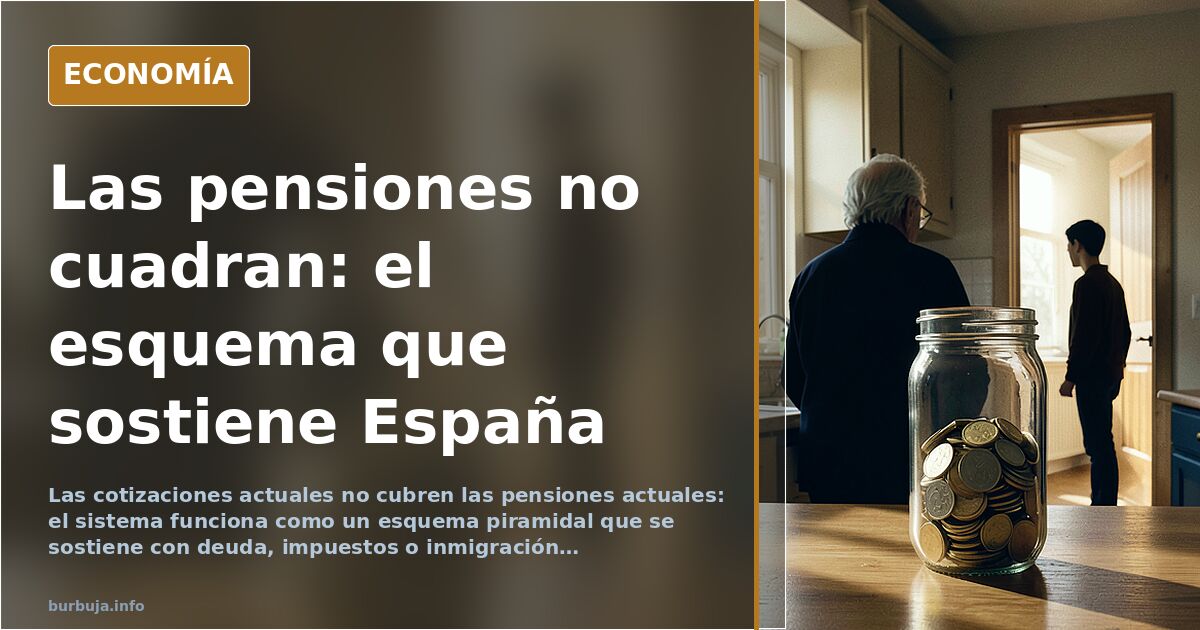
Spain's pension system consumes 40% of public spending and burdens the youth
The Spanish pension system operates like a Ponzi scheme: current workers' contributions do not cover existing retirees' benefits. This conclusion is not new, but the data summarizing it is devastating: pensions absorb nearly **40% of state resources**, according to economic analyses. The taxpayer sustaining this structure is increasingly a young person with precarious wages and no access to housing.
Debate on the system's sustainability has persisted for decades, yet no political party has dared address it publicly. The result is a **problem passed from government to government** as the population pyramid inverts and pressure on public accounts grows. The question is no longer whether the model is sustainable, but when and how it will break.
Why Current Contributions Cannot Pay Today's Pensions
The central argument is accounting-based, not ideological. Active workers' contributions are insufficient to finance committed benefits, and the deficit is covered by debt or general taxes. Some argue the issue is not pensions but the size of the state and its bureaucracy, suggesting cuts there would balance the books. A less optimistic view posits that the imbalance is structural and cannot be resolved by cosmetic adjustments.
This is compounded by a demographic factor worsening the mismatch. The **inverted population pyramid** means fewer workers support more retirees, while increased life expectancy extends benefit periods. The system was designed for a demographic reality that no longer exists.
The MEI: A Tax That Generates No Rights
The Intergenerational Equity Mechanism (MEI) is the most opaque part of the system. It automatically increases every January 1st since 2023 and will continue to do so in 2027, but this contribution **generates no present or future rights** for any benefit, pension, or service. In practice, it is a pure tax disguised as a social security contribution. The label of intergenerational equity does not fool those who examine the fine print.
Golden Pensions and Early Retirements Paid by the Treasury
The distribution is uneven. Critics argue that large companies in sectors like banking or telecommunications have allowed employees to take early retirement at ages **55 and 60 with 100% of their salary**, leaving these golden pensions to be funded by the public treasury. Meanwhile, low-wage workers will retire at 70 with meager pensions, if they receive them at all. Estimates suggest over **three million retirees earn more than €1,600 net in 14 payments**, and around 100,000 exceed €3,000 monthly while owning property with paid-off mortgages.
Youth Trapped Between Taxes and Promises
The cost falls on those still working. The tax burden limits entrepreneurship, and young people wanting to start businesses face a system that exploits lower earners to sustain higher ones. **Housing** consumes salaries, and public healthcare strains under each new user. The result is a weary generation discovering that electoral promises were empty rhetoric.
Will the system last until today's youth retire, or will it collapse sooner?
The Spanish pension system operates like a Ponzi scheme: current workers' contributions do not cover existing retirees' benefits. This conclusion is not new, but the data summarizing it is devastating: pensions absorb nearly **40% of state resources**, according to economic analyses. The taxpayer sustaining this structure is increasingly a young person with precarious wages and no access to housing.
Debate on the system's sustainability has persisted for decades, yet no political party has dared address it publicly. The result is a **problem passed from government to government** as the population pyramid inverts and pressure on public accounts grows. The question is no longer whether the model is sustainable, but when and how it will break.
Why Current Contributions Cannot Pay Today's Pensions
The central argument is accounting-based, not ideological. Active workers' contributions are insufficient to finance committed benefits, and the deficit is covered by debt or general taxes. Some argue the issue is not pensions but the size of the state and its bureaucracy, suggesting cuts there would balance the books. A less optimistic view posits that the imbalance is structural and cannot be resolved by cosmetic adjustments.
This is compounded by a demographic factor worsening the mismatch. The **inverted population pyramid** means fewer workers support more retirees, while increased life expectancy extends benefit periods. The system was designed for a demographic reality that no longer exists.
The MEI: A Tax That Generates No Rights
The Intergenerational Equity Mechanism (MEI) is the most opaque part of the system. It automatically increases every January 1st since 2023 and will continue to do so in 2027, but this contribution **generates no present or future rights** for any benefit, pension, or service. In practice, it is a pure tax disguised as a social security contribution. The label of intergenerational equity does not fool those who examine the fine print.
Golden Pensions and Early Retirements Paid by the Treasury
The distribution is uneven. Critics argue that large companies in sectors like banking or telecommunications have allowed employees to take early retirement at ages **55 and 60 with 100% of their salary**, leaving these golden pensions to be funded by the public treasury. Meanwhile, low-wage workers will retire at 70 with meager pensions, if they receive them at all. Estimates suggest over **three million retirees earn more than €1,600 net in 14 payments**, and around 100,000 exceed €3,000 monthly while owning property with paid-off mortgages.
Youth Trapped Between Taxes and Promises
The cost falls on those still working. The tax burden limits entrepreneurship, and young people wanting to start businesses face a system that exploits lower earners to sustain higher ones. **Housing** consumes salaries, and public healthcare strains under each new user. The result is a weary generation discovering that electoral promises were empty rhetoric.
Will the system last until today's youth retire, or will it collapse sooner?
Also available in: Deutsch
Summary of a discussion on Burbuja.info - Foro de economía, actualidad y política., translated from Spanish and reviewed before publication. Read the full discussion (15 replies).
More summaries
-
Spanish Workers Call Pension System a Pyramid Scheme
Workers in Spain denounce wage withholdings of €300 to €1,600 for a pension system they view as unsustainable and unlikely to benefit them.
-
Spain's Saiz claims one million unpaid interns now pay social security
Spanish Minister Elma Saiz highlights the registration of one million unpaid interns in Social Security, sparking accusations of manipulating unemployment figures.
-
Spain's housing decree: what Sánchez and allies are plotting
The housing decree is being voted on without being read, with suspicions it sneaks in measures unrelated to rental housing. Junts, PNV and Bildu will decide the outcome.
-
Viral Claim Accuses Spanish Teachers of Indoctrination
A viral post labels teachers as political commissars and claims the state removes children from non-compliant families, reigniting debate on public schooling.
-
Spain: Claims of Moroccan Bribery Plot Against Begoña Gómez
Journalist Eric Frattini alleges Israeli ex-agents revealed a Moroccan plot to bribe Begoña Gómez in Tangier, though no public evidence supports the claim.
-
Spain's Nov 11 strike faces worker skepticism
Nov 11 strike in Spain meets distrust of UGT and CC.OO. amid stalled collective bargaining.