
Spain's Nov 11 strike faces worker skepticism
Nov 11 strike in Spain meets distrust of UGT and CC.OO. amid stalled collective bargaining.
English · Original discussion in Spanish · Published
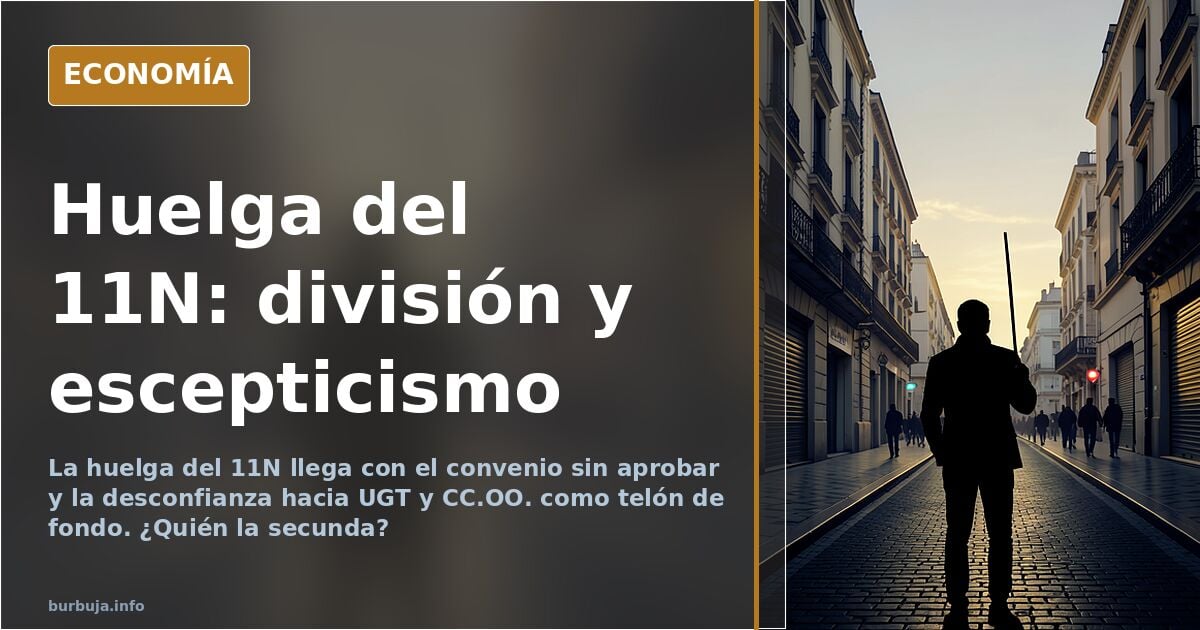
Nov 11 strike: Union calls it, workers stay home
Will anyone join the November 11 strike? The question is not rhetorical in a context where the union call comes with an unapproved collective agreement, housing as a banner, and a socialist government accused of using strikes as a distraction. The result, judging by responses, is a mosaic of skepticism: some yes, others no, and almost nobody convinced it will achieve anything.
The call is signed by UGT and CC.OO., but trust in these major unions is broken. They are accused of calling strikes only when convenient for the Executive and failing to defend workers in public companies like ADIF and RENFE. The underlying suspicion: that the strike is not against power, but a sham to reinforce it.
Unapproved agreement, real driver of the stoppage
The immediate reason for the call is the lack of agreement on the collective bargaining contract. For those who have to decide whether to join, the strike is not a political act: it is the only lever left when negotiations stall. And here arises the division between those who see the stoppage as a right to exercise and those who see it as an empty gesture.
Some have it clear: if the agreement is not approved, they stop work. The decision does not depend on acronyms or speeches, but on wages and conditions not moving. The problem is that this logic coexists with another: that of those who believe the strike will change nothing and that the only benefit is taking a week off.
Strike as political weapon: Against whom is it called?
The debate turns toxic when politics enters. Unions are accused of being opportunists and calling strikes only when the current government needs an external enemy. The Nov 11 strike is read, in part, as a pro-Sánchez gesture, not as a protest against the Executive.
The accusation is explicit: those same people who call the strike applaud the PSOE (Spanish Socialist Workers' Party). And the lingering question is who the stoppage targets. Against the wind? Against employers? Against a government presenting itself as a victim? The confusion is total.
Housing, the backdrop
The background is housing, a basic good turned into an object of speculation. The union call is presented as a response to that problem, but distrust towards the organizers makes many not see it as a solution. There is talk of a large socialist landlord and a trickster confusing people with antiestéticar of the far-right.
The result is that the Nov 11 strike is not perceived as a pressure tool, but as another element in the political game. Meanwhile, the average worker decides whether to stop or not.
November 11, between abstention and Japanese-style strike
The conclusion is that the strike generates no enthusiasm. Some will not join out of conviction, others due to distrust of the organizers, and some don't even know what it's for. The Japanese-style strike, which consists of working more, appears as the only creative alternative.
November 11 presents itself as a strength test, but also as a thermometer of union discredit. And the question remains in the air: Does anyone think they will do it?
Also available in: Deutsch
Summary of a discussion on Burbuja.info - Foro de economía, actualidad y política., translated from Spanish and reviewed before publication. Read the full discussion (17 replies).
More summaries
-
Spain's Nov 11 General Strike Falters as Public Sector and Transport Skip It
Spain's November 11 general strike lacks public sector and transport support, with pay cuts and political suspicions dampening participation.
-
Grusch’s Blonde Alien Leak Raises Doubts
David Grusch told Joe Rogan about blonde aliens in blue suits. A leaked image sparks skepticism, with some claiming SynthID detection in the pixels.
-
Spain’s Muslim Converts Demand Local Islam
UCIDE estimates over 4% Muslims in Spain vs INE's 2%. Some 200,000 are native Spaniards seeking an Islam free from foreign interference.
-
Viral Claim Accuses Spanish Teachers of Indoctrination
A viral post labels teachers as political commissars and claims the state removes children from non-compliant families, reigniting debate on public schooling.
-
Spain: Claims of Moroccan Bribery Plot Against Begoña Gómez
Journalist Eric Frattini alleges Israeli ex-agents revealed a Moroccan plot to bribe Begoña Gómez in Tangier, though no public evidence supports the claim.
-
Night Shifts and Female Managers: Spanish Workplace Tensions
A heated debate on a Spanish economic forum links night shifts, female managers, and workplace toxicity to gender and hierarchy.