
Spain's packed bars reflect demographics, not economic boom
In Spain, full terraces are driven by low birth rates, guaranteed pensions and tourism, rather than widespread economic prosperity.
English · Original discussion in Spanish · Published
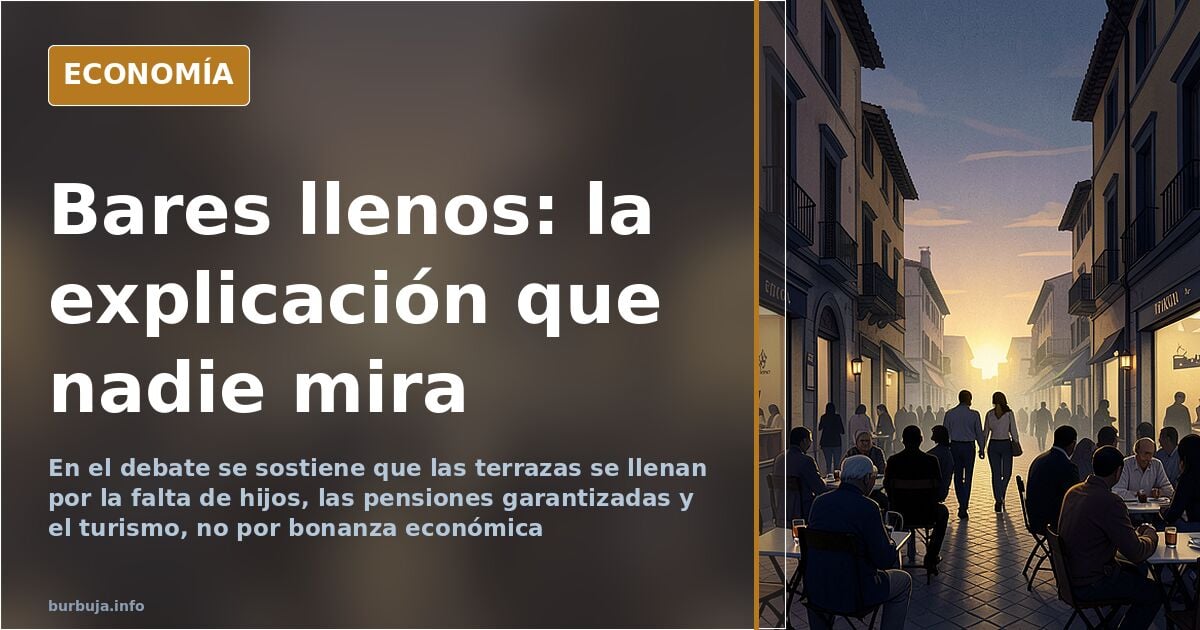
Why Spanish bars remain busy despite economic stagnation
A familiar scene repeats itself every weekend in any Spanish city: overflowing terraces, waiting lists for tapas and a vague sense that the crisis doesn't exist. The common street explanation—that hospitality is thriving and therefore so is the economy—collapses when you look at who occupies those tables. The prevailing argument in public debate suggests otherwise: bars aren't full because people have money, but because there are fewer mouths to feed at home.
The thesis is simple yet uncomfortable. A significant portion of the population aged 20 to 40 has no children, according to online discussions. Without family burdens, leisure becomes the primary outlet: dinners, vermouths, weekend getaways and rounds that last longer because no one needs to go home to do laundry. Added to this is a second group with real spending power: retirees with pensions, paid-off homes and, in some cases, rental income. Together, these groups sustain much of the visible bar consumption.
25% unemployment doesn't stop the tapas habit
This argument clashes with official statistics. With unemployment hovering around 25% during the cycle's toughest moments, how do terraces fill up? The conversation suggests average spending per outing is low: a tapa, coffee and juice for €3.30, or two tapas for nearly five euros. Multiplied by four euros daily, the expense doesn't require a high salary; it requires having no dependents.
The complete calculation, comparing those with three children against those with none, is where the analysis gains strength: the gap in disposable spending isn't closed by any average wage.
Civil servants, pensioners and circulating cash
Contrary to the image of an impoverished country, another view holds that many people have money in their pockets, evident on the streets. Public employees and retirees are cited as the main pillars of consumption: guaranteed incomes, independent of the economic cycle, allowing for home renovations out of boredom or car upgrades. The comparison with €3,000 virtual reality glasses serves as a hint: if they sell, someone pays for them.
Not everyone shares this portrait. Some describe a real decline: bars struggling, closing or being transferred without buyers. Others note that consumption concentrates in specific age groups: those aged 40 to 70 spend most on hospitality, while younger people have reduced daily bar visits to a couple of outings per week.
Tourism and undeclared revenue
A third factor undermines hospitality as an economic thermometer: it takes very few customers to fill a venue. A small percentage of the population, combined with millions of tourists, is enough to make a terrace seem bustling. Much of this billing moves in cash, making it an unreliable indicator of the real economy's health.
Added to this is the aging effect: there are fewer people aged 0 to 40 than 40 to 60. The demographic pyramid pushes venues toward an older audience with more time and fewer obligations.
The denial phase
The most pessimistic reading goes beyond consumption: beer on the terrace would be the last thing taken from the population, the final symptom of normality before deterioration becomes impossible to hide. As long as there is a free table and cheap tapas, everything will seem intact.
The point where the analysis stalls is the same as always: if bar spending responds to lack of children, pensions or cultural habit, then it says nothing about the country's economic health. It only says who sits at the table.
Also available in: Deutsch
Summary of a discussion on Burbuja.info - Foro de economía, actualidad y política., translated from Spanish and reviewed before publication. Read the full discussion (97 replies).
More summaries
-
Spain's average salary is €25,000. So why are bars full?
Despite an average gross salary of €25,000 in Spain, consumption remains high due to inheritance, dual incomes, credit, and the black market.
-
Spain's Government pays Christmas bonus before elections
Spain disburses the Christmas bonus for civil servants and pensioners just hours before voting, according to forum calculations.
-
Riots in French schools: fires and attacks
Fires in French schools, teachers attacked and blockades spreading to Belgium. The unrest is attributed to the education strike and radical groups.
-
Global birth rate collapse is economic, not ideological
Fertility drops in Iran, Morocco and Colombia like in Europe: children shifted from labor assets to twenty-year liabilities with monthly costs.
-
La Séptima: Spain's new channel airs only politics
La Séptima, a new Spanish TV channel, broadcasts 24 hours of political talk shows without series or sports.
-
Young and Latino Votes Challenge Trumpism in US Midterms
In the US midterms, young and Latino voters lean Democratic. However, electoral history shows cycles shift quickly, with economic factors often outweighing demographic trends.