
La Séptima: Spain's new channel airs only politics
La Séptima, a new Spanish TV channel, broadcasts 24 hours of political talk shows without series or sports.
English · Original discussion in Spanish · Published
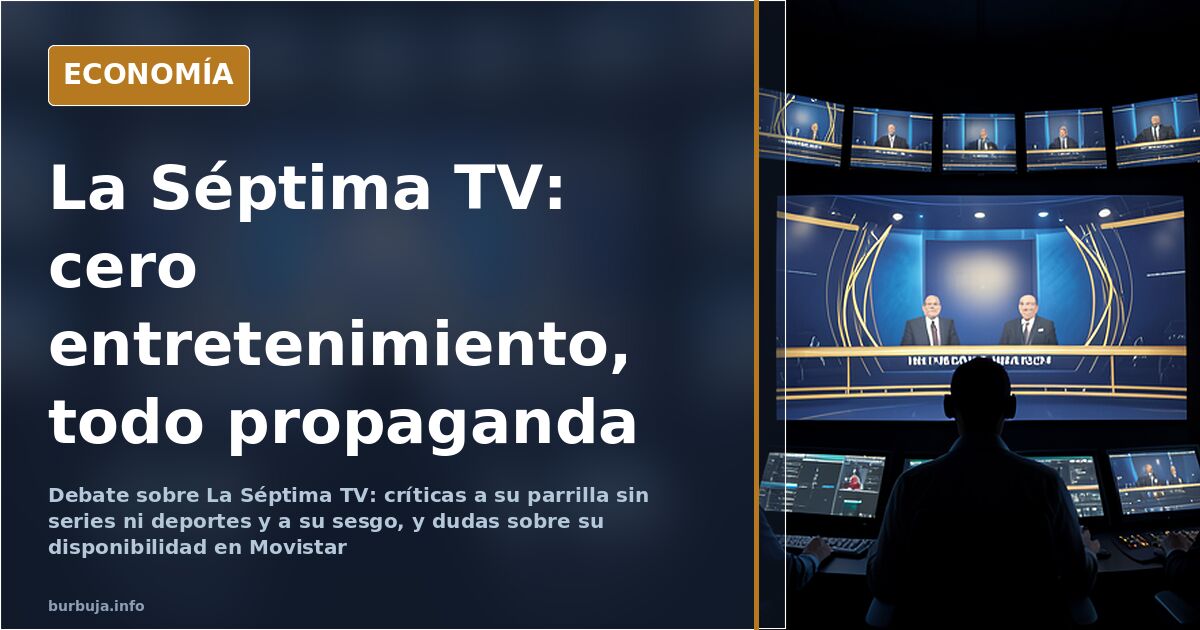
La Séptima broadcasts 24 hours of political news without series or sports
A television channel that does not air a single series, match, or movie. Only panels, talk shows, and "breaking news" from dawn to midnight. This is the model of La Séptima, the network that landed on digital terrestrial television (TDT) in Spain and has already generated a wave of rejection among those who tuned in out of curiosity. The most repeated diagnosis: it is not biased entertainment, but uninterrupted propaganda.
According to viewers, the schedule is reduced to a single format. A studio, some commentators, and a changing graphic. Nothing else. Unlike generalist channels, which alternate news, fiction, sports, and cinema, entertainment is conspicuously absent here. And in terms of production costs, this is no minor detail.
Why a 24-hour channel without fiction or sports is cheaper
Producing a series costs money. Broadcasting sports requires rights, licenses, and industry contacts. Putting four people to talk for hours in front of a camera costs a fraction of that. The circulating analysis suggests that La Séptima's model responds not only to an editorial line but to a very specific media economy: **cheap content, minimal production, and a captive audience**.
Some compare it with local television stations of the nineties, those that filled hours with talk shows and old movies. The difference is that there are no movies here. Only current affairs. And current affairs, when served without counterbalance, become something else.
The target audience and suspicions of a windfall
In the collective imagination, the channel is associated with an older viewer, little inclined to use platforms and loyal to linear television. It is the niche that traditional channels have been abandoning and which now finds a refuge where they are only spoken to about politics. **An audience loyalized by habit, not by offer.**
The other side is economic suspicion. In the background looms the idea that the broadcasting license is the real business: obtaining the concession, broadcasting at ridiculous costs and, when the audience stabilizes or the political wind changes, selling. There is no public data confirming such an operation, but the cost structure invites speculation.
The audience that says it doesn't watch it
The most curious phenomenon is that of the non-existent audience. Many of those who criticize it admit they haven't tuned in, have removed it from their guide, or learned of its existence through social media. **Rejection is as fast as judgment.** The channel has become a topic of conversation before having time to prove anything.
However, the first audience figures, disseminated by the channel itself, place it with some margin. It remains to be seen if this initial interest holds or if it is just the peak of curiosity from the first days.
The TVE precedent and the ghost of dismissal
Comparison with public television is inevitable. If TVE already carries the fruta of aligning with the government of the day, La Séptima arrives without the obligation to disguise it. And there arises the most repeated theory: the channel as a natural destination for professionals leaving public TV if the political sign changes. **A labor refuge with an antenna.**
There is no confirmation of any of this. But the suspicion fits the Spanish television ecosystem, where licenses have changed hands more frequently than acknowledged.
With these foundations, the channel has two paths: consolidate as a profitable niche or remain a seasonal experiment. If advertising responds, it will continue. If not, the schedule will be left without viewers. And then only the graphic will remain.
Also available in: Deutsch
Summary of a discussion on Burbuja.info - Foro de economía, actualidad y política., translated from Spanish and reviewed before publication. Read the full discussion (114 replies).
More summaries
-
Sánchez's La Séptima Debuts Logo Featuring PSOE Colors
La Séptima unveils its logo using the PSOE color palette. While the channel broadcasts 24/7 news and live streams, the question of who finances it remains unanswered.
-
Moncloa hands Contreras a new TV channel with a 15-year licence
Spain's government awards José Miguel Contreras a new television channel with a 15-year licence, while the PRISA chairman refuses to approve the project.
-
La Séptima: Spain's new public TV channel launches amid controversy
José Miguel Contreras registers 'La Séptima' for a new DTT channel launching in November 2026, sparking accusations of political bias.
-
128,000 pesetas in 1988: the salary that supported a family now barely covers one person
A salary of 128,000 pesetas in 1988 supported a family of four. Adjusted for today, that's €2,368, not enough to live alone in a big city.
-
Young and Latino Votes Challenge Trumpism in US Midterms
In the US midterms, young and Latino voters lean Democratic. However, electoral history shows cycles shift quickly, with economic factors often outweighing demographic trends.
-
US Teacher Refuses to Break Up Fight: 'Pay Isn't Worth the Risk'
A US teacher declined to intervene in a classroom brawl, citing low pay. Debate focuses on legal liability and physical safety for educators.