
Ayuso, immigration and the housing battle in Madrid, Spain
Ayuso's migration U-turn reopens the housing battle in Madrid: unaffordable prices and a segregation proposal with no legal path forward.
English · Original discussion in Spanish · Published
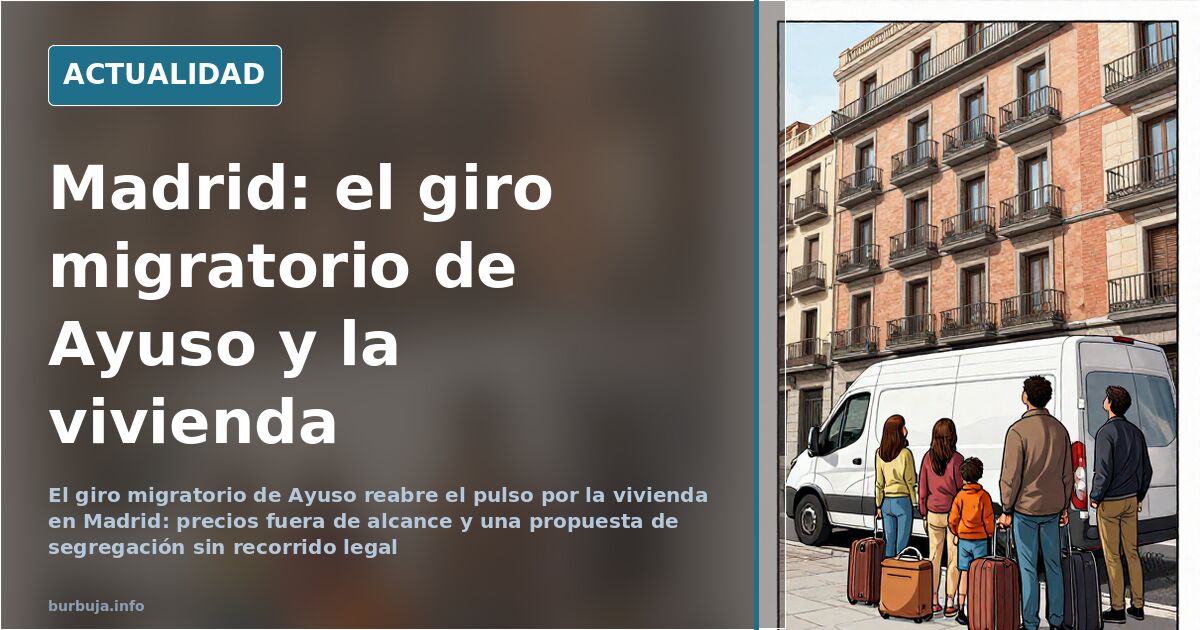
Why Ayuso's migration policy is straining housing in Madrid
Can Madrid be separated from the rest of Spain? On paper, no. The Constitution does not allow for the secession of an autonomous community and, according to the diagnosis made in the conversation, any attempt would be blocked long before it ever came to a vote. The idea resurfaces every time Madrid posts an economic record that differs from the rest of the regions, and now it is doing so over the migration policy of Isabel Díaz Ayuso, whose evolution — from standard-bearer of España Viva to a magnet for foreign investment — is described as a 180-degree U-turn.
Can Madrid be separated from the rest of Spain?
No. The proposal clashes with Spain's regional framework and with political arithmetic: it would require a constitutional reform and the backing of institutions that, on the proposal's own terms, would stop it before it even got through the process. No party, parliamentary group or institutional initiative supporting it appears in the conversation. In short, a political fantasy. The discontent behind it is real, but it is not about borders: it is domestic, and it has to do with the housing bill.
Ayuso's U-turn: from España Viva to digital nomads
The economic critique is far more solid than the territorial one. The argument goes that the Madrid regional president went from selling the tale of an España Viva ("Living Spain") versus a Zombie Spain to pursuing an open-door policy and courting digital nomads to inflate regional GDP in the short term. The diagnosis that keeps coming up is short-termism: importing spending power to gloss over growth, without touching the housing supply or underlying productivity.
Housing prices: who is buying, and how fast
Prices in the most sought-after neighborhoods are moving at a pace that lifelong average earners cannot keep up with. The sequence is easy to reconstruct: the child of a well-off family moves down into a middle-class neighborhood, and the middle class that used to get a foothold there slips another rung. In parallel, suspicions circulate about quick purchases with money of dubious origin — a hypothesis thrown out without a shred of evidence, and best read for what it is: a suspicion, not a fact. Any concrete accusation of money laundering requires far more ammunition than an offhand remark.
How much foreign population is at stake
One of the pieces shared puts the number of Ecuadorians living in Spain, including those holding a DNI (Spanish national ID), at more than one million. It is a figure circulated without any verifiable source and works more as a gauge of the mood than as a statistic. What matters for the issue at hand is the climate of the debate, not the accuracy of the number.
Who really decides in a state
Another line of analysis holds that states do not go where a temporary government says, but where the senior civil service dictates and, above all, the top military command, which holds the monopoly on violence. The thesis is ambitious and debatable, but it serves to recall an uncomfortable truth: no government fully controls the machinery it claims to run.
The segregation that is actually advancing
While a border that no one is going to move is being debated, another one closes on its own every month. It does not separate Madrid from Spain: it separates those who sign a mortgage from those who can only watch the listings from the other side. That is segregation, and it needs no constitutional reform.
Also available in: Deutsch
Summary of a discussion on Burbuja.info - Foro de economía, actualidad y política., translated from Spanish and reviewed before publication. Read the full discussion (16 replies).
More summaries
-
Madrid's Ayuso vows to drive the Latin Kings out, offering no details
Isabel Díaz Ayuso promises to stop the Latin Kings and push them out of Madrid, with no measures, resources or timeline: the focus is on who actually holds the powers.
-
Ketamine: the drug slipping through Spain's DGT drug tests
In the Balearic Islands, saliva tests fail to detect ketamine, and professional drivers use it to evade police checks. The system's loophole...
-
Why we keep returning to the online debates that hurt us
Leaving a debate community over its toxicity and coming back days later is more common than it seems. The gambling analogy explains why.
-
Florida mother arrested for pouring hot wax on her daughters
A 26-year-old mother has been arrested in Florida after filming herself pouring hot wax on her daughters and setting the kitchen on fire. The debate points to a double standard.
-
Save Europe Act rally sparks tension in Barcelona as Catalan government acts
The Save Europe Act movement holds its first major rally in Barcelona, and the Catalan government responds by reporting it to the prosecutor's office and boosting police presence.
-
Who's to blame for the migration chaos: left, right or pure capitalism
The Ceuta crisis and housing have reignited the debate over the causes: the left, the right or global capitalism? The arguments clash.